Medical Diet Plan for Weight Loss in India: Beyond Generic Advice
Why Doctor-Designed Nutrition Outperforms Every DIY Diet You've Tried
What is a medical diet plan for weight loss in India? A medical diet plan is a physician-designed nutrition protocol built on a measured calorie deficit, a 1.2 to 1.6 g/kg protein target to preserve muscle, and Indian foods structured for adherence. It includes lab-based monitoring, micronutrient correction, and adjustment based on weight, waist, and body composition. It is not a generic meal sheet downloaded from the internet.
The DermaVue Clinics medical team builds diet plans around the South Asian metabolic profile, where insulin resistance and visceral fat are common even at normal BMI. Plans use a 1.2 to 1.6 g/kg protein target, a structured calorie deficit, and Indian foods like dal, eggs, paneer, ragi, millets, and curd, with staged carbohydrate adjustment. Bloodwork including HbA1c, lipid panel, liver function, and creatinine guides protocol changes. Across 7 physician-led DermaVue centres in Kerala and Tamil Nadu, the team has supported a patient base reflected in 7,200 plus reviews with a 4.8 average star rating.
Why Most Weight Loss Diets Fail Indians
The problem isn't willpower. It's biology, bad advice, and diets designed for Western bodies.
| What You Do | What Actually Happens | Why It Fails |
|---|---|---|
| Severe calorie restriction | Metabolism slows 20-30% | Body fights to preserve fat |
| Cut all carbs | Initial water weight loss | Unsustainable, rebounds |
| Skip meals | Muscle breakdown for energy | Worsens body composition |
| Follow celebrity diets | Nutrient deficiencies | Not designed for Indian bodies |
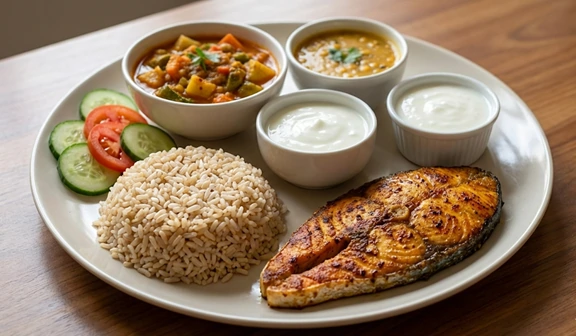
Medical Diet Plan vs Generic Weight Loss Diets
Generic Diet Plans
- One-size-fits-all macros from the internet
- Calorie counting without body composition data
- No lab work. Ignores insulin resistance
- Ignores PCOS, thyroid, and diabetes
- No medical supervision or follow-up
- Muscle loss treated as "progress"
DermaVue Medical Nutrition
- Personalized plan based on labs and body composition
- Body composition focus. Fat loss, not just weight loss
- Qualified dietitian + dermatologist team
- Accounts for diabetes, PCOS, thyroid conditions
- Weekly check-ins with dose and diet adjustments
- Protein-optimized to preserve lean muscle on GLP-1
Protein: The Critical Missing Piece in Indian Diets
Average intake: 0.6 g/kg/day vs recommended 1.2 to 1.6 g/kg for GLP-1 patients.
| Food | Protein / 100 g | Typical Serving | Protein / Serving |
|---|---|---|---|
| Eggs | 13 g | 1 egg (50 g) | 6.5 g |
| Chicken breast | 31 g | 100 g | 31 g |
| Paneer | 18 g | 100 g | 18 g |
| Soya chunks | 52 g | 50 g dry | 26 g |
| Dal (cooked) | 9 g | 1 cup (200 g) | 18 g |
| Greek yogurt | 10 g | 150 g | 15 g |
| Fish (rohu/seer) | 20 g | 100 g | 20 g |
| Sprouted moong | 7 g | 1 cup (100 g) | 7 g |
You'll notice that meeting a 100 g daily protein target requires intentional planning. Most Indians unknowingly consume only 40 to 50 g per day. Your DermaVue dietitian builds a plan that hits your target using foods you already enjoy. Whether you're vegetarian, non-vegetarian, or somewhere in between.
Get Your Personalized Medical Diet Plan
Clinically designed. Dietitian-supervised. Based on your body composition and lab results.
Your 7-Day Sample Indian Diet Plan
A single-day example from our dietitian team. Your actual plan is customized based on labs, activity level, and food preferences.
Day 1: South Indian Balanced
Day 2: Vegetarian High-Protein
Day 3: Kerala Traditional
Managing Rice and Roti on GLP-1 Therapy
Kerala's rice-heavy diet is manageable on GLP-1. The medication naturally reduces appetite, making portion control effortless for most patients.
Protein First
Eat your protein (dal, fish, chicken, paneer) before touching rice or roti. This slows glucose absorption and improves satiety.
Smaller Portions, Naturally
GLP-1 reduces appetite significantly. Most patients naturally eat half their usual rice portion without feeling deprived.
Mixed Rice Strategy
Combine white rice with brown rice or millets. This increases fiber content and reduces glycemic impact without eliminating familiar foods.
Resistant Starch Trick
Cook rice and cool it in the refrigerator before reheating. Cooling converts starch to resistant starch, reducing caloric absorption by up to 12%.
Foods That Help Burn Belly Fat
These foods work synergistically with GLP-1 medications to target visceral fat. Patients notice faster belly fat reduction when these become dietary staples.
Anti-Inflammatory Foods
- Turmeric (haldi) with black pepper
- Fatty fish (sardines, mackerel, seer)
- Green leafy vegetables (spinach, moringa)
- Berries and citrus fruits
- Ginger and garlic
High-Protein Staples
- Eggs (whole, not just whites)
- Paneer and cottage cheese
- Chicken breast and lean fish
- Soya chunks and tofu
- Greek yogurt and whey protein
Low-Glycemic Carbs
- Ragi (finger millet)
- Matta rice (parboiled red rice)
- Oats and barley
- Sweet potato (in moderation)
- Mixed dal and legumes
Foods to Limit or Avoid
These foods work against your weight loss goals. On GLP-1 therapy, your reduced appetite makes it easier to replace these with better alternatives.
High-Sugar Foods
- Fruit juices (even fresh. Eat whole fruit instead)
- Sweetened tea and coffee
- Packaged biscuits and bakery items
- Mithai, halwa, payasam
- Soft drinks and energy drinks
Refined Carbohydrates
- White bread and maida products
- Instant noodles and pasta
- Polished white rice (large portions)
- Packaged cereals with added sugar
- Deep-fried snacks (vada, bonda, chips)
Hidden Calorie Traps
- Coconut oil in excess (>2 tsp/day for cooking)
- "Health drinks" with added sugar
- Flavored yogurt (high sugar content)
- Dried fruits in large quantities
- Granola bars marketed as healthy
How to Count Calories the Indian Way
Western calorie databases don't account for Indian cooking methods. Use this reference table designed for Kerala and South Indian foods.
| Indian Food | Serving Size | Calories (kcal) | Protein (g) |
|---|---|---|---|
| Cooked white rice | 1 cup (200 g) | 200 | 4 |
| Matta rice (parboiled) | 1 cup (200 g) | 210 | 5 |
| Chapati / Roti | 1 medium | 100 | 3 |
| Dosa (plain) | 1 medium | 120 | 2 |
| Idli | 2 pieces | 130 | 4 |
| Puttu (wheat) | 1 cylinder | 180 | 5 |
| Dal (cooked) | 1 cup (200 g) | 180 | 12 |
| Sambar | 1 cup | 120 | 5 |
| Fish curry (Kerala) | 1 serving (150 g) | 220 | 25 |
| Chicken curry | 1 serving (150 g) | 250 | 28 |
| Egg curry | 2 eggs with gravy | 280 | 16 |
| Avial | 1 cup | 150 | 3 |
| Thoran (vegetable stir-fry) | 1 cup | 110 | 3 |
| Paneer tikka | 100 g paneer | 260 | 18 |
| Curd / Yogurt | 1 cup (200 g) | 100 | 8 |
| Coconut chutney | 2 tbsp | 60 | 1 |
Diet on GLP-1 Medications: Special Considerations
GLP-1 medications (semaglutide, tirzepatide) fundamentally change your relationship with food. Here's how to optimize nutrition while your appetite is reduced.
Hydration and Supplements on GLP-1 Therapy
Kerala's tropical climate increases fluid and electrolyte needs. GLP-1 patients require extra attention to hydration and targeted supplementation.
Vitamin D3
60,000 IU weekly for 8 weeks (loading), then maintenance. Most Indians are severely deficient. Essential for metabolism and bone health.
Vitamin B12
1,000 to 2,000 mcg methylcobalamin daily. Critical for vegetarians and patients on metformin. Supports energy and nerve function.
Omega-3 Fatty Acids
1,000 to 2,000 mg EPA+DHA daily. Reduces inflammation, supports cardiovascular health, and may enhance GLP-1 sensitivity.
Creatine Monohydrate
3 to 5 g daily. Preserves lean muscle during weight loss, improves strength, and supports body composition goals on GLP-1.
The DermaVue Dietitian Program
Every SuperHuman Program patient receives a dedicated dietitian as part of their care team. Here's what's included.
Initial Assessment
45 to 60 minute consultation covering food preferences, medical history, lab results, and body composition analysis.
Personalized Meal Plan
Custom diet plan based on your labs, protein targets, cultural preferences, and GLP-1 medication dosage.
Weekly Check-ins
Phone or video calls for the first 3 months. Plan adjustments based on progress, side effects, and changing needs.
Body Composition Tracking
Regular InBody scans tracking lean mass, fat mass, visceral fat, and metabolic rate. Diet adjusted based on data, not guesswork.
Vegetarian Optimization
Specialized plans for vegetarian patients using paneer, dal, soya, legumes, and strategic supplementation to hit protein targets.
Supplement Protocol
Evidence-based supplement recommendations: D3, B12, Omega-3, Creatine, and condition-specific additions based on your lab work.
Generic GLP-1 Update. March 2026
Generic semaglutide entered the Indian market in March 2026. Branded Ozempic at 0.5 mg weekly previously ran around Rs 8,100 per month. Indian generics from Natco, Alkem, and Dr. Reddy's now sit between Rs 1,290 and Rs 4,200 at the same dose. The molecule and safety profile are identical. Physician supervision is still required because GLP-1 therapy carries real contraindications. Cheaper does not mean safer to self-prescribe.
Weight Loss Foods for Indians: The Physician's List
A practical food group reference built from ICMR-NIN 2024 nutrient values [ICMR-NIN, Nutrient Requirements for Indians, 2024]. Use it to plan meals around protein density and glycemic load, not calorie obsession.
| Food Group | Food | Protein (g/100 g) | Calories (kcal/100 g) | Glycemic Index |
|---|---|---|---|---|
| Grains | Matta (parboiled red rice) | 7 | 360 | Medium |
| Grains | Ragi (finger millet) | 7 | 328 | Low |
| Grains | Whole wheat atta | 12 | 340 | Medium |
| Grains | Polished white rice | 7 | 345 | High |
| Dals & Pulses | Moong dal (split) | 24 | 347 | Low |
| Dals & Pulses | Toor dal (arhar) | 22 | 335 | Low |
| Dals & Pulses | Chana dal | 20 | 360 | Low |
| Dals & Pulses | Rajma (kidney bean) | 23 | 340 | Low |
| Vegetables | Spinach (palak) | 2 | 23 | Low |
| Vegetables | Cucumber | 0.6 | 16 | Low |
| Vegetables | Bottle gourd (lauki) | 0.5 | 14 | Low |
| Vegetables | Drumstick (moringa) | 2.5 | 26 | Low |
| Fruits | Guava | 1.4 | 68 | Low |
| Fruits | Papaya | 0.5 | 43 | Medium |
| Fruits | Banana (small) | 1.1 | 89 | Medium |
| Fruits | Mango (Alphonso) | 0.8 | 60 | High |
| Dairy | Paneer (full fat) | 18 | 265 | Low |
| Dairy | Greek yogurt | 10 | 97 | Low |
| Dairy | Curd (low fat) | 5 | 60 | Low |
| Nuts & Seeds | Almonds | 21 | 579 | Low |
| Nuts & Seeds | Flax seeds | 18 | 534 | Low |
| Nuts & Seeds | Pumpkin seeds | 30 | 559 | Low |
| Animal Protein | Egg (whole) | 13 | 155 | Low |
| Animal Protein | Chicken breast | 31 | 165 | Low |
| Animal Protein | Seer fish (neymeen) | 22 | 120 | Low |
| Animal Protein | Sardine | 20 | 208 | Low |
The Glycemic Index column is bucketed (Low under 55, Medium 55 to 69, High 70 plus). Use the Low and Medium columns as your everyday choices. Treat the High column as occasional. Protein and calorie values are drawn from the ICMR-NIN 2024 reference book for Indians.
Low Calorie Foods List for Weight Loss
A pantry-level list for patients who want to bulk up meals without driving the daily calorie total higher. Indian foods only.
Under 50 kcal per practical serving
- Cucumber, 1 cup sliced. About 16 kcal.
- Tomato, 1 medium. About 22 kcal.
- Bottle gourd (lauki) curry, half cup with minimal oil. About 35 kcal.
- Spinach (palak) sabzi, half cup. About 40 kcal.
- Sambar, half cup with low oil. About 45 kcal.
- Moringa (drumstick) leaves stir fry, half cup. About 40 kcal.
- Buttermilk (chaas), 1 glass unsweetened. About 40 kcal.
- Plain green tea, 1 cup. Effectively 0 kcal.
Under 100 kcal per practical serving
- Idli, 2 small. About 90 kcal.
- Moong dal khichdi, half cup. About 95 kcal.
- Boiled egg, 1 whole. About 78 kcal.
- Curd (low fat), half cup. About 60 kcal.
- Sprouted moong, half cup. About 80 kcal.
- Apple (small). About 80 kcal.
- Guava, 1 medium. About 70 kcal.
- Roasted chana, 30 g. About 90 kcal.
7-Day Indian Meal Plan for Weight Loss
A Kerala and South India weighted plan. Daily target sits in the 1,400 to 1,600 kcal band with 90 to 120 g protein. Each day has a vegetarian variant note.
| Day | Breakfast | Mid-Morning | Lunch | Evening | Dinner | kcal / Protein |
|---|---|---|---|---|---|---|
| Mon | 2 idli + sambar + 2 boiled eggs | Buttermilk + 6 almonds | Matta rice (3/4 cup) + fish curry + thoran | Black coffee + roasted chana | 2 chapati + palak paneer + salad | ~1,500 / 105 g |
| Tue | Moong dal chilla (2) + mint chutney | Greek yogurt small cup + guava | Brown rice (3/4 cup) + dal + chicken curry + cucumber | Sprouted moong sundal | 2 ragi dosa + egg roast + avial | ~1,520 / 115 g |
| Wed | Puttu (ragi blend) + kadala curry | 1 boiled egg + papaya | Matta rice (3/4 cup) + sambar + seer fish (100 g) + cabbage thoran | Buttermilk + 4 walnuts | 2 chapati + soya chunks curry + salad | ~1,480 / 110 g |
| Thu | 2 plain dosa + tomato chutney + 2 boiled eggs | Roasted peanuts (small handful) | Brown rice (3/4 cup) + rajma curry + raita + salad | Green tea + 1 small apple | 2 chapati + paneer bhurji + cucumber | ~1,510 / 100 g |
| Fri | Vegetable upma (small bowl) + curd | 1 small banana + 5 almonds | Matta rice (3/4 cup) + dal + grilled chicken (100 g) + thoran | Buttermilk + roasted chana | Appam (2 small) + chicken stew + avial | ~1,560 / 120 g |
| Sat | 2 idiyappam + egg curry | Greek yogurt + papaya | Brown rice (3/4 cup) + sambar + fish fry (100 g) + salad | Black coffee + sprouted moong | 2 chapati + dal fry + bhindi sabzi | ~1,490 / 105 g |
| Sun | 2 boiled eggs + 1 slice whole wheat toast + low fat milk | Guava | Matta rice (3/4 cup) + Kerala chicken curry + thoran + curd | Buttermilk + 5 almonds | 2 ragi roti + paneer tikka + salad | ~1,580 / 115 g |
The Calorie Deficit Explained
A calorie deficit is the daily gap between what you eat and what you burn. For sustainable fat loss in Indian patients, the right gap is 500 to 700 kcal per day. That produces roughly 0.5 kg of fat loss per week without crashing the metabolism or driving muscle loss.
We estimate baseline burn using the Mifflin-St Jeor equation, which calculates resting metabolic rate from weight, height, age, and sex, then multiplies by an activity factor. A sedentary 70 kg woman in Kochi burns roughly 1,750 to 1,900 kcal per day. Subtract 500 to 600 and her daily target sits between 1,200 and 1,400 kcal. The same calculation for a 75 kg man at light activity lands his target near 1,700 to 1,900 kcal.
Two non-negotiables sit on top of the deficit. Protein stays at 1.2 to 1.6 g per kg of ideal body weight to protect muscle [ICMR-NIN, Nutrient Requirements for Indians, 2024]. Resistance training stays at three sessions per week. Without those two, a calorie deficit will shrink lean mass and the scale lies. Your DermaVue dietitian sets the precise number after lab work and InBody scanning. A calculator on this page is on the way as part of our next release.
Diet for Women: PCOS and Hormonal Considerations
Polycystic ovary syndrome affects roughly one in five Indian women of reproductive age and sits at the intersection of insulin resistance and androgen excess. The 2023 international evidence-based guideline for PCOS recommends weight reduction and dietary modification as first-line therapy for women with elevated BMI [Teede HJ et al. International PCOS Guideline 2023].
For PCOS specifically, we lean into a lower carbohydrate, anti-inflammatory pattern. That means reducing white rice, maida, and refined sugar, and replacing them with ragi, matta rice, oats, and millets. Protein anchors every meal at 25 to 35 g. Fat sources skew toward omega-3 from sardines, mackerel, and flax. Vegetables and legumes carry the fiber load to slow glucose absorption and feed the gut.
Anti-inflammatory Indian foods that earn a regular slot: turmeric with black pepper, fenugreek (methi) seeds soaked overnight, garlic, ginger, drumstick leaves, amla, and curd. Ultra processed snacks, sweetened tea, and fruit juice come out of the rotation. When PCOS coexists with elevated HOMA-IR or pre-diabetes, the dietitian and physician discuss whether to layer in metformin or a GLP-1 receptor agonist on top of the diet plan. Most PCOS patients see menstrual regularity, lower androgen symptoms, and better fertility markers within three to six months of consistent dietary change paired with strength training.
Weight Loss Drinks: What Actually Works
Detox teas and slimming concoctions are marketing, not medicine. Here is what survives clinical scrutiny.
Water
The most underrated weight loss drink. Two to three litres per day reduces snacking, improves satiety, and supports kidney clearance during a calorie deficit. In Kerala heat, push to 3 to 3.5 litres.
Black Coffee
Unsweetened coffee provides a small thermogenic bump, blunts appetite, and improves training output. Cap at 2 to 3 cups per day. No sugar, no condensed milk.
Green Tea
Modest effect. Catechins like EGCG produce a small increase in fat oxidation. Real but small. Treat green tea as a low calorie habit replacement for sweetened drinks, not a fat burner.
Protein Shakes
Useful tools, not magic. A 25 to 30 g whey or plant protein shake helps vegetarians and busy patients hit a daily protein floor of 90 to 120 g. Use after training or as a meal anchor when food is impractical.
Detox Teas and Slimming Drinks
Skip them. Most contain laxatives or diuretics that drop water weight, not fat. Some have caused liver injury in case reports. There is no clinical evidence that any commercial detox tea reduces visceral fat.
Buttermilk and Lassi
Plain unsweetened buttermilk is a good post-meal option. It supports satiety and gut health for a tiny calorie cost. Skip sweetened lassi which often clears 200 kcal in a single glass.
Fruit for Weight Loss
Fruit is not the enemy. Whole fruit brings fiber, water, micronutrients, and polyphenols into the day. Fruit juice, by contrast, behaves more like a sugary drink because the fiber is gone. The patient question we hear most often is about mango.
Best picks for daily rotation: berries (high polyphenol, low sugar load), papaya (low calorie, high fiber, gut friendly), watermelon (very low calorie density and high water), and guava (high fiber, high vitamin C, low GI). One serving per day from this group fits inside almost every diet plan.
The mango myth. Patients are told to avoid mango entirely during weight loss. That is overcalled. A small Alphonso or banganapalli mango has roughly 100 to 130 kcal. Once a day, in season, eaten as fruit and not as juice or shake, it does not derail weight loss. Patients with diabetes or active insulin resistance should pair it with protein and cap the portion at half a fruit.
Vegetarian Protein Matrix for Indians
Hitting a 1.2 to 1.6 g/kg protein target on a vegetarian diet is doable but it requires intent. The matrix below gives realistic protein per practical serving. Stack three to four of these per day to land at 90 to 120 g.
| Food | Practical Serving | Protein per Serving | Notes |
|---|---|---|---|
| Paneer | 100 g | 18 g | Best whole food vegetarian protein. Use grilled, not fried. |
| Tofu (firm) | 100 g | 12 g | Lower calorie than paneer. Good for low fat plans. |
| Moong dal (cooked) | 1 cup (200 g) | 14 g | Easy on the gut. Good first dal on GLP-1. |
| Toor dal (cooked) | 1 cup (200 g) | 12 g | South Indian staple. Pair with rice for full amino profile. |
| Chana dal (cooked) | 1 cup (200 g) | 16 g | High fiber. Slows gastric emptying. |
| Rajma (cooked) | 1 cup (180 g) | 15 g | Excellent for satiety. Soak overnight to ease digestion. |
| Soya chunks (dry) | 40 g dry | 20 g | The highest protein density vegetarian option in Indian kitchens. |
| Whey protein isolate | 1 scoop (30 g) | 24 g | Use post training or as a meal anchor. Plant blend works for vegans. |
| Greek yogurt | 150 g | 15 g | Use unsweetened. Add berries or guava. |
| Sprouted moong | 1 cup (100 g) | 7 g | Low calorie booster. Use as a snack, not a meal anchor. |
A practical day for a 65 kg vegetarian woman targeting 90 g protein looks like: paneer breakfast (18 g), dal lunch with curd (20 g), whey shake afternoon (24 g), tofu or soya curry dinner (22 g), and a small handful of nuts (6 g). That clears the floor with room to spare.
FAQ: Diet Plan for Weight Loss
Reviewed by Dr. Rejeesh M. Menon, MDCan I eat rice on GLP-1?
Yes. GLP-1 naturally reduces appetite so portion control becomes easier. Focus on protein-first eating, use mixed rice, and keep portions moderate.
Do I need to follow a strict diet?
Not a crash diet. The program focuses on sustainable nutrition with adequate protein (1.2 to 1.6 g/kg). Your dietitian creates a flexible plan you can maintain long-term.
Is the diet plan vegetarian-friendly?
Absolutely. Many South Indian patients are vegetarian. Plans include paneer, dal, soya, Greek yogurt, and plant-based protein optimization strategies.
How much protein do I need on GLP-1?
1.2 to 1.6 g per kg of ideal body weight daily. For a target weight of 70 kg, that's 84 to 112 g protein per day.
Will I feel hungry on GLP-1?
Most patients report significantly reduced appetite within the first week. The challenge shifts from controlling hunger to ensuring adequate nutrition and protein intake.
How often do I meet the dietitian?
Initial 45 to 60 minute consultation, then weekly check-ins (phone/video) for the first 3 months. Monthly thereafter.
What supplements should I take on GLP-1?
Vitamin D3 (60,000 IU weekly loading, then maintenance), B12 (1,000 to 2,000 mcg daily, especially for vegetarians), Omega-3 (1,000 to 2,000 mg EPA+DHA), and Creatine Monohydrate (3 to 5 g daily) for muscle preservation.
How many calories should I eat for weight loss?
Calorie targets are personalized based on your metabolic rate, activity level, and body composition. Typical ranges: 1,200 to 1,600 kcal for women, 1,500 to 2,000 kcal for men, adjusted with GLP-1 therapy.
Last medically reviewed 7 April 2026 by Dr. Rejeesh M. Menon, MD
Visit Any of Our 7 Clinics
Or book a teleconsultation from anywhere in India
Ready to Start Your Medical Diet Plan?
Talk to a doctor. Free 10-minute WhatsApp consultation available
4.8 rating · 7,200+ patients · Dermatologist-led · 7 clinics across Kerala & Tamil Nadu