EV
01 / 04 Moisturisers
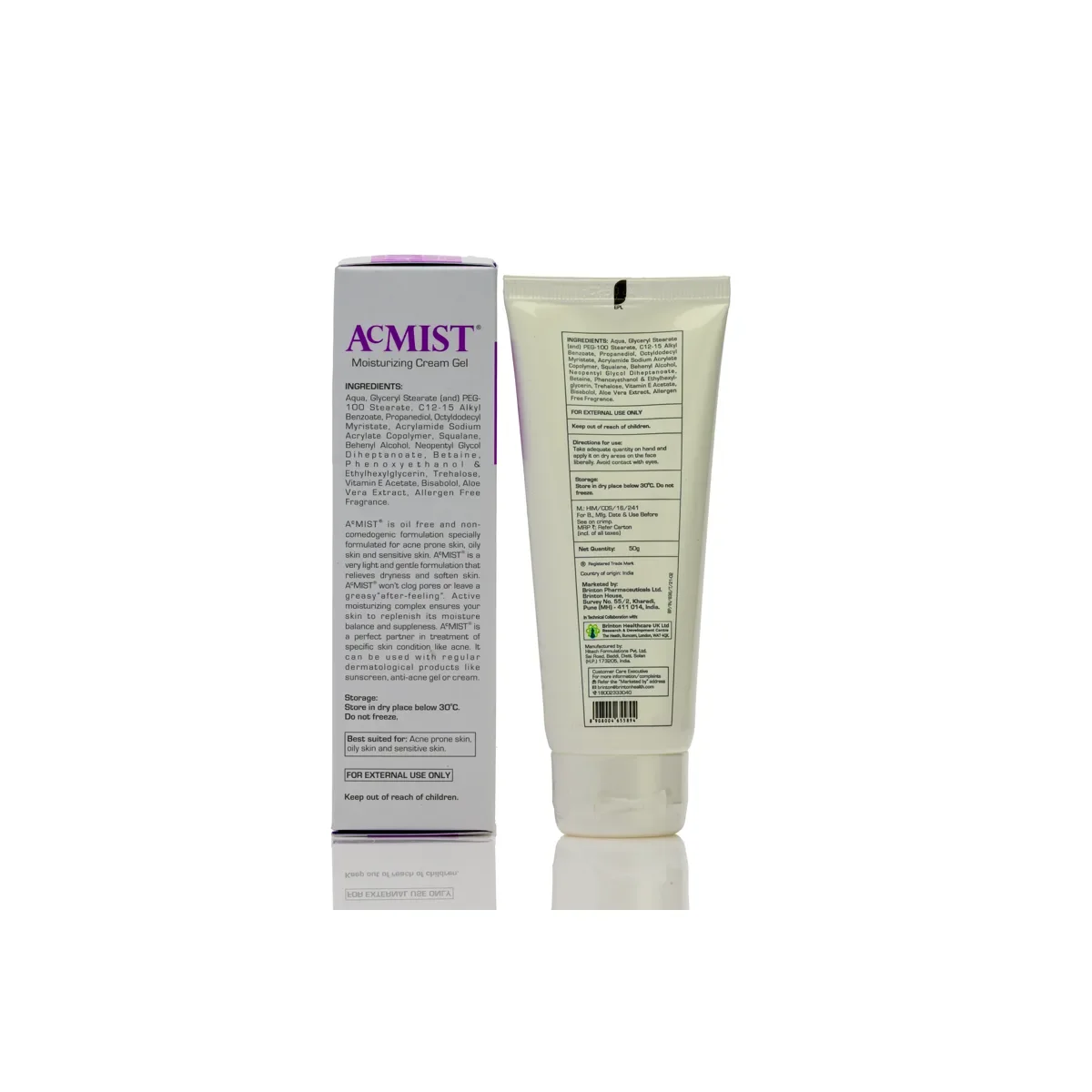
ACMIST MOISTURISING GEL
BRINTON
75G
The Science of Moisturisers
BRINTON ACMIST MOISTURISING GEL (75G)
Drug Facts
INGREDIENT · VITAMIN B COMPLEX, SKIN CONDITIONING AGENT
Niacinamide
also known as Vitamin B3, Nicotinamide
Function
Barrier support, melanin transfer inhibition, anti-inflammatory, skin tone regulation
How it works
Niacinamide functions through multiple pathways including inhibition of melanosome transfer from melanocytes to keratinocytes, thereby potentially reducing hyperpigmentation. Research indicates it modulates skin barrier function by supporting ceramide and lipid synthesis, while simultaneously exerting anti-inflammatory effects through NAD+ pathway involvement. Studies suggest niacinamide's transdermal delivery is pH-dependent, with neutral formulation pH (7.4) facilitating approximately twofold greater skin permeation compared to acidic pH, which may enhance its biological activity.
⚑ For Indian skin (Fitzpatrick IV–VI)
Niacinamide demonstrates particular relevance for Fitzpatrick IV-VI skin types, where post-inflammatory hyperpigmentation (PIH) and melasma represent significant clinical concerns, especially in Indian populations with genetic predisposition to melanin dysregulation. In Kerala's tropical climate with high UV exposure, niacinamide's dual mechanism—supporting barrier integrity against environmental stressors while inhibiting melanin transfer—offers protective benefits without photosensitization risk. Research indicates that niacinamide formulations optimized at neutral pH may enhance efficacy in darker skin phototypes where enhanced permeation facilitates superior melanin transfer inhibition, making it particularly suitable for Indian dermatological practice where melasma prevalence ranges from 8-40% in certain populations. Local humidity and heat may increase transepidermal water loss in tropical settings; niacinamide's barrier-strengthening properties may provide compensatory protection.
Effective concentration
2–10 %w/w (optimal ~4%w/w)
Clinical evidence
Large database analysis examining niacinamide's potential role in skin cancer prevention through supplementation.
Not specified in abstract provided Journal of the American Academy of Dermatology. 2026. PubMed →
Research indicates that neutral pH (7.4) formulations increase niacinamide skin permeation approximately twofold compared to acidic pH (5.0), with corresponding changes in stratum corneum electrical properties facilitating enhanced transdermal delivery. Studies employed Franz cell diffusion experiments and electrical impedance spectroscopy using human skin models to characterize pH-dependent permeation mechanisms.
Not specified in abstract provided Scientific Reports. 2026. PubMed →
Research indicates that dissolving microneedle patches containing niacinamide exhibit greater skin-lightening effects than traditional topical formulations for treating melasma and post-inflammatory hyperpigmentation. Clinical studies have validated safety and efficacy with minimal adverse effects when using advanced transdermal delivery systems.
Not specified in abstract provided Recent Advances in Drug Delivery and Formulation. 2026. PubMed →
Systematic umbrella review evaluating nutritional supplements including niacinamide for primary prevention of skin diseases across 9,229 participants, examining preventive effects against ultraviolet radiation-induced skin pathology and other dermatological conditions.
Not specified in abstract provided Preventive Nutrition and Food Science. 2026. PubMed →
Research comparing glabridin with niacinamide as recognized inhibitor of melanosome transfer in UVB-irradiated co-culture systems demonstrated complementary mechanisms for reducing melanin transfer from melanocytes to keratinocytes through dendrite suppression pathways.
Not specified in abstract provided Pharmaceuticals (Basel, Switzerland). 2026. PubMed →
Pairs well with
Glabridin · Tranexamic acid · Ceramides · Hyaluronic acid · Panthenol · Zinc compounds
INGREDIENT · HUMECTANT, HYDRATING AGENT
Sodium Hyaluronate
also known as Hyaluronic Acid Sodium Salt
Function
May help support skin hydration and moisture retention through hygroscopic properties
How it works
Sodium hyaluronate is a sodium salt of hyaluronic acid that may help bind water molecules in the stratum corneum and dermis, potentially enhancing skin hydration. Research indicates it can penetrate the skin barrier when formulated with appropriate adjuvants and amino acids. Studies suggest the ingredient maintains structural stability during gastrointestinal transit and may exert antioxidant and anti-inflammatory effects when combined with complementary actives. The molecule's ability to modulate CD44 receptor expression has been shown in in vitro keratinocyte models.
⚑ For Indian skin (Fitzpatrick IV–VI)
Sodium hyaluronate has been shown to support hydration in deeper skin tones where transepidermal water loss may be elevated, particularly relevant in Kerala's humid tropical climate where excessive moisture can paradoxically lead to dehydration due to osmotic stress. Research indicates the ingredient does not increase melanin synthesis or phototoxic potential in Fitzpatrick IV-VI skin types. However, formulations should be carefully evaluated as combination products (particularly those with amino acids or cross-linked derivatives) may require stability testing under tropical humidity and heat conditions to prevent degradation. Clinical consideration should be given to post-inflammatory hyperpigmentation risk with injectable formulations in darker skin types, requiring careful injection technique and avoidance of trauma.
Effective concentration
0.1–2 %w/w (optimal ~0.5%w/w)
Clinical evidence
Research indicates that sodium hyaluronate combined with amino acids (glycine, alanine, proline) may enhance moisturizing performance compared to mono-component formulations. Studies suggest this combination strategy may reduce dosing frequency and improve hydration efficacy in skin rejuvenation applications.
Not specified in abstract Journal of Cosmetic Dermatology. 2026. PubMed →
Research suggests that hyaluronic acid derivatives demonstrate high structural stability across gastrointestinal stages and may exert superior antioxidant and anti-inflammatory activity. Studies indicate efficient intestinal barrier penetration without increased enzymatic degradation, with potential upregulation of CD44 receptor expression in keratinocytes.
Not specified in abstract Foods (Basel, Switzerland). 2026. PubMed →
Studies indicate sodium hyaluronate can be successfully formulated in hydrogel systems with complementary ingredients such as xanthan gum, demonstrating adequate physical and microbiological stability over extended storage periods. Research suggests these formulations maintain tunable rheological properties suitable for dermal administration.
Not specified in abstract Gels (Basel, Switzerland). 2026. PubMed →
Pairs well with
Glycerin · Propylene Glycol · Amino Acids (Glycine, Alanine, Proline) · Xanthan Gum · Panthenol · Niacinamide · Ceramides · Lactic Acid
Avoid combining with
High concentrations of alcohol (may cause osmotic dehydration) · Strong chemical exfoliants at high pH (may impair hyaluronic acid stability) · BDDE cross-linked derivatives in certain formulations (safety considerations)