EV
01 / 03 Cleansers
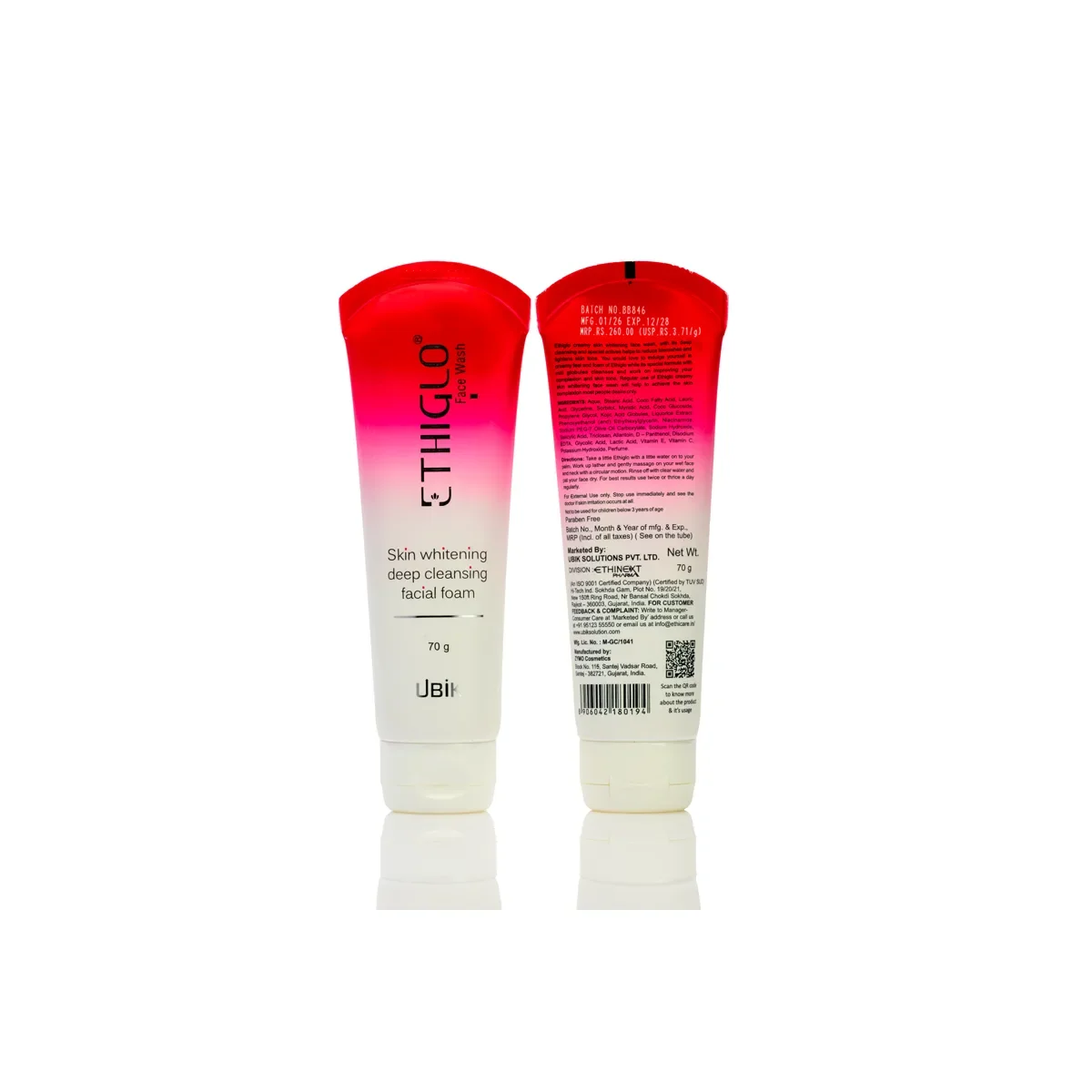
ETHIGLO FACE WASH 70GM GEL
Clinical Efficacy Markers
- Ethyl Ascorbic Acid
- Glycolic Acid
- Niacinamide
The Science of Cleansers
ETHICARE / UBIK ETHIGLO FACE WASH 70GM GEL (70g). Creamy clenaser that helps reduce blemishes and lightens skin tone.
Drug Facts
⚑ Contains photosensitising ingredient(s) — pair with SPF 50+.
INGREDIENT · ANTIOXIDANT, ANTI-AGING, SKINCARE ACTIVE
3-O-Ethyl Ascorbic Acid
also known as Ethyl Ascorbic Acid, EAA, ETVC
Function
Antioxidant support and may help support skin protection against environmental stressors
How it works
Ethyl ascorbic acid is a stable, lipophilic derivative of vitamin C that may help support cellular antioxidant defense mechanisms. Research indicates it may help modulate kinase-dependent signaling pathways affected by ultraviolet radiation exposure. Studies suggest the compound may help support skin barrier function and reduce oxidative stress-induced protein modifications. The lipophilic nature of this derivative may facilitate enhanced skin penetration compared to standard ascorbic acid.
⚑ For Indian skin (Fitzpatrick IV–VI)
Research indicates ethyl ascorbic acid may help support skin protection in darker skin types, with studies demonstrating enhanced cellular viability in melanocytes after UV exposure. In Indian skin (Fitzpatrick IV-VI), this derivative may help reduce post-inflammatory hyperpigmentation (PIH) risk by supporting antioxidant mechanisms during sun exposure and recovery phases. Kerala's tropical climate with high UV intensity and humidity may benefit from this ingredient's stability profile; however, formulation pH and vehicle selection remain critical to minimize any irritation potential in individuals with sensitive or reactive skin. Patch testing is recommended prior to widespread use in patients with history of hypersensitivity or melasma.
Effective concentration
3–10 % (optimal ~5%)
Clinical evidence
Research indicates that 3-O-ethyl ascorbic acid delivered via dissolving microneedles achieved 17.25% cumulative transdermal delivery and significantly reduced visible signs of photoaging including wrinkles and erythema in a UV-induced aging model. Studies suggest microneedle delivery systems enhanced ETVC bioavailability compared to aqueous solutions, with improved skin elasticity and hydration observed in human subjects.
Study authors not specified in abstract International Journal of Biological Macromolecules. 2026. PubMed →
Research indicates that 3-O-ethyl ascorbic acid demonstrated stronger regenerative effects on multiple skin cell types (keratinocytes, melanocytes, fibroblasts) compared to standard ascorbic acid following UVA exposure. Studies suggest the derivative showed consistent protective results across multiple viability assessment methods, supporting potential cellular protection mechanisms in healthy skin cells.
Study authors not specified in abstract Biomedicine & Pharmacotherapy. 2024. PubMed →
Research indicates that 3-O-ethyl ascorbic acid may help support kinase-dependent signaling recovery in UVB-damaged keratinocytes by reducing expression of stress-response kinases and limiting lipid peroxidation damage. Studies suggest the compound may help restore skin cell proteome stability following UV exposure, with effects on ERK1/2, MAP kinase, and IKK pathways.
Study authors not specified in abstract Scientific Reports. 2024. PubMed →
Research indicates that lipid-based gel formulations enhanced 3-O-ethyl L-ascorbic acid retention in the skin compared to standard delivery, with bigel systems achieving greater epidermal penetration. Studies suggest the lipophilic nature of formulation vehicles significantly influences ingredient distribution, with enhanced antioxidant efficacy demonstrated in skin tissue models.
Study authors not specified in abstract Pharmaceutics. 2024. PubMed →
Research indicates that 3-O-ethyl ascorbic acid interacts with skin lipid structures and may support the stability of phosphatidylinositol monolayers. Studies suggest the compound's antioxidant properties may enhance the efficacy of antimicrobial peptides, potentially supporting skin microbiome-related concerns.
Study authors not specified in abstract International Journal of Molecular Sciences. 2024. PubMed →
Pairs well with
Hyaluronic Acid · Tocopherol · Niacinamide · Peptides · Cannabidiol
Avoid combining with
Strong alkaline pH formulations · Benzoyl Peroxide in same formulation
INGREDIENT · ALPHA HYDROXY ACID (AHA), CHEMICAL EXFOLIANT
Glycolic Acid
also known as Glycolic Acid, Hydroxyacetic Acid
Function
Chemical exfoliant; may help support skin renewal and surface keratin dissolution
How it works
Glycolic acid functions as a small-molecular-weight alpha hydroxy acid that may help weaken intracellular bonds within the stratum corneum through pH-dependent hydrolysis. Research indicates the ingredient's permeability and efficacy are significantly influenced by pH dynamics, with effectiveness constrained above its pKa of 3.83. Studies suggest glycolic acid may facilitate enhanced exfoliation when formulated with novel delivery systems that optimize ion-pairing and pH stability. The mechanism involves both chemical dissolution of keratin and potential stimulation of dermal turnover at physiologically tolerable concentrations.
⚑ For Indian skin (Fitzpatrick IV–VI)
Glycolic acid carries heightened risk of post-inflammatory hyperpigmentation (PIH) in Fitzpatrick IV-VI skin types, particularly in Indian populations with darker melanin distribution. Kerala's tropical, humid climate and intense UV exposure (high UVA/UVB index) necessitate strict concurrent photoprotection (SPF 50+ PA+++++) and may require lower concentration initiation (4-6%) with extended adaptation periods. Recommended use restricted to evening application with gradual frequency titration (2-3 times weekly initially), avoiding concurrent use during monsoon or high-humidity seasons when occlusion-related reactions increase. Pre-treatment skin barrier assessment is essential; compromised skin warrants deferral. Patients should receive explicit counseling on mandatory sunscreen compliance and discontinuation at first signs of erythema or dyschromia.
Effective concentration
4–15 % w/w (optimal ~8% w/w)
Clinical evidence
Research indicates that chemical exfoliation efficacy of glycolic acid is significantly limited by pH-dependent permeability reduction above the ingredient's pKa of 3.83, constraining formulation development. Studies suggest that novel biphasic delivery systems utilizing ion-pairing mechanisms may help enhance glycolic acid's exfoliating performance through optimization of pH stability and skin penetration. The findings underscore the critical importance of pH formulation in determining glycolic acid efficacy in topical skincare products.
Not specified in abstract Skin Research and Technology. 2026. PubMed →
Pairs well with
Niacinamide · Ceramides · Hyaluronic Acid · Panthenol · Centella Asiatica Extract · Allantoin
Avoid combining with
Retinol and Retinoids · Salicylic Acid and other BHAs (if same application) · Vitamin C (L-Ascorbic Acid) · Strong oxidizing agents
INGREDIENT · VITAMIN B COMPLEX, SKIN CONDITIONING AGENT
Niacinamide
also known as Vitamin B3, Nicotinamide
Function
Barrier support, melanin transfer inhibition, anti-inflammatory, skin tone regulation
How it works
Niacinamide functions through multiple pathways including inhibition of melanosome transfer from melanocytes to keratinocytes, thereby potentially reducing hyperpigmentation. Research indicates it modulates skin barrier function by supporting ceramide and lipid synthesis, while simultaneously exerting anti-inflammatory effects through NAD+ pathway involvement. Studies suggest niacinamide's transdermal delivery is pH-dependent, with neutral formulation pH (7.4) facilitating approximately twofold greater skin permeation compared to acidic pH, which may enhance its biological activity.
⚑ For Indian skin (Fitzpatrick IV–VI)
Niacinamide demonstrates particular relevance for Fitzpatrick IV-VI skin types, where post-inflammatory hyperpigmentation (PIH) and melasma represent significant clinical concerns, especially in Indian populations with genetic predisposition to melanin dysregulation. In Kerala's tropical climate with high UV exposure, niacinamide's dual mechanism—supporting barrier integrity against environmental stressors while inhibiting melanin transfer—offers protective benefits without photosensitization risk. Research indicates that niacinamide formulations optimized at neutral pH may enhance efficacy in darker skin phototypes where enhanced permeation facilitates superior melanin transfer inhibition, making it particularly suitable for Indian dermatological practice where melasma prevalence ranges from 8-40% in certain populations. Local humidity and heat may increase transepidermal water loss in tropical settings; niacinamide's barrier-strengthening properties may provide compensatory protection.
Effective concentration
2–10 %w/w (optimal ~4%w/w)
Clinical evidence
Large database analysis examining niacinamide's potential role in skin cancer prevention through supplementation.
Not specified in abstract provided Journal of the American Academy of Dermatology. 2026. PubMed →
Research indicates that neutral pH (7.4) formulations increase niacinamide skin permeation approximately twofold compared to acidic pH (5.0), with corresponding changes in stratum corneum electrical properties facilitating enhanced transdermal delivery. Studies employed Franz cell diffusion experiments and electrical impedance spectroscopy using human skin models to characterize pH-dependent permeation mechanisms.
Not specified in abstract provided Scientific Reports. 2026. PubMed →
Research indicates that dissolving microneedle patches containing niacinamide exhibit greater skin-lightening effects than traditional topical formulations for treating melasma and post-inflammatory hyperpigmentation. Clinical studies have validated safety and efficacy with minimal adverse effects when using advanced transdermal delivery systems.
Not specified in abstract provided Recent Advances in Drug Delivery and Formulation. 2026. PubMed →
Systematic umbrella review evaluating nutritional supplements including niacinamide for primary prevention of skin diseases across 9,229 participants, examining preventive effects against ultraviolet radiation-induced skin pathology and other dermatological conditions.
Not specified in abstract provided Preventive Nutrition and Food Science. 2026. PubMed →
Research comparing glabridin with niacinamide as recognized inhibitor of melanosome transfer in UVB-irradiated co-culture systems demonstrated complementary mechanisms for reducing melanin transfer from melanocytes to keratinocytes through dendrite suppression pathways.
Not specified in abstract provided Pharmaceuticals (Basel, Switzerland). 2026. PubMed →
Pairs well with
Glabridin · Tranexamic acid · Ceramides · Hyaluronic acid · Panthenol · Zinc compounds