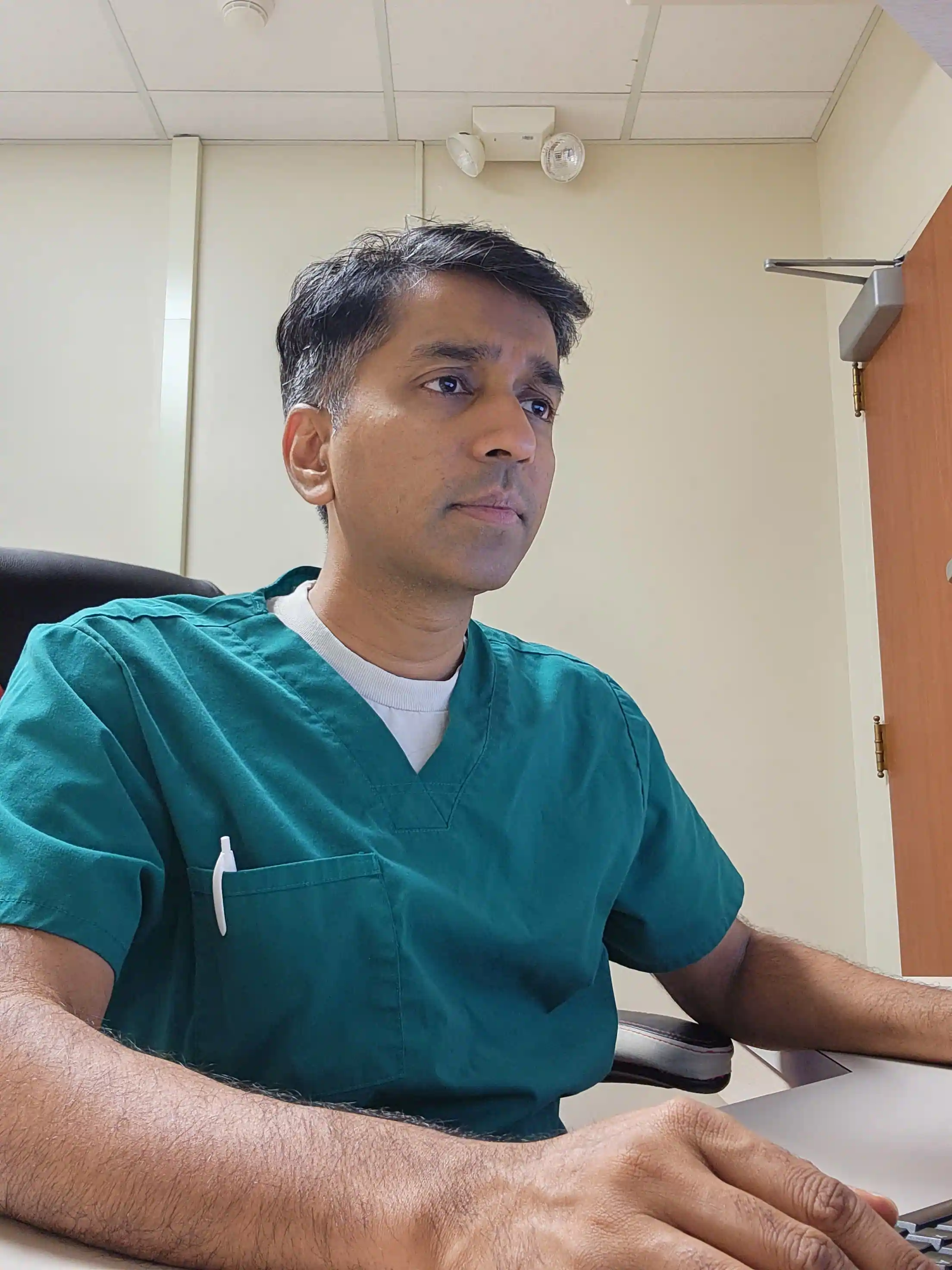
Dr. Rejeesh Menon, MD, FACP
Internal medicine physician, ABIM board certified since 2016, and Fellow of the American College of Physicians. Clinical Assistant Professor at Washington State University. Founder of DermaVue Clinics and the SuperHuman physician-supervised GLP-1 program.
Dr. Rejeesh Menon is the Founder and Chairman of DermaVue Clinics and the Medical Director of the SuperHuman GLP-1 medical weight loss program. He holds an MBBS from T.D. Medical College, University of Kerala, completed Internal Medicine residency at the University of North Dakota, has been ABIM board certified since October 2016, and is a Fellow of the American College of Physicians. He is Clinical Assistant Professor at the Elson S. Floyd College of Medicine, Washington State University, and leads the DermaVue clinical strategy.
I treat metabolic health, not calorie counts.
I trained in Internal Medicine in the US after an MBBS at T.D. Medical College in Kerala, then a research fellowship in radiation oncology at the University of Florida, then residency at the University of North Dakota. By the time I had my ABIM certificate in 2016, I had watched South Asian patients arrive at US hospitals five to ten years earlier in their metabolic disease than my American patients. Lower BMIs. Higher visceral fat. Worse insulin sensitivity for the same body weight. The thresholds my training textbooks used were wrong for them.
The Indian patient is the reason I built DermaVue's SuperHuman Program. We use Indian BMI thresholds (≥23 kg/m² for overweight, ≥25 for obesity) and the IDF South Asian waist cutoffs (80 cm women, 90 cm men) on every assessment. We do not start a patient on a GLP-1 because the BMI looks high. We start when the metabolic picture demands it, after baseline labs, after a real conversation about side effects, and after the patient has read the consent in their own language. The data behind semaglutide and tirzepatide is overwhelming. The execution discipline is what separates a program from a prescription.
The clinical hours I spend at Pullman Regional Hospital and Lourdes Medical Center in Washington are not a sideline. They are the discipline. Hospital medicine teaches you what goes wrong when prevention has failed. Every SuperHuman protocol is built backwards from the hospital ward: which patients ended up there, what we missed in primary care that put them there, what we should have screened for ten years earlier. That is the lens I bring to the dietitian, the protein target, the resistance training prescription, and the GLP-1 titration plan.
I do not promise patients a cure. PCOS is chronic. Insulin resistance is chronic. The thin-fat phenotype is genetic. What I promise is a protocol that respects the biology, transparent pricing (₹325 per weekly injection for generic semaglutide on the entry tier, ₹1,415 for Ozempic, ₹3,281 for Mounjaro), and a physician who will tell them when to stop as honestly as when to start. The SuperHuman Program is what physician-led medical weight loss looks like when the physician is the one writing the protocol.
The verifiable record.
- Board Certification American Board of Internal Medicine ABIM Certified since October 2016
- Fellowship Fellow, American College of Physicians FACP designation
- Residency Internal Medicine, University of North Dakota Fargo, ND, 2013-2016
- Research Fellowship Department of Radiation Oncology, University of Florida Post-Doctoral Research Scholar, 2011-2013
- Medical Degree MBBS, T.D. Medical College, University of Kerala 2003-2009; ECFMG Certified February 2012
- Faculty Appointment Clinical Assistant Professor, Washington State University Elson S. Floyd College of Medicine, since October 2022
- Hospital Appointment Attending Physician, Pullman Regional Hospital Department of Medicine, Washington State
- Professional Memberships ACP · AMA · IMA American College of Physicians, American Medical Association, Indian Medical Association
Eight peer-reviewed papers, six published abstracts.
During the University of Florida research fellowship, Dr. Menon contributed to the development of Enterade, an amino-acid compound that mitigates acute gastrointestinal toxicity during radiation and chemotherapy. The program received the NSBRI SmartCap Award from the NASA-funded National Space Biomedical Research Institute and continues in clinical use through collaborations with Harvard Medical School, the Department of Defense, and Dana-Farber.
- Glucose stimulates calcium-activated chloride secretion in small intestinal cells American Journal of Physiology, Cell Physiology, April 2014, 306-7, C687-C696
- An amino acid mixture mitigates radiation-induced gastrointestinal toxicity Health Physics, June 2014, 106(6):734-44
- Glucose enhances rotavirus enterotoxin-induced intestinal chloride secretion Pflügers Archiv, European Journal of Physiology, 469(9), 1093-1105
- Comparative evaluation of four therapeutic regimes in Chikungunya arthritis Prospective randomized parallel-group study, 2010
Full publication list: Google Scholar profile · ORCID 0000-0002-9400-2167
Peer reviewer: Journal of Gastroenterology and Metabolism · International Journal of Infectious Diseases and Therapy · American Journal of Clinical Medicine Research · American Journal of Medical and Biological Research.
What physician-led medical weight loss looks like.
The DermaVue SuperHuman Program is a physician-supervised GLP-1 medical weight loss program for patients across India. The program operates through DermaVue's seven-clinic network in Kerala and Tamil Nadu (Thiruvananthapuram, Kollam, Thiruvalla, Kottayam, Kochi-Aluva, Thrissur, and Coimbatore), and nationwide via teleconsultation under the Telemedicine Practice Guidelines 2020.
Every prescription decision is made after baseline metabolic labs, an Indian-threshold BMI and waist-circumference assessment, a contraindication screen (medullary thyroid carcinoma, MEN-2, pancreatitis, eating disorders, active pregnancy planning), and a 30-minute consultation. Three medication categories are anchored on the cost surface: generic semaglutide from ₹325 per weekly injection, Ozempic (Novo Nordisk) from ₹1,415, Mounjaro (Eli Lilly) from ₹3,281. The program fee is discussed at consultation, never on a pricing surface.
External recognition.
- NSBRI SmartCap Award
NASA-funded National Space Biomedical Research Institute team award for the development of Enterade, an amino-acid compound for acute gastrointestinal syndrome in radiation oncology and military medicine applications.
- University of Florida Shands Cancer Center, Celebration of Excellence
For significant research contributions during the post-doctoral fellowship in the Department of Radiation Oncology.
What patients ask before booking.
What are Dr. Rejeesh Menon's medical qualifications?
Dr. Rejeesh Menon holds an MBBS from T.D. Medical College, University of Kerala, and an MD in Internal Medicine from the University of North Dakota residency program, Fargo. He has been American Board of Internal Medicine (ABIM) certified since 2016 and is a Fellow of the American College of Physicians (FACP). He serves as Clinical Assistant Professor at the Elson S. Floyd College of Medicine, Washington State University.
Where does Dr. Rejeesh Menon practice?
Dr. Rejeesh Menon is Founder and Chairman of DermaVue Clinics, a seven-clinic network across Kerala and Tamil Nadu, and Medical Director of the SuperHuman Program. He simultaneously practices US hospital medicine as an attending physician at Pullman Regional Hospital, Washington, and a hospitalist at Lourdes Medical Center, Pasco. Consultations in India are delivered through the DermaVue clinic network and nationwide via teleconsultation under the Telemedicine Practice Guidelines 2020.
What is Dr. Rejeesh Menon's clinical focus?
Internal medicine with a cardiometabolic and obesity-medicine subspecialty interest: GLP-1 receptor agonist therapy (semaglutide, tirzepatide), polycystic ovary syndrome, insulin resistance, type 2 diabetes prevention, and the South Asian thin-fat phenotype that drives cardiometabolic risk at lower BMI thresholds in Indian patients. His prior research at the University of Florida Department of Radiation Oncology focused on intestinal nutrient and electrolyte transport, with eight peer-reviewed publications and six published abstracts.
Why does the SuperHuman Program use Indian BMI thresholds?
Indian patients develop insulin resistance, fatty liver, and atherosclerotic disease at lower body weights than Western populations. The Indian consensus thresholds (BMI ≥23 for overweight, ≥25 for obesity, waist 80 cm in women and 90 cm in men) capture this risk; WHO thresholds (25 and 30) systematically underestimate metabolic risk in South Asians. Dr. Menon applies the Indian thresholds across every SuperHuman assessment, in line with ICMR-INDIAB guidance.
Has Dr. Rejeesh Menon published peer-reviewed research?
Yes. Eight peer-reviewed publications in journals including the American Journal of Physiology-Cell Physiology, Pflügers Archiv, and Health Physics, plus six published abstracts at gastroenterology, FASEB, and ASTRO meetings. He contributed to the development of Enterade, an amino-acid compound for radiation-induced gastrointestinal toxicity, which received the NSBRI SmartCap Award funded by NASA. He serves as a peer reviewer for four journals including the Journal of Gastroenterology and Metabolism.
Can I consult Dr. Rejeesh Menon via teleconsultation?
Yes. SuperHuman Program teleconsultations are delivered under the Telemedicine Practice Guidelines 2020 issued by the Ministry of Health and Family Welfare. The flow is: complete the eligibility quiz, attend a 30-minute video consultation with the SuperHuman team, complete baseline metabolic labs, then receive a personalised GLP-1 protocol where clinically indicated. Cold-chain medication delivery covers most Indian metros and tier-2 cities.
How does Dr. Rejeesh Menon decide which GLP-1 medication to prescribe?
The decision is biological, not commercial. Generic semaglutide (Natco Semanat, Alkem Semasize) from ₹325 per weekly injection is the appropriate starting point for most patients with BMI 23 to 32 and moderate insulin resistance. Ozempic (Novo Nordisk) from ₹1,415 per weekly injection is reserved for patients who need the branded pen device or have specific tolerability requirements. Mounjaro (Eli Lilly tirzepatide) from ₹3,281 per weekly injection is considered for patients with BMI above 32, HbA1c above 6.0 despite metformin, or who have plateaued on maximum-dose semaglutide.
What labs does Dr. Rejeesh Menon require before starting GLP-1 therapy?
Baseline labs are mandatory: HbA1c, fasting insulin, lipid profile, complete liver function, renal function (eGFR + creatinine), thyroid panel, vitamin D, and vitamin B12. Patients with PCOS receive an extended panel covering SHBG, free testosterone, DHEAS, and 17-hydroxyprogesterone. The SuperHuman team does not initiate GLP-1 therapy on the basis of BMI alone, and recent labs (within 90 days) can be uploaded from any major Indian lab chain.
Ready to start with the SuperHuman Program?
Video consultations available across India under TPG 2020. In-person consultations at any of 7 DermaVue clinics in Kerala and Tamil Nadu. Cold-chain medication delivery to most Indian metros and tier-2 cities.
Reviewed by Dr. Rejeesh Menon, MD, FACP · Last updated 16 May 2026