EV
01 / 04 Anti-Pigmentation
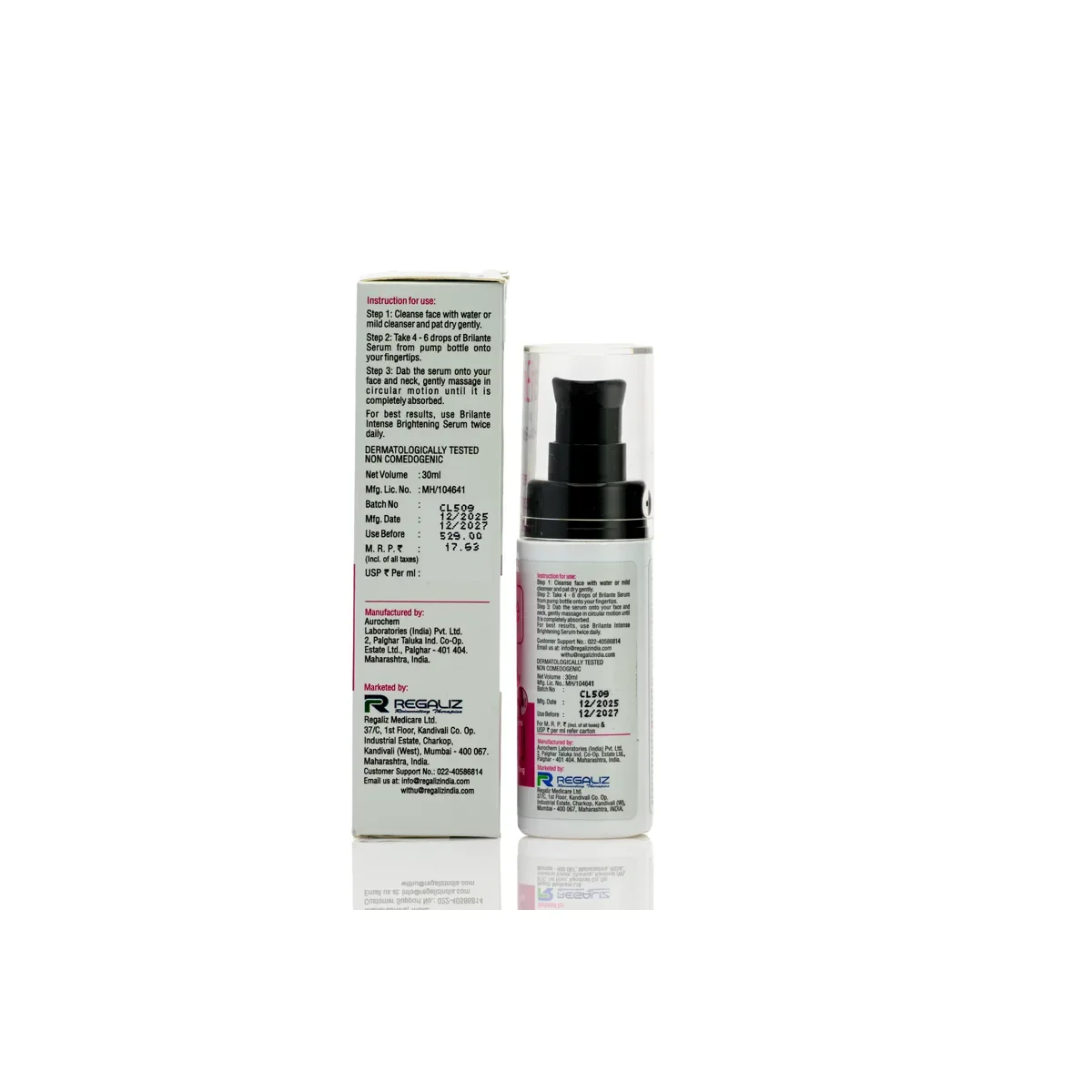
BRILANTE INTENSE BRIGHTENING SERUM
REGALIZ
30ML
The Science of Anti-Pigmentation
REGALIZ BRILANTE INTENSE BRIGHTENING SERUM (30ML)
Drug Facts
⚑ Contains photosensitising ingredient(s) — pair with SPF 50+.
INGREDIENT · SKIN-LIGHTENING AGENT, TYROSINASE INHIBITOR, ANTIOXIDANT
Arbutin
also known as Arbutin, β-Arbutin, Hydroquinone Glucoside
Function
May help support melanin regulation and support more even skin tone appearance
How it works
Arbutin research indicates it functions as a competitive inhibitor of tyrosinase, the enzyme central to melanin synthesis. Studies suggest arbutin may work through modulation of the MITF (Microphthalmia-associated transcription factor) pathway to regulate melanogenesis. The compound appears to deliver hydroquinone (HQ) in a controlled manner to melanocytes, potentially reducing direct exposure to free HQ. Research indicates enzymatic stability and metabolic pathway characteristics may influence the duration and safety profile of skin-lightening effects.
⚑ For Indian skin (Fitzpatrick IV–VI)
Arbutin use in Fitzpatrick IV-VI Indian skin requires careful consideration due to increased risk of post-inflammatory hyperpigmentation (PIH) if applied before skin barrier is fully recovered from inflammation or irritation. In Kerala's tropical, humid climate with high UV index and occupational sun exposure patterns, concurrent strict photoprotection (SPF 50+ broad-spectrum, reapplication every 2 hours) is essential to prevent paradoxical darkening or PIH. Patients with darker skin tones show greater melanin density and higher baseline tyrosinase activity; arbutin efficacy may plateau at lower concentrations, and discontinuation may result in rapid repigmentation. Monitor for signs of irritation, sensitization, or unexpected darkening; lower concentrations (2-4%) and longer treatment intervals are recommended for Indian skin. Combination with other depigmenting agents should be approached cautiously to minimize cumulative irritation risk in this population.
Effective concentration
2–10 % w/w (optimal ~2% w/w)
Clinical evidence
Studies indicate that naturally derived arbutin derivatives (6'-O-caffeoylarbutin) may resist hydrolysis to hydroquinone through conjugation and steric effects, demonstrating superior enzymatic stability compared to parent arbutin. Research suggests this improved stability may contribute to prolonged skin-lightening efficacy and reduced toxicity concerns. The derivative appears to operate through MITF pathway modulation in melanogenesis regulation.
Authors not listed Chemistry & Biodiversity. 2026. PubMed →
Research indicates that arbutin formulated in combination with kojic acid within a supramolecular delivery system may demonstrate synergistic inhibition of melanin production pathways. Studies suggest the combination exhibited above 85% antioxidant activity in radical scavenging assays and remained chemically stable for up to 12 weeks under controlled storage. Evidence suggests such multifunctional systems may offer enhanced melanogenesis regulation potential.
Authors not listed Macromolecular Bioscience. 2026. PubMed →
Research indicates that arbutin, when evaluated in keratinocyte-melanocyte co-culture models as a contextual reference agent, may demonstrate a more favorable safety profile compared to certain alternative depigmenting agents. Studies suggest arbutin's in vitro stress signature and inflammatory response metrics warrant continued safety surveillance, particularly regarding leukoderma-related hazard assessment. Evidence indicates comparative safety profiling remains relevant for informing appropriate agent selection in clinical depigmentation protocols.
Authors not listed Molecules (Basel, Switzerland). 2026. PubMed →
Pairs well with
Kojic Acid · Glycolic Acid · Niacinamide · Vitamin C (L-Ascorbic Acid) · Alpha-Lipoic Acid · Retinol
Avoid combining with
Rhododendrol (similar cytotoxicity profile concerns) · High-dose Raspberry Ketone (in vitro data suggests potential for similar stress signatures) · Strong Benzoyl Peroxide formulations (incompatibility/oxidation risk)
INGREDIENT · DEPIGMENTING AGENT / TYROSINASE INHIBITOR
Alpha-Arbutin
also known as Alpha-Arbutin, α-Arbutin
Function
May help support skin brightening and even tone through tyrosinase inhibition and melanin synthesis modulation
How it works
Alpha-arbutin undergoes hydrolysis to release hydroquinone, which research indicates may inhibit tyrosinase enzyme activity and potentially reduce melanin production in melanocytes. Studies suggest the ingredient works through competitive inhibition of tyrosinase, the key enzyme responsible for melanin synthesis. The mechanism may involve downregulation of melanin-synthesis-related genes, supporting its use in addressing hyperpigmentation concerns.
⚑ For Indian skin (Fitzpatrick IV–VI)
Alpha-arbutin has been shown in research to support melanin reduction across diverse skin types and may be particularly relevant for Fitzpatrick IV-VI individuals in Kerala where high UV exposure and genetic predisposition contribute to melasma and PIH. Studies indicate the ingredient's efficacy is not compromised in darker skin phenotypes; however, practitioners should monitor for delayed or uneven depigmentation patterns common in Indian skin, as PIH risk remains significant during treatment. The tropical Kerala climate with intense UVB exposure necessitates concurrent daily broadspectrum sunscreen use (SPF 50+) and consideration of sequential therapy; alpha-arbutin alone may be insufficient for moderate-to-severe melasma in this population. Combining with other tyrosinase inhibitors or tranexamic acid may enhance efficacy, though patch testing is advisable given variable skin sensitivity in pigmented populations.
Effective concentration
2–4 % (optimal ~2%)
Clinical evidence
Research indicates alpha-arbutin was used as a comparative standard for tyrosinase inhibitory activity and skin-brightening applications. The study evaluated Reishi extract against alpha-arbutin, suggesting both ingredients have potential for anti-aging and depigmenting formulations.
Authors not listed International Journal of Cosmetic Science. 2026. PubMed →
Studies indicate certain botanical compounds demonstrated tyrosinase inhibition superior to alpha-arbutin in vitro, with liquiritigenin reducing pigmentation by 22-41% in melanoma cells. The research suggests alpha-arbutin remains a relevant comparative benchmark for depigmenting efficacy evaluation.
Authors not listed Natural Product Research. 2026. PubMed →
Research indicates that Cinnamomum burmanni essential oil nanoemulgel demonstrated anti-photoaging effects comparable to alpha-arbutin in vivo and through computational modeling. Findings suggest alpha-arbutin remains a relevant clinical standard for evaluating anti-aging and depigmenting formulation efficacy.
Authors not listed Natural Product Research. 2025. PubMed →
Studies indicate tranexamic acid demonstrated additive melanin-inhibitory effects when combined with alpha-arbutin in B16 melanoma cells. Research suggests the combination may enhance depigmenting efficacy, supporting sequential or combination therapeutic approaches for melasma management.
Authors not listed Cell Biology International. 2026. PubMed →
Research indicates advanced nanocarrier encapsulation of alpha-arbutin achieved 95.65% melanin inhibition rate in zebrafish models and demonstrated enhanced skin penetration and melanin reduction in C57BL/6J mice. Studies suggest improved delivery systems may enhance alpha-arbutin's transdermal bioavailability and depigmenting efficacy compared to conventional formulations.
Authors not listed ACS Applied Materials & Interfaces. 2025. PubMed →
Pairs well with
Tranexamic Acid · Kojic Acid · Vitamin C (Ascorbic Acid) · Niacinamide · Glycolic Acid · Salicylic Acid
Avoid combining with
Benzoyl Peroxide (may reduce efficacy) · High concentrations of vitamin A derivatives (retinol/retinoids may increase irritation risk)