EV
01 / 03 Anti-Pigmentation
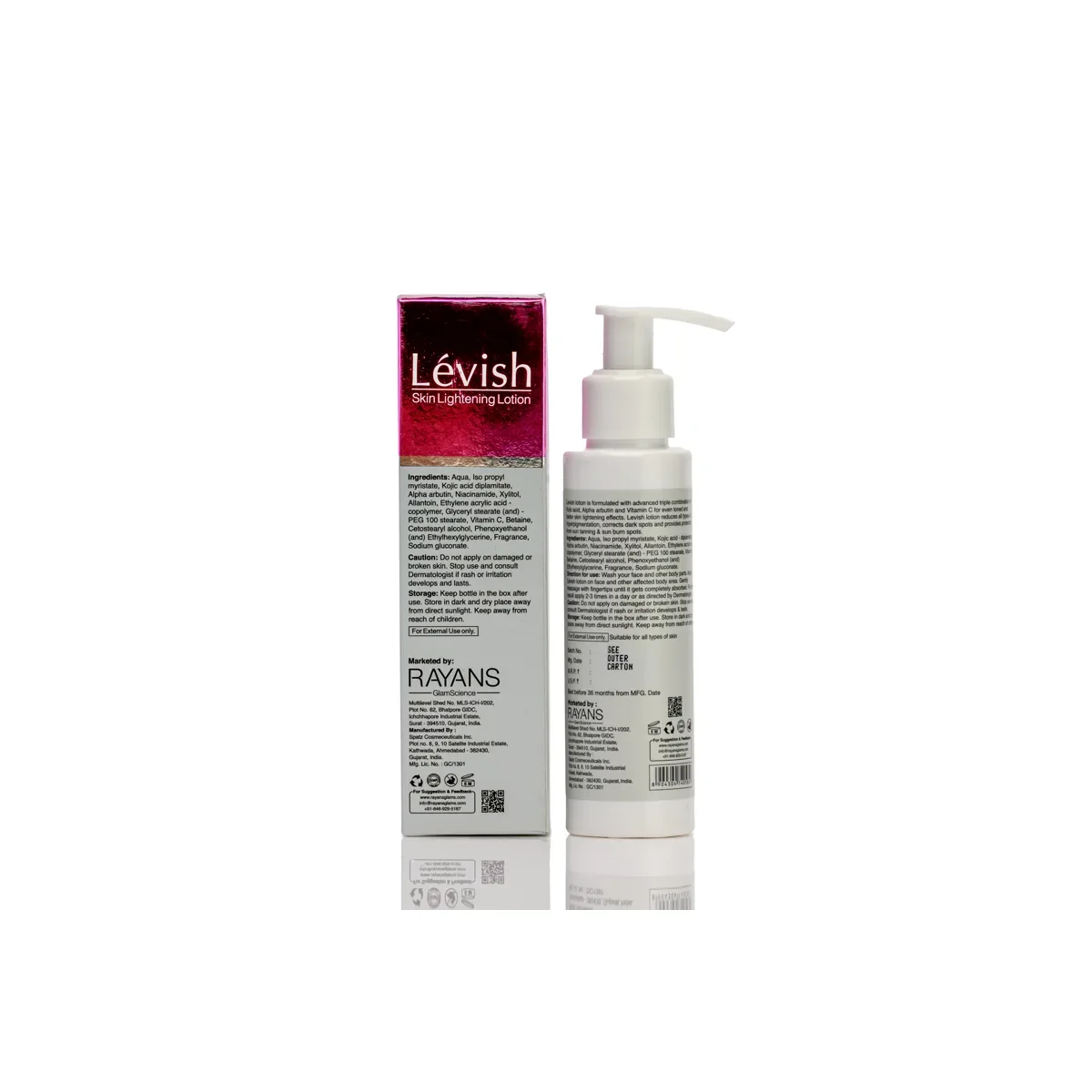
LEVISH BODY LOTION 300ML
RAYANS
100ML
The Science of Anti-Pigmentation
RAYANS LEVISH BODY LOTION 300ML (100ML)
Drug Facts
INGREDIENT · DEPIGMENTING AGENT / TYROSINASE INHIBITOR
Alpha-Arbutin
also known as Alpha-Arbutin, α-Arbutin
Function
May help support skin brightening and even tone through tyrosinase inhibition and melanin synthesis modulation
How it works
Alpha-arbutin undergoes hydrolysis to release hydroquinone, which research indicates may inhibit tyrosinase enzyme activity and potentially reduce melanin production in melanocytes. Studies suggest the ingredient works through competitive inhibition of tyrosinase, the key enzyme responsible for melanin synthesis. The mechanism may involve downregulation of melanin-synthesis-related genes, supporting its use in addressing hyperpigmentation concerns.
⚑ For Indian skin (Fitzpatrick IV–VI)
Alpha-arbutin has been shown in research to support melanin reduction across diverse skin types and may be particularly relevant for Fitzpatrick IV-VI individuals in Kerala where high UV exposure and genetic predisposition contribute to melasma and PIH. Studies indicate the ingredient's efficacy is not compromised in darker skin phenotypes; however, practitioners should monitor for delayed or uneven depigmentation patterns common in Indian skin, as PIH risk remains significant during treatment. The tropical Kerala climate with intense UVB exposure necessitates concurrent daily broadspectrum sunscreen use (SPF 50+) and consideration of sequential therapy; alpha-arbutin alone may be insufficient for moderate-to-severe melasma in this population. Combining with other tyrosinase inhibitors or tranexamic acid may enhance efficacy, though patch testing is advisable given variable skin sensitivity in pigmented populations.
Effective concentration
2–4 % (optimal ~2%)
Clinical evidence
Research indicates alpha-arbutin was used as a comparative standard for tyrosinase inhibitory activity and skin-brightening applications. The study evaluated Reishi extract against alpha-arbutin, suggesting both ingredients have potential for anti-aging and depigmenting formulations.
Authors not listed International Journal of Cosmetic Science. 2026. PubMed →
Studies indicate certain botanical compounds demonstrated tyrosinase inhibition superior to alpha-arbutin in vitro, with liquiritigenin reducing pigmentation by 22-41% in melanoma cells. The research suggests alpha-arbutin remains a relevant comparative benchmark for depigmenting efficacy evaluation.
Authors not listed Natural Product Research. 2026. PubMed →
Research indicates that Cinnamomum burmanni essential oil nanoemulgel demonstrated anti-photoaging effects comparable to alpha-arbutin in vivo and through computational modeling. Findings suggest alpha-arbutin remains a relevant clinical standard for evaluating anti-aging and depigmenting formulation efficacy.
Authors not listed Natural Product Research. 2025. PubMed →
Studies indicate tranexamic acid demonstrated additive melanin-inhibitory effects when combined with alpha-arbutin in B16 melanoma cells. Research suggests the combination may enhance depigmenting efficacy, supporting sequential or combination therapeutic approaches for melasma management.
Authors not listed Cell Biology International. 2026. PubMed →
Research indicates advanced nanocarrier encapsulation of alpha-arbutin achieved 95.65% melanin inhibition rate in zebrafish models and demonstrated enhanced skin penetration and melanin reduction in C57BL/6J mice. Studies suggest improved delivery systems may enhance alpha-arbutin's transdermal bioavailability and depigmenting efficacy compared to conventional formulations.
Authors not listed ACS Applied Materials & Interfaces. 2025. PubMed →
Pairs well with
Tranexamic Acid · Kojic Acid · Vitamin C (Ascorbic Acid) · Niacinamide · Glycolic Acid · Salicylic Acid
Avoid combining with
Benzoyl Peroxide (may reduce efficacy) · High concentrations of vitamin A derivatives (retinol/retinoids may increase irritation risk)
INGREDIENT · VITAMIN B COMPLEX, SKIN CONDITIONING AGENT
Niacinamide
also known as Vitamin B3, Nicotinamide
Function
Barrier support, melanin transfer inhibition, anti-inflammatory, skin tone regulation
How it works
Niacinamide functions through multiple pathways including inhibition of melanosome transfer from melanocytes to keratinocytes, thereby potentially reducing hyperpigmentation. Research indicates it modulates skin barrier function by supporting ceramide and lipid synthesis, while simultaneously exerting anti-inflammatory effects through NAD+ pathway involvement. Studies suggest niacinamide's transdermal delivery is pH-dependent, with neutral formulation pH (7.4) facilitating approximately twofold greater skin permeation compared to acidic pH, which may enhance its biological activity.
⚑ For Indian skin (Fitzpatrick IV–VI)
Niacinamide demonstrates particular relevance for Fitzpatrick IV-VI skin types, where post-inflammatory hyperpigmentation (PIH) and melasma represent significant clinical concerns, especially in Indian populations with genetic predisposition to melanin dysregulation. In Kerala's tropical climate with high UV exposure, niacinamide's dual mechanism—supporting barrier integrity against environmental stressors while inhibiting melanin transfer—offers protective benefits without photosensitization risk. Research indicates that niacinamide formulations optimized at neutral pH may enhance efficacy in darker skin phototypes where enhanced permeation facilitates superior melanin transfer inhibition, making it particularly suitable for Indian dermatological practice where melasma prevalence ranges from 8-40% in certain populations. Local humidity and heat may increase transepidermal water loss in tropical settings; niacinamide's barrier-strengthening properties may provide compensatory protection.
Effective concentration
2–10 %w/w (optimal ~4%w/w)
Clinical evidence
Large database analysis examining niacinamide's potential role in skin cancer prevention through supplementation.
Not specified in abstract provided Journal of the American Academy of Dermatology. 2026. PubMed →
Research indicates that neutral pH (7.4) formulations increase niacinamide skin permeation approximately twofold compared to acidic pH (5.0), with corresponding changes in stratum corneum electrical properties facilitating enhanced transdermal delivery. Studies employed Franz cell diffusion experiments and electrical impedance spectroscopy using human skin models to characterize pH-dependent permeation mechanisms.
Not specified in abstract provided Scientific Reports. 2026. PubMed →
Research indicates that dissolving microneedle patches containing niacinamide exhibit greater skin-lightening effects than traditional topical formulations for treating melasma and post-inflammatory hyperpigmentation. Clinical studies have validated safety and efficacy with minimal adverse effects when using advanced transdermal delivery systems.
Not specified in abstract provided Recent Advances in Drug Delivery and Formulation. 2026. PubMed →
Systematic umbrella review evaluating nutritional supplements including niacinamide for primary prevention of skin diseases across 9,229 participants, examining preventive effects against ultraviolet radiation-induced skin pathology and other dermatological conditions.
Not specified in abstract provided Preventive Nutrition and Food Science. 2026. PubMed →
Research comparing glabridin with niacinamide as recognized inhibitor of melanosome transfer in UVB-irradiated co-culture systems demonstrated complementary mechanisms for reducing melanin transfer from melanocytes to keratinocytes through dendrite suppression pathways.
Not specified in abstract provided Pharmaceuticals (Basel, Switzerland). 2026. PubMed →
Pairs well with
Glabridin · Tranexamic acid · Ceramides · Hyaluronic acid · Panthenol · Zinc compounds
INGREDIENT · ANTIOXIDANT, ANTI-AGING, SKIN BRIGHTENING
Ascorbic Acid
also known as Vitamin C
Function
Antioxidant protection, collagen synthesis support, and melanin regulation
How it works
Ascorbic acid functions as a free radical scavenger, reducing oxidative stress that contributes to photoaging and hyperpigmentation. Research indicates it may support collagen cross-linking and stabilization through its role as a cofactor in hydroxylation reactions. Studies suggest ascorbic acid derivatives may suppress inflammatory cytokine pathways including interleukin-33, potentially benefiting barrier-compromised skin states. Evidence indicates it may modulate melanin synthesis pathways, though efficacy is dependent on formulation stability and skin penetration.
⚑ For Indian skin (Fitzpatrick IV–VI)
Ascorbic acid has been shown to support barrier function and may help address post-inflammatory hyperpigmentation (PIH), a significant concern in Fitzpatrick IV-VI skin types prevalent in Kerala. Studies on ascorbic acid derivatives suggest they may suppress inflammatory mediators that exacerbate PIH development in darker skin tones. In Kerala's humid tropical climate, the high instability of pure ascorbic acid necessitates stabilized derivatives such as tetrahexyldecyl ascorbate for effective formulation and penetration. Patients with Fitzpatrick IV-VI skin should be monitored for potential irritation during initial use, particularly in combination with other actives, and formulations should be pH-controlled (pH 3.5 or lower for efficacy without excessive irritation). Evidence suggests that well-formulated ascorbic acid preparations may support epidermal turnover and dermal matrix organization, which may help improve barrier resilience in darker skin types prone to reactive conditions.
Effective concentration
10–20 % (for pure ascorbic acid; derivatives may be effective at lower concentrations) (optimal ~15% (for pure ascorbic acid; derivatives may be effective at lower concentrations))
Clinical evidence
Tetrahexyldecyl ascorbate, a lipid-soluble derivative of ascorbic acid, has been shown to have superior stability and skin-mimicking properties compared to native ascorbic acid. Studies suggest this derivative may address both extrinsic photoaging and intrinsic hyperpigmentation without the formulation challenges of parent compound ascorbic acid.
Not specified in abstract Journal of Cosmetic Dermatology. 2026. PubMed →
Glyceryl ascorbate derivatives (2GA16) demonstrated dose-dependent suppression of interleukin-33 expression and increased expression of filaggrin and involucrin in keratinocytes. Research indicates these modifications may support epidermal barrier formation and reduce inflammatory cytokine production relevant to atopic and reactive dermatitis.
Not specified in abstract Skin Pharmacology and Physiology. 2026. PubMed →
Ascorbic acid has been shown to induce epidermal turnover and support synthesis of well-aligned extracellular matrix through perivascular niche cells in human skin equivalents. Evidence suggests these mechanisms may improve skin barrier function and dermal elasticity through cell-to-cell communication pathways.
Not specified in abstract EMBO Reports. 2026. PubMed →
Ascorbic acid showed linear concentration-response antioxidant activity in FRAP assays with half-maximal effective concentration values consistent with literature standards. Research indicates ascorbic acid demonstrates reliable measurable antioxidant capacity suitable for cosmetic formulation stability profiling and comparative analysis.
Not specified in abstract MethodsX. 2026. PubMed →
Pairs well with
Hyaluronic Acid · Glycerin · Vitamin E · Ferulic Acid · Niacinamide · Peptides
Avoid combining with
Benzoyl Peroxide · High pH ingredients · Retinol (may reduce stability; use in separate formulations) · Sodium Bicarbonate · Iron or copper ions (destabilizing)