EV
01 / 04 Anti-Pigmentation
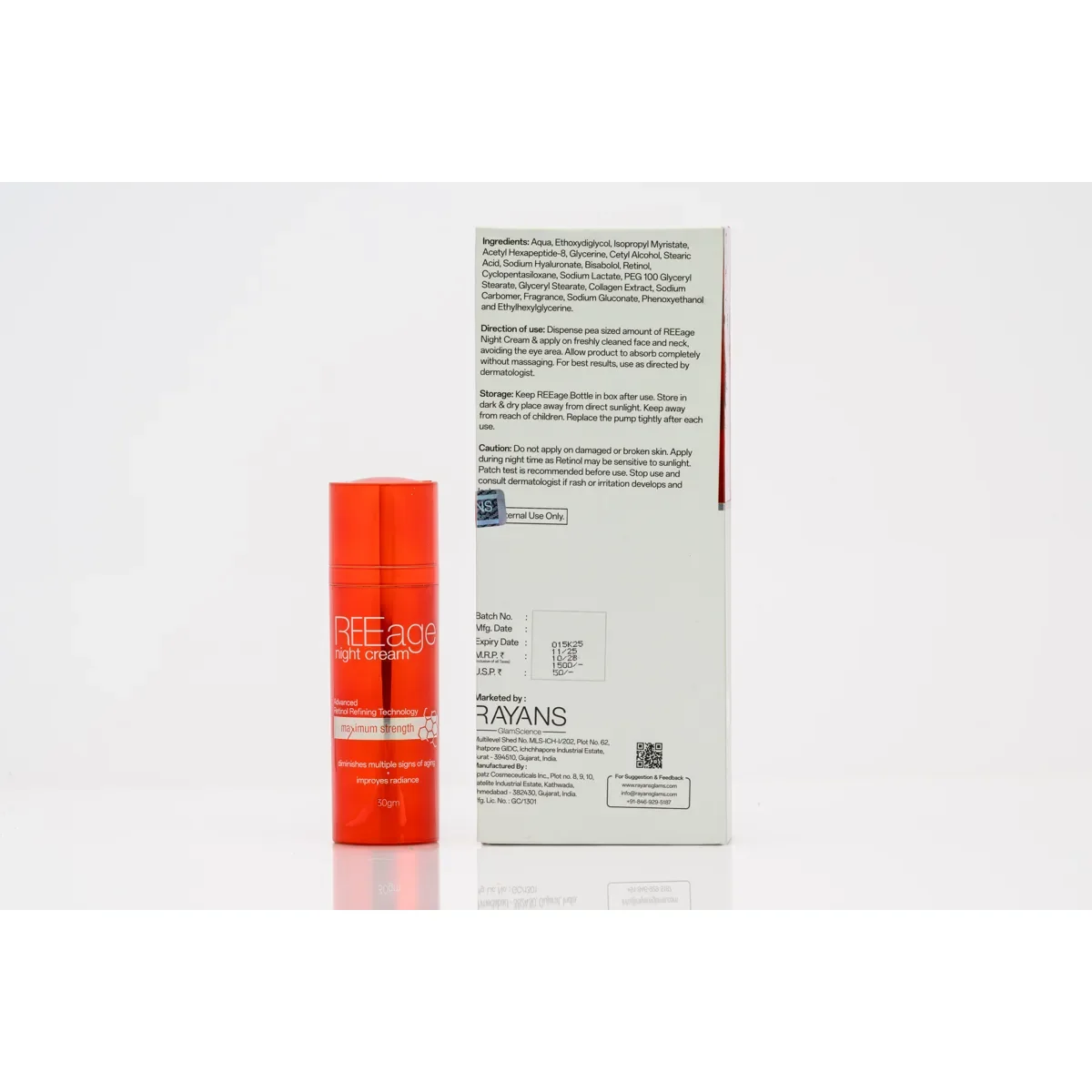
REEAGE NIGHT CREAM
RAYANS
30G
Clinical Efficacy Markers
- Acetyl Hexapeptide-8
- Bakuchiol
- Retinol
The Science of Anti-Pigmentation
RAYANS REEAGE NIGHT CREAM (30G)
Drug Facts
Aqua, Ethoxydiglycol, Isostearyl Myristate, Acetyl Hexapeptide-8, Glycerine, Cetyl Alcohol, Stearic Acid, Sodium Hyaluronate, Bakuchiol, Retinol, Cyclopentasiloxane, Sodium Lactate, PEG 100 Glyceryl Oleate, Glyceryl Stearate, Collagen Extract, Sodium Carbomer, Fragrance, Sodium Gluconate, Phenoxyethanol and Ethylhexylglycerin
⚑ Contains photosensitising ingredient(s) — pair with SPF 50+.
INGREDIENT · RETINOID, VITAMIN A DERIVATIVE
Retinol
also known as Vitamin A, Retinyl Alcohol
Function
May help support skin cell turnover, collagen synthesis, and reduction of fine lines and wrinkles through vitamin A receptor activation
How it works
Retinol undergoes metabolic conversion to retinaldehyde and retinoic acid, which bind to nuclear retinoid receptors (RAR and RXR) in keratinocytes and fibroblasts. This activation has been shown to upregulate genes involved in collagen synthesis, cell proliferation, and differentiation while potentially downregulating matrix metalloproteinases. Research indicates retinol may also support mitochondrial function and counteract photo-oxidative stress in dermal fibroblasts through multiple signaling pathways including those related to cellular senescence.
⚑ For Indian skin (Fitzpatrick IV–VI)
Retinol may carry heightened irritation risk in Fitzpatrick IV-VI skin types and requires cautious introduction due to increased melanin content and barrier sensitivity. Post-inflammatory hyperpigmentation (PIH) is a significant concern in Indian skin populations; initiation at lower concentrations (0.25%) with gradual titration over 4-8 weeks is recommended. In Kerala's tropical, humid climate with high UV exposure, concurrent use of broad-spectrum SPF 50+ UVA/UVB sunscreen is mandatory to prevent photodamage and mitigate PIH risk. Formulations should incorporate stabilizing technologies (such as ethosomes or encapsulation systems) to reduce irritation potential while enhancing permeation without overwhelming the skin barrier. Night-time application and alternating frequency (2-3 times weekly initially) may help minimize sensory irritation and erythema in darker skin phenotypes.
Effective concentration
0.25–1 % w/w (optimal ~0.5% w/w)
Clinical evidence
Studies indicate that ethosomal encapsulation of retinol using TPGS modification substantially reduces degradation rates at room temperature while maintaining particle size stability. Research suggests that optimized ethosomal formulations with binary alcohol systems can achieve enhanced transdermal permeation and drug loading capacity, potentially addressing retinol's chemical instability limitations. Incorporation of antioxidants has been shown to further improve stability profiles of retinol-containing delivery systems.
et al. AAPS PharmSciTech. 2026. PubMed →
Research indicates that retinoids including retinol remain the gold standard for topical anti-aging treatments, though their application is frequently limited by skin irritation and poor tolerability, particularly in sensitive or aged populations. Studies suggest comparative efficacy between retinol and plant-based alternatives can be evaluated through transcriptomic analysis and collagen synthesis assays in both 2D and 3D skin models. Evidence indicates that retinol's irritation profile may be particularly problematic for certain populations, creating clinical demand for refined formulation approaches.
et al. Pharmaceuticals (Basel, Switzerland). 2026. PubMed →
Research indicates that retinol shows promise in addressing dermal fibroblast senescence, which is a central mechanism of skin aging involving telomere shortening, mitochondrial decline, and dysregulation of signaling pathways. Studies suggest retinol's mechanism may involve modulation of pathways such as TGF-β and mTOR signaling to counteract the senescence-associated secretory pattern (SASP). However, retinol remains constrained by transdermal efficiency and cellular targeting limitations that present opportunities for formulation innovation.
et al. International Journal of Molecular Sciences. 2026. PubMed →
Research indicates that retinol has been employed in reconstructed human epidermis models to induce photo-oxidative stress, demonstrating its relevance in studying skin aging mechanisms. Studies suggest that evaluation of anti-aging compounds often involves co-treatment with retinol to assess inflammatory, hydration, proliferation, and barrier-related markers. Evidence indicates retinol's role in photodamage modeling helps elucidate mechanisms of cellular senescence and mitochondrial dysfunction in skin aging pathways.
et al. Biomedicines. 2026. PubMed →
Pairs well with
Tocopherol · Tocopheryl Acetate · Niacinamide · Hyaluronic Acid · Ceramides · Glycerin · Centella Asiatica Extract · Rosmarinus Officinalis Extract
Avoid combining with
Benzoyl Peroxide · Vitamin C (L-Ascorbic Acid) at high pH · AHA/BHA (concurrent use may increase irritation) · Tretinoin · Adapalene · Isotretinoin
INGREDIENT · HUMECTANT, HYDRATING AGENT
Sodium Hyaluronate
also known as Hyaluronic Acid Sodium Salt
Function
May help support skin hydration and moisture retention through hygroscopic properties
How it works
Sodium hyaluronate is a sodium salt of hyaluronic acid that may help bind water molecules in the stratum corneum and dermis, potentially enhancing skin hydration. Research indicates it can penetrate the skin barrier when formulated with appropriate adjuvants and amino acids. Studies suggest the ingredient maintains structural stability during gastrointestinal transit and may exert antioxidant and anti-inflammatory effects when combined with complementary actives. The molecule's ability to modulate CD44 receptor expression has been shown in in vitro keratinocyte models.
⚑ For Indian skin (Fitzpatrick IV–VI)
Sodium hyaluronate has been shown to support hydration in deeper skin tones where transepidermal water loss may be elevated, particularly relevant in Kerala's humid tropical climate where excessive moisture can paradoxically lead to dehydration due to osmotic stress. Research indicates the ingredient does not increase melanin synthesis or phototoxic potential in Fitzpatrick IV-VI skin types. However, formulations should be carefully evaluated as combination products (particularly those with amino acids or cross-linked derivatives) may require stability testing under tropical humidity and heat conditions to prevent degradation. Clinical consideration should be given to post-inflammatory hyperpigmentation risk with injectable formulations in darker skin types, requiring careful injection technique and avoidance of trauma.
Effective concentration
0.1–2 %w/w (optimal ~0.5%w/w)
Clinical evidence
Research indicates that sodium hyaluronate combined with amino acids (glycine, alanine, proline) may enhance moisturizing performance compared to mono-component formulations. Studies suggest this combination strategy may reduce dosing frequency and improve hydration efficacy in skin rejuvenation applications.
Not specified in abstract Journal of Cosmetic Dermatology. 2026. PubMed →
Research suggests that hyaluronic acid derivatives demonstrate high structural stability across gastrointestinal stages and may exert superior antioxidant and anti-inflammatory activity. Studies indicate efficient intestinal barrier penetration without increased enzymatic degradation, with potential upregulation of CD44 receptor expression in keratinocytes.
Not specified in abstract Foods (Basel, Switzerland). 2026. PubMed →
Studies indicate sodium hyaluronate can be successfully formulated in hydrogel systems with complementary ingredients such as xanthan gum, demonstrating adequate physical and microbiological stability over extended storage periods. Research suggests these formulations maintain tunable rheological properties suitable for dermal administration.
Not specified in abstract Gels (Basel, Switzerland). 2026. PubMed →
Pairs well with
Glycerin · Propylene Glycol · Amino Acids (Glycine, Alanine, Proline) · Xanthan Gum · Panthenol · Niacinamide · Ceramides · Lactic Acid
Avoid combining with
High concentrations of alcohol (may cause osmotic dehydration) · Strong chemical exfoliants at high pH (may impair hyaluronic acid stability) · BDDE cross-linked derivatives in certain formulations (safety considerations)