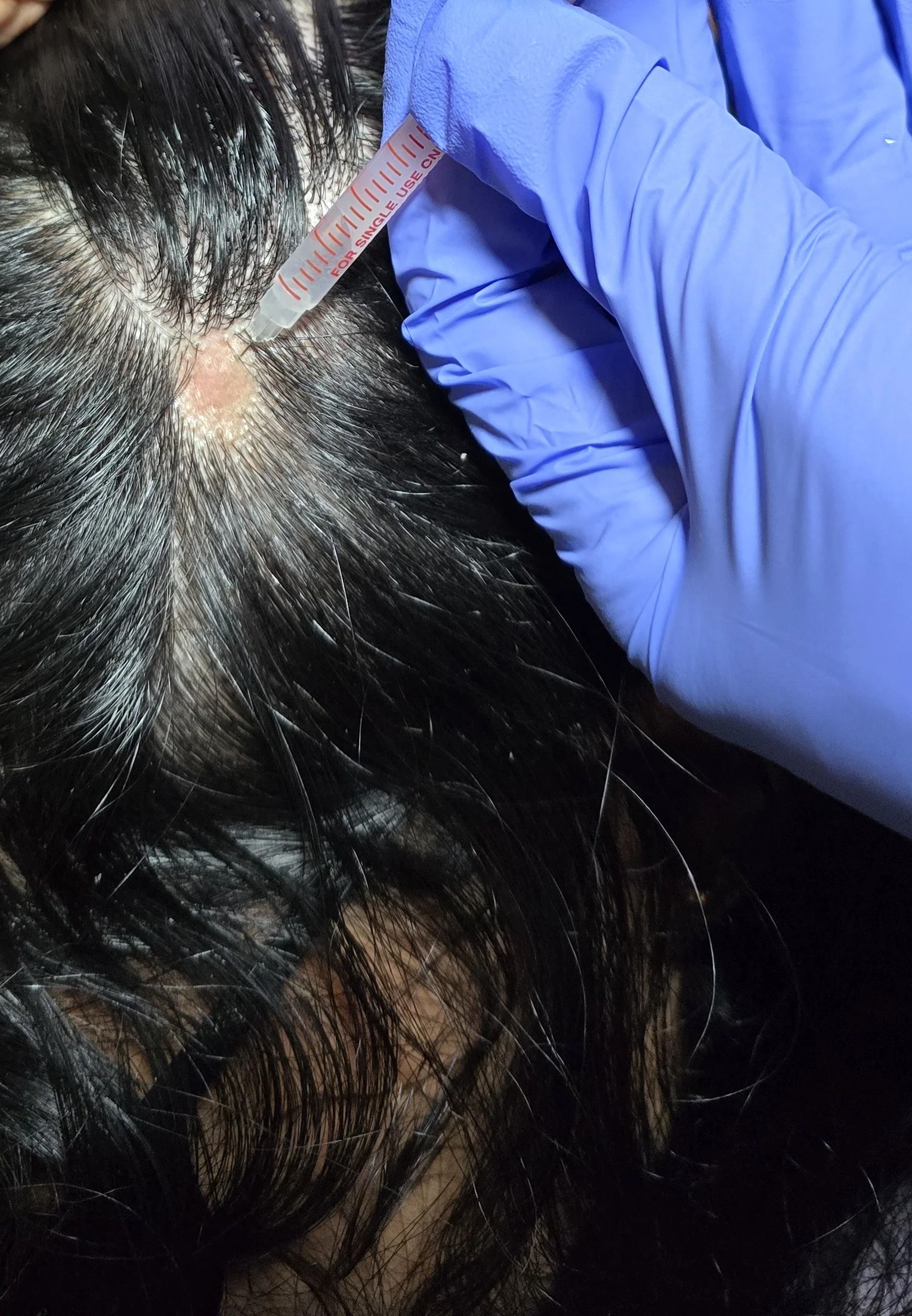
Quick answer: Both GFC and PRP use growth factors from your own blood to stimulate hair follicles. GFC uses a more refined extraction process that produces a higher concentration of growth factors than standard PRP, which makes it a more predictable treatment for most hair loss patients. Both are available at DermaVue Coimbatore. The right choice depends on your specific hair loss pattern and is decided after a clinical assessment.
Hair loss is one of the most common concerns among patients at our DermaVue Gandhipuram clinic. Among the questions we hear most often is this: my doctor mentioned both GFC and PRP. What is the difference and which one should I go for?
It is a reasonable question because the two treatments are often described in the same breath, and some clinics use the terms interchangeably. They are not the same treatment. Understanding the difference helps patients make an informed decision before committing to a course of sessions.
Written by Dr. Sarath Chandran, MD DVL, IADVL-registered dermatologist and Managing Director, DermaVue Clinics. Peer reviewed by Dr. Minu Liz Mathew, MD DVL, Clinical Director, Kochi.
Table of Contents
- What Causes Hair Loss: The Conditions These Treatments Address
- What Is PRP and How Does It Work
- What Is GFC and How Does It Differ from PRP
- GFC vs PRP: A Side-by-Side Comparison
- Who Is a Suitable Candidate
- What to Expect During and After a Session
- When Hair Loss Requires a Different Approach
- GFC and PRP Treatment in Coimbatore
- Frequently Asked Questions
What Causes Hair Loss: The Conditions These Treatments Address
Both GFC and PRP are used for the same set of hair loss conditions. Understanding which condition you have is the starting point for any treatment plan. At our Coimbatore hair loss clinic, the most common conditions we treat with these approaches are:
Androgenetic alopecia (male and female pattern hair loss): The most common cause of hair loss in India. Driven by genetic sensitivity to dihydrotestosterone (DHT), which causes follicles to miniaturise over time. GFC and PRP can slow this progression and stimulate existing miniaturised follicles.
Alopecia areata: An autoimmune condition causing patchy hair loss. PRP and GFC are used as supportive treatments alongside medical management.
Diffuse hair thinning: Often caused by nutritional deficiency, thyroid dysfunction, PMOS (previously called PCOS), or post-illness hair shedding. GFC and PRP support regrowth once the underlying cause is being addressed.
Post-partum hair loss: Diffuse shedding after delivery that persists beyond six months may benefit from these treatments alongside nutritional support.
An important point before comparing the treatments: neither GFC nor PRP works on follicles that have been permanently lost. Both treatments stimulate dormant or miniaturising follicles that are still present in the scalp. This is why early intervention gives better results than waiting until hair loss is advanced.
What Is PRP and How Does It Work
PRP (platelet-rich plasma) is prepared by drawing a small amount of your blood (typically 10 to 20 ml), spinning it in a centrifuge to separate the plasma from red blood cells, and then injecting the platelet-rich layer into the scalp.
Platelets contain growth factors including platelet-derived growth factor (PDGF), vascular endothelial growth factor (VEGF), transforming growth factor (TGF), and insulin-like growth factor (IGF). When concentrated and injected into the scalp, these growth factors stimulate hair follicles that are in a dormant or miniaturising state and encourage them to enter the active growth phase.
The concentration of platelets in PRP depends on the centrifuge protocol, the kit used, and the operator’s technique. This variability is one of the practical limitations of standard PRP. Two PRP sessions done on different days can produce meaningfully different growth factor concentrations depending on how the blood was processed.
What Is GFC and How Does It Differ from PRP
GFC (growth factor concentrate) is a newer refinement of the PRP concept. The preparation process extracts growth factors more selectively, producing a solution with a higher and more consistent concentration of the specific growth factors relevant to hair follicle stimulation.
The key difference is in the extraction process. Standard PRP spins blood to separate plasma from red blood cells and then uses that plasma. GFC goes a step further by using a proprietary extraction process that concentrates the growth factors themselves, rather than using the whole platelet-rich plasma. The result is a solution with higher growth factor concentration and lower contamination from inflammatory cells that can sometimes counteract the regenerative effect.
Evidence for GFC in hair loss is growing. Studies published in peer-reviewed dermatology journals, including in publications tracked by The Lancet group, have shown GFC producing comparable or superior outcomes to standard PRP for androgenetic alopecia with fewer session requirements in some patients. The more consistent growth factor concentration is the primary clinical advantage.
GFC vs PRP: A Side-by-Side Comparison
| PRP | GFC | |
|---|---|---|
| Full name | Platelet-rich plasma | Growth factor concentrate |
| Source | Your own blood | Your own blood |
| Preparation | Centrifuge separation of plasma | Refined extraction concentrating growth factors specifically |
| Growth factor concentration | Variable (depends on kit and protocol) | Higher and more consistent |
| Inflammatory cells | Present in some protocols | Reduced |
| Session count (initial course) | 4 to 6 sessions | 4 to 6 sessions |
| Session spacing | 3 to 4 weeks | 3 to 4 weeks |
| Maintenance | Every 3 to 6 months | Every 3 to 6 months |
| Downtime | Nil to minimal | Nil to minimal |
| Suitable for | Androgenetic alopecia, alopecia areata, diffuse thinning | Androgenetic alopecia, alopecia areata, diffuse thinning |
| Evidence base | Established, widely published | Growing, consistently positive in recent studies |
| Available at DermaVue Coimbatore | Yes | Yes |
Who Is a Suitable Candidate
Good candidates for either GFC or PRP
- Adults with early to moderate androgenetic alopecia (Norwood scale II to V for men, Ludwig I to II for women)
- Patients with alopecia areata who have not responded fully to topical or oral treatment alone
- Patients with diffuse hair thinning where the underlying cause is being treated
- Patients who want to complement or delay hair transplant surgery
- Patients who have had a hair transplant and want to improve density in surrounding areas
Who is likely to get better results from GFC over standard PRP
- Patients who have completed a course of PRP with partial results and want a more concentrated treatment
- Patients with moderate to severe androgenetic alopecia where a higher growth factor concentration is clinically desirable
- Patients who want more predictable session-to-session consistency
Who may not benefit from either treatment
- Patients with advanced hair loss where follicles have been permanently lost across large areas of the scalp
- Patients with active scalp infections or inflammatory scalp conditions that have not been treated first
- Patients on blood thinners or with platelet disorders (assessed at consultation)
For patients with advanced hair loss where GFC and PRP alone will not restore density, a combination approach involving hair transplant surgery at DermaVue Coimbatore is worth discussing at consultation.
What to Expect During and After a Session
Before the session
- Wash your hair normally on the day of the session. Do not apply oil or styling products.
- Inform the dermatologist of all medications, supplements, and any blood-thinning agents you are taking.
- Avoid alcohol for 24 hours before the session.
During the session
- A small amount of blood is drawn from your arm (typically 10 to 20 ml).
- The blood is processed using the centrifuge or GFC extraction kit while you wait (approximately 15 to 20 minutes).
- A topical anaesthetic is applied to the scalp. After it takes effect, the PRP or GFC solution is injected into the scalp using fine needles across the areas of hair loss.
- Total session time is approximately 45 minutes to 1 hour.
After the session
- Mild redness, swelling, or tenderness on the scalp for 24 to 48 hours is normal.
- Avoid washing your hair for 12 hours after the session.
- Avoid direct sun on the scalp for 48 hours.
- Do not apply oil, hair colour, or styling products for 48 hours.
- Some patients notice increased shedding in the first 2 to 4 weeks. This is a normal part of the follicle stimulation cycle and precedes new growth.
When results become visible
Most patients begin to notice a reduction in shedding after the second or third session. Visible improvement in density typically appears from the third or fourth session onward. The full benefit of an initial course becomes apparent 3 to 4 months after the last session in the course.
When Hair Loss Requires a Different Approach
GFC and PRP are not the right first choice for every patient presenting with hair loss. If your hair loss is caused by an underlying medical condition (thyroid dysfunction, iron deficiency, PMOS), treating that condition takes priority. GFC or PRP alongside an untreated underlying cause will produce limited results.
For patients with advanced androgenetic alopecia where large areas of the scalp no longer have active follicles, a consultation about hair transplant surgery at DermaVue Coimbatore is more appropriate. GFC or PRP can be used alongside or after transplant surgery to improve density and support graft survival, but cannot replace surgical restoration where follicles are absent.
If you are currently on minoxidil or finasteride (or dutasteride), GFC and PRP can be continued alongside these medications. Inform the dermatologist of your current hair loss treatment before the session.
GFC and PRP Treatment in Coimbatore
Both GFC and PRP hair treatments are available at our DermaVue Gandhipuram clinic. All sessions are performed or supervised by IADVL-registered MD DVL dermatologists. A clinical hair assessment before the first session determines which treatment is appropriate for your specific hair loss pattern, stage, and history.
| Branch | Address | Phone / WhatsApp |
|---|---|---|
| Coimbatore | 460, Ponnaiyan St, Cross Cut Rd, Ram Nagar, Gandhipuram, Coimbatore, Tamil Nadu 641009 | +91 80868 60018 |
Book a hair loss consultation at our Coimbatore clinic. Visit dermavue.com/locations/coimbatore, call us on +91 80868 60018, or WhatsApp our Coimbatore team.
Related Reading
- PRP and GFC Hair Treatment at DermaVue
- Hair Loss Treatment in Coimbatore
- Hair Transplant in Coimbatore
- DermaVue Coimbatore
Frequently Asked Questions
What is the difference between GFC and PRP for hair loss? Both GFC (growth factor concentrate) and PRP (platelet-rich plasma) use growth factors extracted from your own blood to stimulate hair follicles. The key difference is in the preparation process. PRP uses centrifuge separation of plasma from blood, producing a platelet-rich solution with variable growth factor concentration depending on the kit and protocol. GFC uses a more refined extraction process that produces a higher and more consistent concentration of the specific growth factors relevant to hair follicle stimulation. Both are effective for hair loss. GFC offers more predictable session-to-session consistency.
Which is better for hair loss: GFC or PRP? GFC typically produces a higher growth factor concentration per session than standard PRP, which makes it more predictable. However, both treatments are effective for androgenetic alopecia, alopecia areata, and diffuse hair thinning. The right choice depends on your specific hair loss pattern, stage, and treatment history. A clinical assessment at DermaVue Coimbatore will determine which is more appropriate for your situation.
How many sessions of GFC or PRP are needed for hair loss? Most patients need 4 to 6 sessions of either treatment for the initial course, spaced 3 to 4 weeks apart. After the initial course, maintenance sessions every 3 to 6 months help sustain the results. The exact number of sessions depends on the type and stage of hair loss.
Is GFC or PRP painful? A topical anaesthetic is applied to the scalp before the injections, which significantly reduces discomfort during the procedure. Most patients describe a mild pricking sensation during the injections. Mild tenderness on the scalp for 24 to 48 hours after the session is normal.
How long does it take to see results from GFC or PRP? Most patients notice a reduction in shedding after the second or third session. Visible improvement in hair density typically appears from the third or fourth session onward. The full benefit of an initial course becomes apparent 3 to 4 months after the last session. Some initial shedding in the first 2 to 4 weeks after starting treatment is normal and precedes new growth.
Can GFC or PRP regrow lost hair? GFC and PRP stimulate dormant or miniaturising hair follicles that are still present in the scalp. They can restore density in areas where follicles are weakened or dormant. They cannot regrow hair in areas where follicles have been permanently lost. This is why early treatment gives better results than waiting until hair loss is advanced.
Is GFC or PRP available at DermaVue Coimbatore? Yes. Both GFC and PRP hair treatments are available at our DermaVue Gandhipuram clinic. All sessions are performed or supervised by IADVL-registered MD DVL dermatologists. A clinical hair assessment before the first session determines which treatment is more appropriate for your specific hair loss pattern.
Can I do GFC or PRP alongside minoxidil or finasteride? Yes. GFC and PRP can be continued alongside minoxidil (topical or oral) and finasteride or dutasteride. In many cases, combining a growth factor treatment with medical therapy produces better results than either approach alone. Inform the dermatologist of all hair loss medications you are currently taking before starting treatment.
Authored by Dr. Sarath Chandran, MD DVL, IADVL-registered dermatologist and Managing Director, DermaVue Clinics. Peer reviewed by Dr. Minu Liz Mathew, MD DVL, Clinical Director, Kochi. Published July 2026. This article is for general information and does not substitute a clinical consultation. Individual treatment plans vary based on hair loss type, stage, and medical history.