Hair fall is more than a cosmetic concern - it is an emotional burden that affects self-confidence, professional identity, and quality of life. In my clinical experience treating hundreds of hair loss patients every month at DermaVue Coimbatore, I have observed that Coimbatore’s unique environmental and lifestyle factors create a distinct pattern of hair fall that demands locally informed treatment strategies.
If you are losing more than 100-150 strands daily, noticing visible scalp thinning, or watching your hairline recede, this guide will help you understand the science behind your hair loss and the evidence-based treatments available in Coimbatore today.
Why Hair Fall Is Particularly Common in Coimbatore
Before discussing treatments, it is essential to understand the local factors that make hair fall nearly epidemic in Coimbatore. These factors explain why generic solutions - oil treatments, over-the-counter shampoos, or unregulated supplements - frequently fail.
Hard Water: Coimbatore’s Hidden Hair Hazard
Coimbatore’s water supply contains elevated levels of calcium, magnesium, and other dissolved minerals - a condition classified as “hard water” (typically 150-300+ mg/L total dissolved solids in many areas). Published research in the Indian Journal of Dermatology has shown that hard water exposure reduces hair tensile strength and increases hair breakage compared to deionized water. The mineral deposits create a film on the scalp and hair shaft, blocking follicular openings, causing dryness, and accelerating breakage. Many patients report that their hair fall reduces significantly when traveling to cities with softer water - a consistent clinical observation that confirms the impact.
Clinical recommendation: Consider a water softener or shower filter with ion-exchange resin, and use chelating shampoos (containing EDTA or phytic acid) once weekly to remove mineral buildup.
Climate, Pollution, and Stress
Coimbatore’s warm, humid climate promotes scalp sweating, fungal overgrowth (Malassezia), and seborrheic dermatitis - all contributing to hair fall. Industrial pollution and vehicle emissions deposit particulate matter containing polycyclic aromatic hydrocarbons (PAHs) on the scalp, inducing oxidative stress at the follicular level. A 2019 study published in Environmental Health Perspectives demonstrated that exposure to common air pollutants decreases expression of beta-catenin and other proteins responsible for hair growth and retention.
The city’s growing IT sector and industrial economy create chronic stress - a well-documented trigger for telogen effluvium, where hair prematurely enters the shedding phase 2-3 months after a stressful event.
Understanding Hair Fall: When Should You Worry?
The average person loses 50-100 hair strands daily as part of the natural hair growth cycle. This is physiologically normal. However, you should consult a dermatologist if you notice:
- More than 100-150 strands falling daily consistently
- Visible scalp thinning or widening hair partition
- Receding hairline or temples (particularly before age 35)
- Smooth, round bald patches (suggesting alopecia areata)
- Hair coming out in clumps during washing
- Hair fall accompanied by scalp itching, burning, or flaking
- Hair loss that persists beyond 3 months despite home care
Early intervention is critical. Hair follicles that remain dormant for extended periods undergo miniaturization and may become permanently inactive. The Indian Association of Dermatologists, Venereologists and Leprologists (IADVL) recommends seeking specialist evaluation for hair fall persisting beyond 6-8 weeks, particularly when accompanied by visible changes.
Common Causes of Hair Fall: A Diagnostic Framework
Effective treatment begins with accurate diagnosis. At DermaVue Coimbatore, we use trichoscopy (dermoscopic examination of the scalp at 10-70x magnification) and blood investigations to identify the precise cause before initiating treatment.
1. Androgenetic Alopecia (Male and Female Pattern Hair Loss)
The most common cause worldwide, affecting approximately 50% of men and 25% of women by age 50. Indian studies (Grover, Indian J Dermatol Venereol Leprol, 2009) suggest prevalence rates of 58% in men aged 30-50 years in hospital-based populations. It is genetic, caused by sensitivity to dihydrotestosterone (DHT), which progressively miniaturizes hair follicles.
- Men: Receding hairline, thinning crown (Hamilton-Norwood classification)
- Women: Widening central part, diffuse thinning (Ludwig classification); rarely complete baldness
2. Telogen Effluvium
A temporary condition where physical or emotional stress pushes hair follicles into the resting (telogen) phase prematurely, causing diffuse shedding 2-3 months later. Common triggers in Coimbatore include work stress, COVID-19 infection (post-COVID hair fall remains a frequent presentation in 2026), childbirth, crash dieting, and severe illness.
3. Nutritional Deficiencies
Deficiencies in iron (ferritin less than 40 ng/mL is associated with hair loss), vitamin D (endemic in South India despite abundant sunlight - a 2018 IJDVL study found 70-90% deficiency rates in urban Indian populations), vitamin B12, zinc, and protein directly impact hair follicle cycling. Vegetarian dietary patterns prevalent in Coimbatore increase risk for B12 and iron deficiency.
4. Thyroid Disorders
Both hypothyroidism and hyperthyroidism cause diffuse hair loss. Thyroid hormones regulate the hair follicle cycle at the level of the dermal papilla. Subclinical hypothyroidism, often overlooked, should be investigated with TSH and free T4 in all patients presenting with diffuse hair loss.
5. PCOS-Related Hair Loss
Polycystic ovary syndrome is a leading cause of hair fall in young women in South India. Excess androgens cause scalp hair miniaturization while paradoxically promoting facial and body hair growth. IADVL guidelines recommend screening for PCOS in women with female pattern hair loss, particularly when accompanied by irregular periods, acne, or weight gain.
6. Alopecia Areata
An autoimmune condition causing smooth, round bald patches. Can occur at any age. The IADVL task force notes a prevalence of approximately 0.7-3.8% in Indian dermatology outpatient populations.
7. Scalp Conditions
Dandruff, seborrheic dermatitis, scalp psoriasis, and fungal infections (tinea capitis) damage the follicular environment. Coimbatore’s humidity creates a particularly favorable environment for Malassezia overgrowth.
8. Traction Alopecia
Hair loss from tight hairstyles - ponytails, braids, buns - that mechanically stress follicles. Common in women who regularly tie hair tightly for work or cultural reasons.
Evidence-Based Hair Fall Treatments Available in Coimbatore
At DermaVue Coimbatore, we offer a comprehensive range of treatments graded by evidence strength. The right treatment depends on your specific diagnosis, severity, and goals.
Medical Management (Evidence: Strong)
For early-stage androgenetic alopecia:
- Minoxidil 5% topical (FDA-approved): Level I evidence from multiple RCTs demonstrating increased hair count and diameter. Available as solution or foam. Common side effect: initial shedding at weeks 2-6 (a positive sign of follicular cycling).
- Finasteride 1 mg oral (men only, FDA-approved): Blocks 5-alpha reductase type II, reducing scalp DHT by ~70%. The landmark Kaufman et al. study (JAAD, 1998; n=1,553) demonstrated significant improvement over 2 years. Not recommended for women of childbearing potential.
- Spironolactone 50-200 mg (women, off-label): Anti-androgen with Level II-III evidence for female pattern hair loss. IADVL guidelines support its use in women with hyperandrogenism.
- Nutritional correction: Iron supplementation (target ferritin >70 ng/mL), vitamin D3 (60,000 IU weekly until replete), biotin 2.5-5 mg/day (evidence limited to deficiency states).
PRP Hair Treatment (Evidence: Moderate)
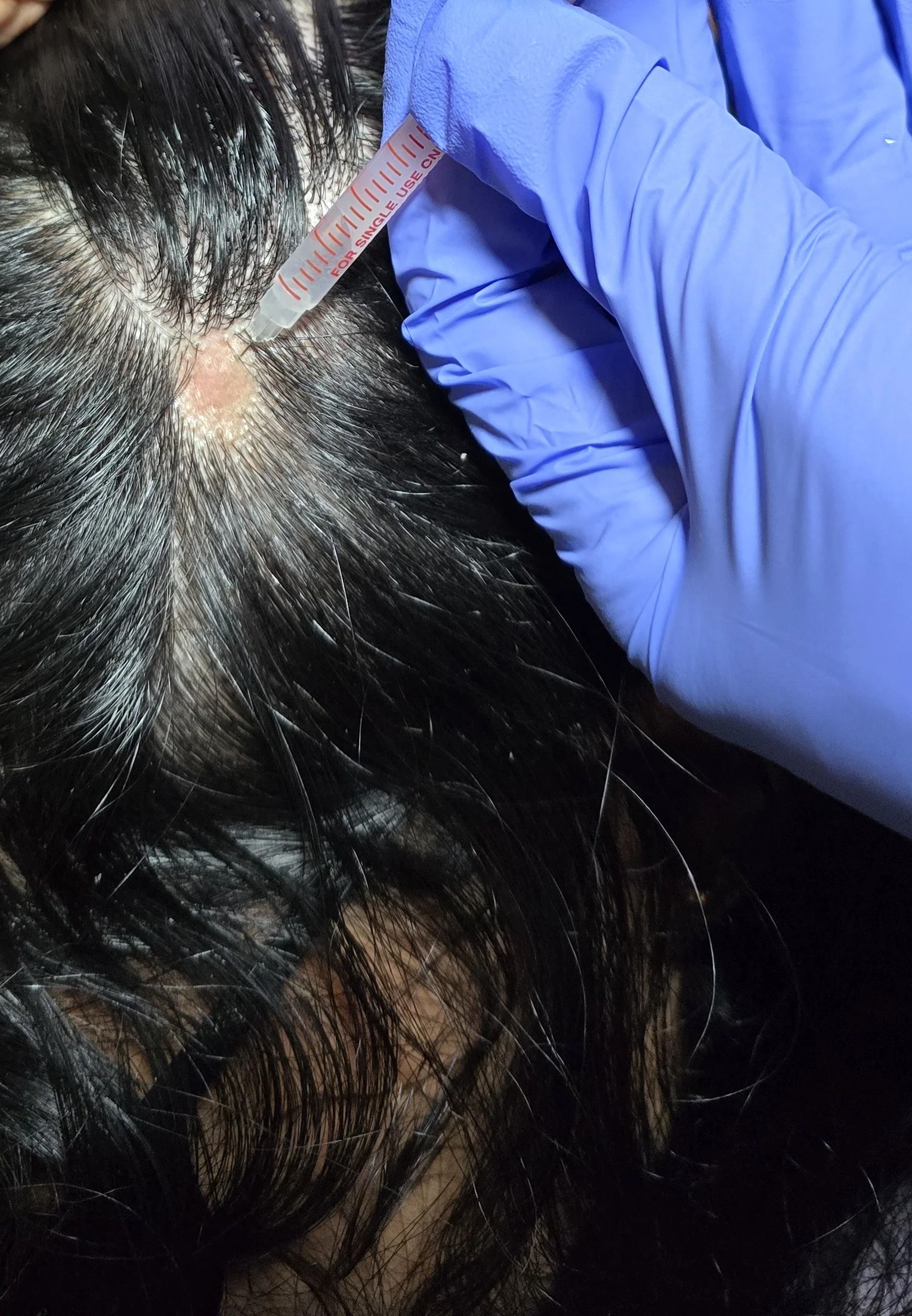
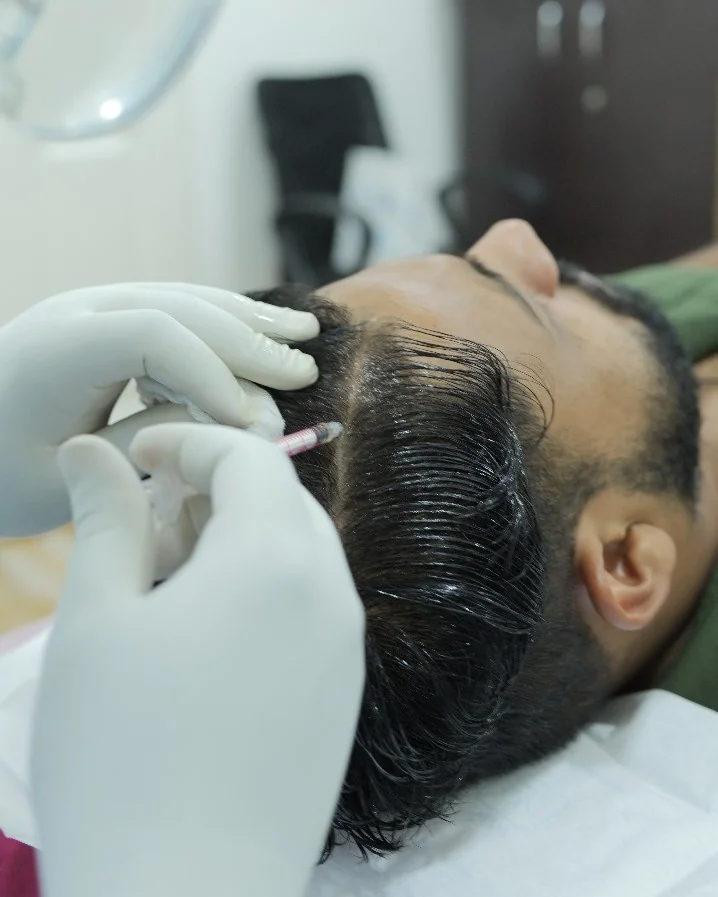
Platelet-Rich Plasma therapy concentrates growth factors (PDGF, TGF-beta, VEGF, EGF) from your own blood and delivers them to the scalp via micro-injections. A 2019 systematic review and meta-analysis in Dermatologic Surgery (Giordano et al.; 11 RCTs) found statistically significant improvement in hair density and thickness compared to placebo. Optimal protocol: 3-4 sessions at 4-week intervals, followed by maintenance every 3-6 months.
GFC Treatment (Growth Factor Concentrate) (Evidence: Emerging)
An advanced preparation that yields higher and more consistent growth factor concentrations than traditional PRP. Preliminary evidence suggests enhanced efficacy, though head-to-head RCTs comparing GFC to PRP are still limited.
Mesotherapy (Evidence: Low-Moderate)
Micro-injections of vitamins, peptides, and medications directly into the scalp. Evidence is heterogeneous - a 2020 systematic review in JAAD found some support but noted significant variability in protocols and outcomes. Best used as an adjunct to established therapies.
Low-Level Laser Therapy (LLLT) (Evidence: Moderate)
FDA-cleared devices using 650-670 nm wavelength photobiomodulation. A 2020 meta-analysis in Lasers in Medical Science (11 RCTs, n=680) demonstrated significant improvement in hair density. Can be used as home-based adjunctive therapy.
Hair Transplant (Evidence: Strong for Appropriate Candidates)
For advanced hair loss (Norwood grade 3+) where medical treatments have not provided adequate results. Modern FUE (Follicular Unit Extraction) technique offers natural-looking results with minimal scarring. Best candidates: stable hair loss, adequate donor area, age preferably above 25.
How to Choose a Hair Clinic in Coimbatore
With numerous clinics offering hair treatments, these criteria help identify quality care:
- Qualified dermatologists (MD DVL or equivalent) - not cosmetologists or technicians performing medical procedures
- Proper diagnosis first - trichoscopy and blood work before treatment, not a one-size-fits-all approach
- Evidence-based treatments - clinics that explain the evidence grade behind their recommendations
- Realistic expectations - ethical practitioners discuss treatment limitations, not just successes
- Transparent pricing - no hidden costs or pressure tactics
Why DermaVue for Hair Fall Treatment in Coimbatore
At DermaVue Gandhipuram, Coimbatore, our approach is diagnosis-first and evidence-based. We use trichoscopy and digital scalp analysis to identify the specific cause before recommending treatment. Every patient receives a personalized treatment plan based on their diagnosis, severity, budget, and goals - from medical management to PRP, GFC, mesotherapy, and hair transplant services.
Our dermatologists are IADVL-registered MD DVL specialists with experience treating the specific hair loss patterns influenced by Coimbatore’s hard water, climate, and lifestyle factors.
Related DermaVue Services
Frequently Asked Questions
Can hair fall be reversed completely?
It depends entirely on the cause and stage. Telogen effluvium (stress-related) and nutritional deficiency hair loss are often fully reversible once the underlying cause is corrected. Androgenetic alopecia can be effectively managed and slowed with evidence-based treatments (minoxidil, finasteride, PRP), though it typically requires ongoing maintenance. Hair transplant offers a durable solution for advanced cases where follicles have permanently miniaturized.
How long before I see results from hair fall treatment?
Most treatments require 3-6 months to show visible results because of the hair growth cycle (anagen phase lasts 2-6 years, telogen phase 2-3 months). Reduced shedding may be noticeable within 4-6 weeks, but new visible regrowth typically takes 3-4 months. Patience and consistency are essential - the IADVL recommends evaluating treatment response at the 6-month mark before considering protocol changes.
Does Coimbatore’s hard water actually cause hair fall?
Yes, it contributes significantly. Research published in the International Journal of Trichology and Indian Journal of Dermatology confirms that hard water reduces hair tensile strength, increases breakage, and alters hair surface texture. While hard water alone may not cause pattern baldness, it accelerates shedding in susceptible individuals and compounds other causes. Water softeners and chelating shampoos can mitigate this effect.
Is PRP treatment painful?
PRP involves micro-injections into the scalp using fine needles. We apply topical numbing cream (lidocaine-prilocaine) 30-45 minutes before the procedure, making it comfortable for most patients. Mild discomfort during injection is normal, and temporary swelling or redness may persist for 24-48 hours. Most patients tolerate the procedure well and return to normal activities the same day.
Can women undergo PRP and hair transplant?
Absolutely. PRP is well-studied and effective for female pattern hair loss. Hair transplant is also possible for women with stable hair loss and adequate donor area, though candidate selection is more nuanced than in men. Ludwig grade I-II female pattern hair loss with good donor density are ideal candidates. A thorough evaluation by a dermatologist experienced in female hair loss is essential before proceeding.
Conclusion: Act Early, Choose Evidence-Based Care
Hair fall is treatable - but timing matters. The earlier you seek qualified dermatological evaluation, the more treatment options remain available and the better the outcomes. Generic home remedies, unregulated supplements, and delay only allow follicular miniaturization to progress.
At DermaVue Coimbatore, we combine accurate diagnosis with evidence-based treatments to help you address hair loss effectively. Whether you need medical management, PRP therapy, or advanced restoration, the journey begins with understanding your specific cause.
Your hair health deserves the same evidence-based approach as any other medical concern. Book a consultation with our dermatology team to start your personalized treatment plan.