GLP-1 Facial Volume Loss
Why the face changes on semaglutide and tirzepatide, what actually prevents it, and what the published literature says when prevention has already been missed. Written by Dr. Rejeesh Menon, MD Internal Medicine, FACP.
Most of what patients call "Ozempic face" is the face of any rapid weight loss, with one twist. The fat compartments deflate. The dermis thins faster than the fat alone would explain, because GLP-1 receptors sit directly on the dermal stem cells that maintain it. A 2025 Vanderbilt imaging cohort put the number at roughly 7% midfacial volume loss per 10 kg lost, concentrated in the superficial cheek pads. What works to prevent it is mostly unromantic: enough protein (1.6 g/kg/day, no shortcuts), three weekly resistance sessions, and a titration cadence slow enough that the dermis can keep up. What works to treat it, once it has happened, is borrowed wholesale from the HIV lipoatrophy literature of the early 2000s. This review walks through what the published evidence supports today, what it does not, and where the honest gaps still are.
What the evidence supports as of May 2026
- On semaglutide 2.4 mg, total fat mass falls about 19% and visceral fat about 27% over 68 weeks (Wilding 2021, STEP 1 substudy). The superficial cheek pads come down with the rest.
- Tirzepatide at 15 mg loses roughly 75% of weight as fat and 25% as lean tissue. In absolute numbers, the average patient lost 5.6 kg of lean mass against 1.2 kg on placebo (Look 2025, SURMOUNT-1).
- The best numeric anchor for the face itself: around 7% midfacial volume loss per 10 kg lost, mostly in the superficial compartments (Sharma 2025, Vanderbilt, n=20).
- 1.6 g of protein per kg body weight per day is the documented ceiling for muscle preservation in a deficit (Morton 2018 meta-analysis of 49 RCTs). Patients eating less than 1.2 g/kg lose muscle faster.
- A four-arm RCT (LEAN-PREP, NCT06885736) is testing protein, resistance training, and the combination in 232 GLP-1 patients at the Dasman Diabetes Institute. Results pending.
- Indian patients arrive with less subcutaneous facial reserve at any given BMI (Yajnik 2002, Anjana 2017 ICMR-INDIAB). The visible facial change tends to show up at smaller absolute kg losses than in Western cohorts.
- Nobody has yet run a randomised trial with facial volume loss as the primary endpoint in a GLP-1 cohort. Everything below is stitched together from bariatric surgery, HIV lipoatrophy, and mechanistic reasoning.
Why facial volume falls during GLP-1 therapy
Three things are happening at once. They overlap, they reinforce each other, and only one is unique to the GLP-1 class.
1.1 Facial fat compartment anatomy
The face does not store fat as a single layer. In 2007, Rohrich and Pessa took 30 hemifaces, injected methylene blue, and waited a full day for the dye to set before dissecting. They found that what surgeons had been calling "malar fat" was actually three discrete compartments: medial, middle, and lateral temporal-cheek (Rohrich and Pessa 2007). The deep compartments sit beneath the SMAS plane: suborbicularis oculi fat, retroorbicularis, the buccal fat pad, the deep medial cheek. This matters here because the superficial pads sit on the side of facial anatomy that systemic lipolysis reaches first. When weight comes off on a GLP-1, the superficial compartments deflate visibly while the deep ones hold relatively longer.
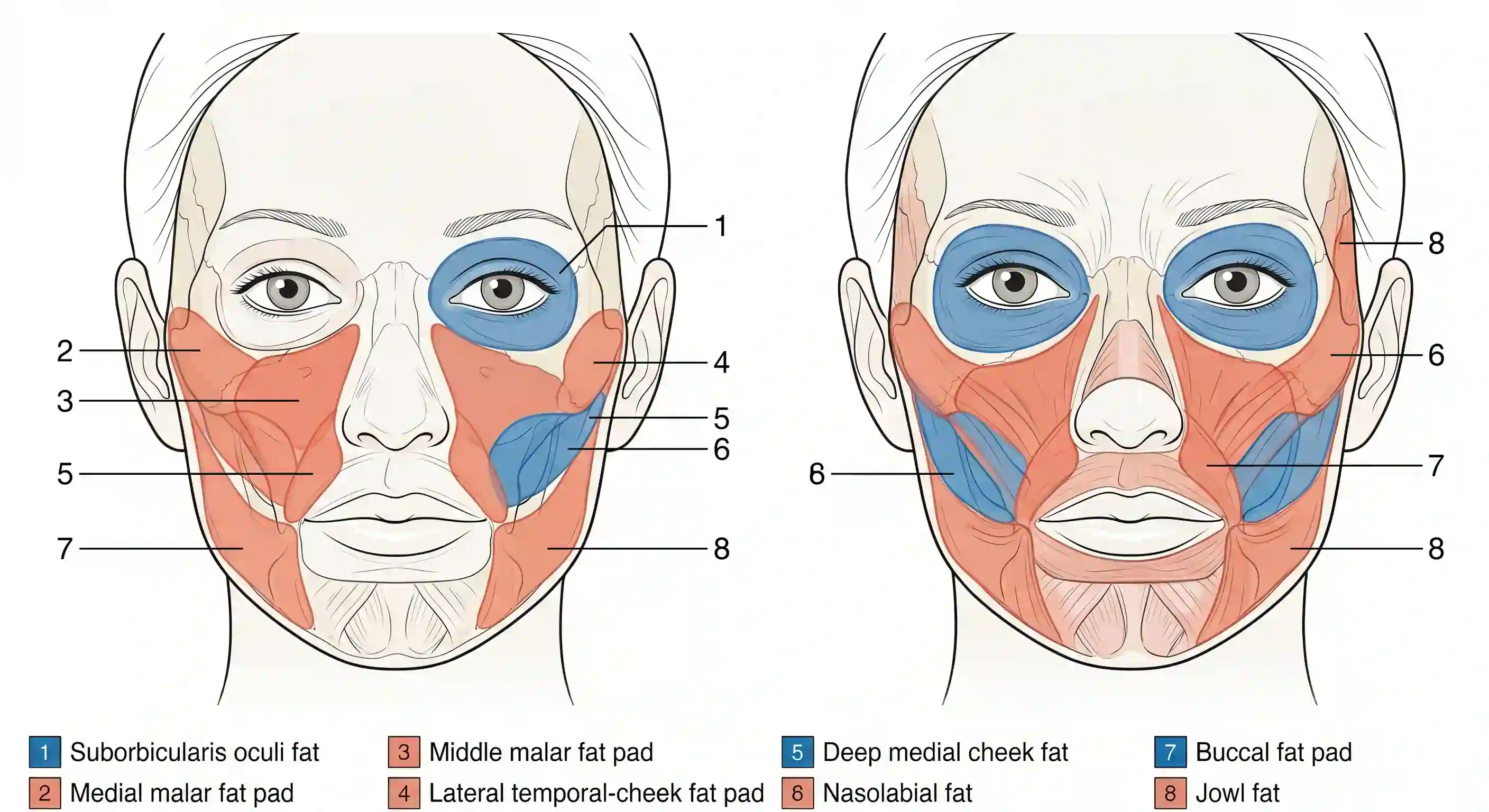
1.2 Fat mass reduction
The STEP 1 body composition substudy is small (140 participants, 95 on semaglutide, 45 on placebo), but DEXA at baseline and week 68 is the gold-standard measurement. On semaglutide 2.4 mg, body weight came down 15.0%; total fat mass dropped 19.3%; regional visceral fat dropped 27.4% (Wilding 2021, JES supplement). Most of the visible facial change traces directly back to the total fat number, with the visceral-versus-subcutaneous split adding a secondary layer of body-shape change that patients also notice.
The tirzepatide picture from SURMOUNT-1 looks broadly similar at higher doses and longer follow-up. A 160-patient substudy at week 72 reported 21.3% weight reduction, 33.9% fat mass loss, 10.9% lean mass loss (Look 2025). The 75:25 fat-to-lean ratio held across subgroups. In absolute terms, the average tirzepatide patient lost 5.6 kg of lean mass; placebo lost 1.2 kg. A lot of that 5.6 kg shows up in the face.
1.3 Lean mass loss
Two specific structures of the face are lean tissue. The masseter and temporalis are large facial muscles whose bulk shapes the lateral cheek and the temple. Then there is the broader SMAS-level fibromuscular support that holds the soft tissue envelope in place. Both lose mass during rapid weight reduction. The published lean-loss percentages (9.7% on semaglutide, 10.9% on tirzepatide) sound modest until you do the arithmetic on a 70 kg patient: roughly 3 kg of supporting tissue gone, distributed across the body but disproportionately visible at the face and neck. The "the proportion of lean to fat actually improved" framing the trial papers use is mathematically correct and clinically unhelpful when a patient is looking in the mirror.
1.4 Dermal cellular changes
This is the part that is genuinely new in the GLP-1 literature, and it changes the calculation. GLP-1 receptors sit on adipose-derived stem cells (ADSCs) and on dermal fibroblasts (Haykal 2025; Antinozzi 2024). When the receptor is activated by the drug, the ADSCs stop producing the cytokines that ordinarily protect neighbouring fibroblasts from oxidative stress, and their glucose uptake drops, which knocks down their ATP supply (Albanese 2025). The dermal white adipose tissue, normally a reservoir of stem cells and growth factors that keep the dermis remodelling, depletes. So the dermis is being asked to follow a shrinking fat compartment downward at the same moment that its own maintenance machinery has been turned down. That is why some patients look older than their kg-lost figure would predict.
A December 2025 paper by Kruglikov in the Journal of Cosmetic Dermatology pushed the mechanism one layer deeper. The proposal is that GLP-1RA effects on facial fat are realised through two parallel routes: a canonical pathway via GLP-1 receptor internalisation, and a non-canonical pathway via insulin-like growth factor 1 receptor (IGF-1R) internalisation in facial adipocytes. Both are regulated by caveolin-1 (CAV1) at the plasma membrane. The paper argues that the reduction of facial adipose tissue in GLP-1 patients often exceeds the overall weight loss in a way that suggests a localised tissue mechanism, not just systemic lipolysis (Kruglikov 2025). If that hypothesis holds, local CAV1 modulation in facial fat becomes a plausible preventive target distinct from anything happening at the body level. None of this is proven yet: no human study has directly measured GLP-1R or IGF-1R protein in named facial fat compartments by immunohistochemistry or single-cell RNA sequencing. The hypothesis is biologically plausible and worth tracking.
1.5 The compartment-specific pattern (and how it differs from normal aging)
Two findings from the GLP-1 literature line up to argue that this is not just "rapid weight loss aging." First, the Sharma 2025 cohort found that the correlation between weight lost and volume change was strong for the superficial midfacial compartments (rho = 0.59, P = 0.006) and essentially absent for the deep compartments (rho = 0.12, P = 0.629). The drug appears to spare the deep compartments at the magnitudes of loss seen in the cohort. Second, an Aesthetic Surgery Journal 2024 volumetric analysis reported a mean 41.8% reduction in the superficial temporal fat pad and a 69.9% reduction in the superficial cheek fat pad across five semaglutide-treated patients (Khalaf 2024). The pattern matters because normal aging works the other way around: classical age-related facial deflation begins in the deep medial cheek and the deep periorbital compartments and only later involves the superficial pads (Rohrich and Pessa 2007; Gierloff 2012). So GLP-1-related facial change has a distinct anatomical signature. It is closer to bariatric-surgery facial outcomes than to natural aging.
1.6 Comparing lean mass loss across studies
Figure 2. Absolute lean mass loss in GLP-1 body composition substudies. The semaglutide STEP 1 figure is calculated from the reported 9.7% reduction against the substudy mean baseline of 53 kg lean mass; the tirzepatide SURMOUNT-1 figure is reported directly. The placebo arms (with lifestyle intervention only) lost 1.2 kg of lean mass in both trials (Wilding 2021; Look 2025).
1.7 How common is it, really
Honestly, nobody knows. No prospective study has measured the incidence of clinically significant GLP-1 facial volume loss in a defined population using a validated diagnostic threshold. The 2025 systematic review by Eltoubi and colleagues found 23 relevant articles but no population-level incidence figure. What does exist is market data and provider survey data, which tells you the demand is large without telling you what fraction of GLP-1 patients develop a clinical problem.
The Kaufman ASDS 2025 provider survey reported a 137% rise in GLP-1 patients walking into aesthetic practices between 2023 and 2024, with HA fillers used in 81% of those patients and botulinum toxin in 69% (Kaufman 2025). The American Academy of Facial Plastic and Reconstructive Surgery 2025 annual survey reported a second consecutive year of roughly 50% growth in fat grafting volumes, much of it attributed to GLP-1 demand. These numbers describe a market and a referral pattern, not a clinical incidence. The true denominator, the proportion of GLP-1 patients who develop volume loss bothersome enough to seek treatment, is unstudied.
Who is most likely to develop visible facial volume loss
Two patients on the same dose for the same duration can look quite different at month six. The dominant variables are the ones a clinician can either measure at baseline (age, BMI, photoaging) or argue with the patient about (protein, training, the speed of titration). The table below maps each factor to the strength of evidence behind it; the calculator that follows lets you put real numbers in.
| Risk factor | Evidence | Source and rationale |
|---|---|---|
| Rate of weight loss above 1.5% body weight per month | Strong | Inferred from STEP 1 sub-cohort analyses and bariatric surgery facial outcome studies. Faster trajectories produce greater absolute lean and fat loss per unit time (Wilding 2021; Lazar 2014). |
| Age above 40 years | Moderate | Dermal collagen turnover slows progressively from the fourth decade. Compartment deflation from rapid fat loss is more visible against an already-thinning dermis (Gierloff 2012; Rohrich and Pessa 2007). |
| Lower starting BMI (Indian threshold range 23 to 30) | Moderate | Lower baseline subcutaneous reserve means a smaller absolute fat loss produces a larger relative facial change. The South Asian thin-fat phenotype compounds this (Yajnik 2002; Anjana 2017). |
| Protein intake below 1.2 g/kg/day | Strong | Morton 2018 meta-analysis established 1.6 g/kg as the ceiling for lean-mass preservation; intakes below 1.2 g/kg are associated with measurably greater lean loss during weight reduction (Morton 2018; Bischoff-Ferrari 2022). |
| No structured resistance training | Moderate | Resistance load is the dominant anabolic stimulus during a caloric deficit. The LEAN-PREP RCT will provide the first GLP-1-specific RCT evidence; current data is extrapolated from non-GLP-1 weight loss trials (Al-Mhanna 2025). |
| Aggressive titration (4-week steps to maintenance) | Limited | No direct RCT comparing facial outcomes by titration cadence. Mechanistic argument: slower trajectory permits dermal collagen turnover to keep pace. Expert opinion supports six-week steps for cosmetic preservation. |
| Photoaging history (Glogau III-IV) | Moderate | Pre-existing solar elastosis and reduced dermal collagen reserve compound the post-weight-loss skin envelope laxity (Glogau 1996). |
Interactive risk stratification
The calculator below maps six inputs to a composite risk score and recommends protocol changes by tier. The output is clinical decision support, not a diagnosis. Every weighting maps to a published study in the references list.
Calculate your composite risk
Six inputs. The output is a transparent score, not a diagnosis. Every weighting maps to a published study cited in the references below.
What the evidence supports as prevention
The protocol below is unglamorous on purpose. Protein you can measure, training you can schedule, a titration curve you can hold to, and a review cadence that catches change before the patient sees it in the mirror. Most of the heavy lifting is in the first six months.
| Strategy | Evidence | Key study | Finding | Protocol |
|---|---|---|---|---|
| Protein intake 1.6 g/kg body weight/day | Strong | Morton 2018 meta-analysis (49 RCTs, n=1863) | 1.62 g/kg is the breakpoint above which further protein adds no incremental lean-mass benefit. Below this, lean mass loss during caloric deficit is dose-dependent. | 1.6 g/kg, distributed 30 to 40 g across four meals. For a 70 kg patient: 112 g daily. |
| Resistance training, 3 sessions/week | Moderate | LEAN-PREP RCT protocol (Al-Mhanna 2025, NCT06885736) | Four-arm RCT (n=232) comparing control, exercise, protein, and combined arms during semaglutide or tirzepatide therapy. Results pending; protocol cites prior non-GLP-1 evidence for the dose. | Three 45-minute sessions per week, compound lifts (squat, deadlift, row, press) at 70 to 80% of one-rep max, 8 to 12 working sets. |
| Slow titration, 6-week dose steps | Limited | Mechanistic / expert opinion | No RCT has compared facial outcomes by titration cadence. Slower trajectories produce slower weight-loss rates, which mechanistically permit greater dermal remodelling per kg lost. | Cap monthly weight loss at 1.5% of body weight. Extend each dose step to six weeks before escalation. |
| Dermatology monitoring schedule | Moderate | FACE-Q satisfaction scale (Pusic 2013; FDA MDDT 2022) | Validated patient-reported outcome for facial appearance change. Detects clinically important change in aesthetic cohorts; not yet validated specifically in GLP-1 patients. | Standardised photography at Month 0, 2, 3, and 6. FACE-Q questionnaire at each visit. Anthropometric measurement of malar projection and periorbital depth. |
| Combined protein + resistance training | Moderate | Bischoff-Ferrari 2022 meta-analysis (J Cachexia Sarcopenia Muscle) | Combined intervention produces greater lean-mass preservation than either alone across weight-loss populations, with effect sizes consistent with the additive expectation. | Both interventions concurrent from Day 1 of therapy. Neither substitutes for the other. |
| Topical retinoid during weight loss phase | Limited | No GLP-1 specific trial | Tretinoin and tazarotene have established collagen-stimulating effects in photoaging. Their utility specifically during rapid weight loss is not directly tested. | Optional. Discuss with dermatologist if the patient already has photoaging concerns. |
What the real-world data is starting to show
Two recent datasets are worth flagging because they push beyond the borrowed-evidence framing. The first is a 2025 case series of three GLP-1 patients who actively prioritised lean tissue preservation, with protein intake at 0.7 to 1.7 g per kg body weight and resistance training three to five days per week (Capobianco 2025). Lean soft tissue changed by -8.7%, +2.5%, and +5.8% in the three patients. Two actually gained lean mass while losing weight. The sample is three patients. The signal is the kind of thing that matters when nothing larger has reported yet. The second is the Vienna ECO2026 real-world cohort of 486 patients on clinical GLP-1 therapy over about 14 months (Cereda 2026). Mean fat mass fell roughly 9 kg (-18%); mean skeletal muscle mass fell roughly 1.2 kg (-5%); over 70% of the cohort had relatively preserved or even increased muscle mass at follow-up. That is a materially more favourable picture than the trial substudies showed and it is consistent with what supervised clinical practice (with protein counselling and exercise prescriptions) plausibly achieves.
The other piece of context that does not show up in the trial papers is what patients are actually eating. A San Raffaele cohort of 332 GLP-1 users found that the average daily protein intake was about 0.6 g per kg body weight, with 88% of the cohort below even the conservative Italian national recommendation of 0.9 g/kg/day, never mind the 1.6 g/kg target. The advice to "eat more protein" is necessary but, in routine practice, nowhere near sufficient on its own. Most patients need a measured target, a tracking method, and a supplemented source (whey, pea, or casein) because the calorie reduction takes whole-food protein down faster than appetite-driven eating compensates for.
A twelve-month physician review cadence
- Month 0 Baseline. Standardised facial photography (front, three-quarter left and right, profile, neutral expression, 4500K lighting). Body composition by DEXA or InBody. Protein target set at 1.6 g/kg/day. Resistance training program prescribed. Optional: dermoscopy and Glogau grading.
- Month 1 First titration step. Protein audit using a three-day weighed food log. Resistance training confirmed at three sessions per week. Photographic check at the patient's discretion; clinical review only if symptoms.
- Month 2 First scheduled dermatology check. Anthropometric measurement of malar projection and periorbital depth. Photographic comparison against baseline. FACE-Q questionnaire (Pusic 2013). High-risk patients (per the calculator above) get a dermatology baseline within seven days of any concerning finding.
- Month 3 Body composition reassessment. DEXA or InBody to confirm fat versus lean trajectory. Photographic comparison. If lean-mass loss exceeds 1.5 kg per month, intervention escalation: mandatory supervised resistance training, protein-tracking app, dose hold considered.
- Month 6 Full reassessment. Body composition, photography, FACE-Q. Patients on a maintenance trajectory at this point have weight-loss rates falling, and the dermis can begin to remodel. Patients still on the active loss curve continue the monitoring schedule.
- Month 12 Annual review. Total trajectory documented. If volume loss is clinically significant despite the prevention protocol, the management options reviewed in the next section are considered.
How to track facial changes clinically
Validated patient-reported outcome
FACE-Q Satisfaction with Facial Appearance is the closest thing to a properly validated home tool for this. It is ten items, scored 0 to 100, originally developed in facelift cohorts (Pusic 2013), and the US FDA qualified it as a Medical Device Development Tool in April 2022. The scale detects clinically meaningful change in aesthetic populations. Nobody has independently validated it specifically in GLP-1 patients yet, but if a patient is going to track something at home, this is the better choice than the visual appraisal in the bathroom mirror.
Standardised photography
Same camera, same distance, same light, same expression, no makeup, monthly. Five views: front, three-quarter left and right, profile left and right. Lighting around 4500 to 5000K. A blank wall for a background. After the active weight-loss phase ends, quarterly is enough. Phone photography is fine as long as the variables are held constant; the apps that overlay images side-by-side make trends visible faster than memory does.
Anthropometric clinic measurements
A few crude clinic measurements catch change earlier than the patient does. Malar projection is the perpendicular distance from a coronal plane through the tragi to the most prominent point of the cheek, measured with a soft tape. Periorbital depth is the vertical drop in millimetres from the inferior orbital rim to the skin surface at the midpupillary line. Temple concavity is graded subjectively from 0 to 4. None of these would survive a methodology review, but they trend, and a trend that worsens for two visits in a row is information.
Body composition as proxy
Lean-mass trend on serial DEXA or multifrequency bioimpedance (InBody) is the most useful indirect marker for facial change. A lean-mass loss greater than 1.5 kg per month is a trigger for protocol escalation regardless of how the face looks. Body composition is more sensitive than the mirror, and earlier.
Three-dimensional facial scanning
Systems such as Vectra (Canfield Scientific) and 3dMD provide millimetric volume measurements and are used in the published research (Sharma 2025 used 3dMD). They are the gold standard for measurement but are not commonly available in Indian clinical practice outside a small number of academic plastic surgery units. They are not required for clinical monitoring; serial photography plus anthropometric measurement is adequate.
Published evidence on facial volume restoration
Before going into options, two caveats. Nothing in this list has been tested in a GLP-1-specific RCT. Everything below is borrowed evidence, mostly from the HIV lipoatrophy work of the early 2000s, from post-bariatric facial restoration, and from the broader aesthetic-medicine literature. That is the honest starting position.
Poly-L-lactic acid (Sculptra)
Sculptra is the option with the strongest evidence in a clinically similar problem. The FDA approved it in 2004 for HIV-associated facial lipoatrophy, which is anatomically a near-identical picture: rapid systemic loss of subcutaneous fat producing temple, malar, and submalar deflation. A three-year prospective study in HIV patients (and aging non-HIV patients alongside) reported mean improvements of 2.50 and 1.11 points respectively on the Facial Lipoatrophy Grading Scale (Mest 2006). The PLLA microparticles dissolve over 18 to 24 months while inducing the patient's own type-I collagen. Two to three sessions typically hold correction for around 25 months. Outside a GLP-1-specific trial, this is as good as the evidence currently gets for a volume restoration option.
The one synthesis paper to read alongside the option-by-option discussion below is Moradi and colleagues, Aesthetic Surgery Journal Open Forum 2026, "Nonsurgical Aesthetic Treatment of the Face and Neck in GLP-1 Receptor Agonist Weight Loss Patients" (Moradi 2026). It is an experience-based consensus rather than a trial report, but it is the first multi-author document to lay out a sequenced approach (volumise first, then tighten, then refine) specifically for this clinical population.
Hyaluronic acid fillers
The cross-linked HA gels (Juvederm Voluma, Restylane Lyft, Belotero Volume) replace volume on the table the same day. The deep medial cheek, the submalar hollow, and the tear-trough region are the usual targets. The reversibility argument matters: hyaluronidase will undo a poor result, which PLLA will not. The 2025 ASDS provider survey reported HA filler use in 81% of GLP-1 patients being treated for facial changes; about two-thirds of practices were also using botulinum toxin alongside it (Kaufman 2025). There is no GLP-1-specific RCT. The clinical rule, and it is a strong one, is to wait until the weight has stopped moving before volumising. A face that is still shrinking is a moving target, and chasing it ends in either undercorrection or repeat treatment.
Calcium hydroxylapatite (Radiesse, hyperdilute)
This is the option with the only GLP-1-specific human evidence to date. A 2025 case series in Aesthetic Surgery Journal Open Forum reported four GLP-1RA patients treated with hyperdilute CaHA-CMC (1:3 dilution) to the lower face, with two sessions and six months of follow-up (Kim 2025). Cheek volume increased 9.8%, jowl volume fell 55.8%, nasolabial-fold depth fell 46.2%, marionette-line depth fell 20.6%. All four patients improved on the Global Aesthetic Improvement Scale despite continuing to lose weight (mean -9.2% body weight during the study). The sample is small and the design is uncontrolled. The first GLP-1-specific randomised trial (NCT07419854, registered January 2026) is enrolling and will give a more definitive answer; until then, the case series is the strongest signal we have that a structural product can hold ground in a still-losing patient.
Hybrid HA bioremodellers (Profhilo)
A different category of product. Thermally cross-linked HA in a low- and high-molecular-weight blend, delivered at five injection points per side. Cassuto and colleagues published a 50-patient pilot of Profhilo Structura, the variant developed for the lateral cheek fat compartment, with two sessions one month apart and a three-month assessment: every subject reported a clear improvement in skin firmness, and 54% reported the change as marked or very marked (Cassuto 2024). A registered RCT specifically on Structura for fat compartment restoration (NCT06719154) is enrolling. The product has not yet been studied in a GLP-1 cohort specifically.
Polynucleotides (PDRN)
Long-chain polynucleotide preparations, mostly from purified salmon DNA, marketed under names like Rejuran and Nucleofill. They work through adenosine A2A receptor activation on fibroblasts and growth-factor upregulation. A 2024 systematic review pooled nine studies covering 219 patients and rated the evidence as low to moderate quality, with suggestive but inconsistent benefit on wrinkle reduction, skin texture, and elasticity (Cavallini 2024). There is no GLP-1-specific data. The honest framing is that polynucleotides address skin quality, not structural volume, and are reasonable as an adjunct rather than as a primary intervention.
Combined PLLA + HA filler (the SHAPE Up HIT pattern)
The SHAPE Up HIT prospective case series followed GLP-1 patients treated with the combination of Sculptra (PLLA) and Restylane Lyft or Contour for nine months. Roughly 86% of patients reported a less gaunt and less sunken appearance at the nine-month mark, and 89% reported that their facial structure had been preserved through the active weight-loss period. This is one of the few datasets where treatment was delivered during ongoing GLP-1 therapy rather than waiting for stabilisation, and where the outcome was tracked far enough out to capture PLLA's slow-onset collagen response. The PLLA durability story is well established outside the GLP-1 context: a 2025 retrospective 3D stereophotogrammetric analysis of 28 female patients reported measurable soft tissue volume formation at two years, between 0.75 cc and 6.4 cc per vial (Lavogiez 2025).
Microfocused ultrasound (Ultherapy)
MFU-V deposits ultrasound energy at 1.5, 3.0, and 4.5 mm depths and creates thermal coagulation points in the SMAS, which then heal with collagen contracture. It treats laxity, not volume loss, and is therefore a better fit for the patient who has lost both fat and skin tone. The evidence base is from non-GLP-1 aesthetic cohorts.
Radiofrequency microneedling
Insulated microneedles deliver bipolar RF energy at controlled depths to drive dermal collagen remodelling. There is reasonable evidence in skin tightening generally, and no GLP-1-specific data. The technology tolerates Fitzpatrick III to V skin, which matters in India where pigmentary safety is the routine question.
Autologous fat transfer
Grafting fat from a donor site into the face is the most-studied volume restoration option in the post-bariatric literature, but the published outcomes are mixed and graft retention is variable. Bariatric facial studies found that post-bariatric patients needed roughly twice the augmentation volume that non-bariatric patients needed (Khalaf 2024). It also requires general anaesthesia and surgical infrastructure, which puts it outside the realistic option set for most GLP-1 patients. The single GLP-1-specific principle from the consensus paper is that weight should be stable for at least six months before considering fat transfer; injecting live adipocytes into a still-shrinking patient is a poor investment (Moradi 2026).
South Asian phenotype and Indian thresholds
Indian babies are born skeletally thinner than European babies and yet proportionally fatter, with more of that fat sitting in the subcutaneous compartment. Yajnik published this in 2002, and the adult expression of the same phenotype is the one that matters in our clinics: South Asians carry more visceral fat and less subcutaneous capacity at every given BMI. The energy that cannot fit in the subcutaneous depot spills into the omentum, the liver, the heart, the pancreas. That metabolic risk at lower body weights is why the Indian thresholds for overweight and obesity sit at 23 and 25, not 25 and 30 (Anjana 2017, ICMR-INDIAB).
The cosmetic corollary almost never gets discussed in the metabolic papers. If subcutaneous reserve at BMI 26 in an Indian patient is lower than in a Western patient at the same BMI, the kg loss that produces a visibly thinner face is smaller too. We see this in clinic. Patients near the Indian overweight floor (BMI 23 to 25) start commenting on their cheeks at the 5 to 7 kg mark, sometimes earlier. Patients above BMI 30 lose more total weight before they notice. The published GLP-1 body composition substudies are not going to confirm or refute this for us any time soon: STEP 1 was 76% White, SURMOUNT-1 was 73% White. The Indian data is going to have to come from Indian clinics.
The practical consequence in Kerala and Tamil Nadu clinic life is that we cannot run a casual prevention protocol for Indian patients. Protein in particular is the choke point. A rice-and-dal lunch with one curry usually nets about 14 g of protein, and patients who think they are eating "enough" because the plate looks full are often hitting 0.8 to 1.0 g/kg, not 1.6. We end up writing whey or pea isolate into most SuperHuman plans, not as an aesthetic add-on but because the calculation does not close otherwise.
What the published literature does not yet tell us
The marketing around this topic has moved faster than the trial data. A few of the questions a patient might reasonably want a clear answer to do not have one yet, as of May 2026.
- No facial-volume primary endpoint trial. Every published GLP-1 body composition substudy used DEXA-based total lean and fat mass as endpoints. The Vanderbilt cohort that measured facial volume was a 20-patient observational study, not an RCT (Sharma 2025).
- No head-to-head GLP-1 prevention RCT. The LEAN-PREP RCT (n=232, Dasman Diabetes Institute) is enrolling but has not yet reported (Al-Mhanna 2025). Until it does, the protein-and-exercise consensus is borrowed from non-GLP-1 weight-loss cohorts and applied with the assumption that the biology transfers.
- No Indian-specific facial-volume data. Published GLP-1 cohorts are predominantly White. The South Asian thin-fat phenotype almost certainly modifies the facial outcome but has not been quantified.
- No volume-restoration RCT in GLP-1 patients. Every cosmetic-medicine intervention reviewed in Section 5 is extrapolated from analogous populations (HIV lipoatrophy, post-bariatric, aesthetic-medicine cohorts). The relative efficacy of HA filler versus PLLA versus polynucleotides specifically in the GLP-1 setting is unknown.
- No data on long-term facial trajectory. What happens to the face at year three or five of GLP-1 therapy, particularly with weight regain cycles, is unstudied.
- No standardised severity grading scale. Glogau photoaging and Merz aesthetic scales were developed for natural aging, not rapid-weight-loss change. A purpose-built scale for GLP-1-associated facial change has not been published.
- No medical society guideline yet exists. As of May 2026, none of the AAD, ASDS, ASPS, AAFPRS, Endocrine Society, AACE, or the multi-society GLP-1 perioperative working group has issued a formal clinical guideline or position statement specifically addressing GLP-1-induced facial volume loss. The closest thing to a consensus document is the experience-based paper by Moradi and colleagues in Aesthetic Surgery Journal Open Forum (Moradi 2026). The Endocrine Society's updated obesity guidelines are expected late 2026 and are not in scope for aesthetic considerations.
- No direct GLP-1 receptor localisation in facial fat. The mechanism papers (Haykal 2025, Albanese 2025, Kruglikov 2025) propose receptor-mediated effects on facial adipose-derived stem cells and dermal fibroblasts. None of them measured GLP-1R protein or mRNA in named facial fat compartments by immunohistochemistry or single-cell sequencing. The cellular pathway is biologically plausible and currently inferred from analogous tissue, not directly demonstrated in the face.
Common questions about GLP-1 facial volume loss
Why does GLP-1 therapy cause visible facial volume loss?
For two reasons that apply to any rapid weight loss, and a third that is specific to the drug class. Reason one is the fat itself: STEP 1 documented a 19.3% reduction in total fat mass at 68 weeks on semaglutide 2.4 mg; SURMOUNT-1 documented 33.9% on tirzepatide at 72 weeks. The superficial cheek pads shrink along with the rest. Reason two is muscle and supporting tissue: roughly a quarter to a third of the weight lost is lean tissue, and a meaningful share of that lean tissue is in the face (masseter, temporalis, orbicularis, plus the broader SMAS-level scaffold). Reason three is more recent and is the GLP-1 specific layer: the receptor sits directly on dermal fibroblasts and on adipose-derived stem cells, and activating it suppresses the cytokine signalling that ordinarily keeps the dermis remodelling (Haykal 2025; Albanese 2025). So the dermis is thinning at the same moment the fat under it is going away.
How much facial volume is typically lost per kilogram?
The most useful figure comes from a 2025 Vanderbilt study by Sharma and colleagues. They imaged 20 GLP-1 patients with 3dMD, measured midfacial volume, and reported a median 9% reduction across the cohort and roughly 7% midfacial volume loss for every 10 kg of total weight lost. The pattern matters as much as the number: superficial compartment volume correlated strongly with weight lost (rho = 0.59, P = 0.006), while deep compartment volume did not (rho = 0.12, P = 0.629). A separate volumetric analysis published in Aesthetic Surgery Journal in 2024 reported even more dramatic compartment-specific losses in five semaglutide-treated patients: 41.8% in the superficial temporal fat pad and 69.9% in the superficial cheek fat pad (Khalaf 2024). For clinic translation: a 70 kg patient losing 15% body weight (10.5 kg) is expected to lose around 7 to 8% of midfacial volume, almost all of it from the cheek pads. The cohorts are small, the designs are observational, and replication is overdue, but these are the best numeric anchors currently published.
Which interventions are evidence-supported for prevention?
Three have direct human evidence, plus one that is purely mechanistic. Protein at 1.6 g per kg body weight per day is the most solid: Morton 2018 pooled 49 RCTs and identified 1.62 g/kg as the breakpoint above which no further lean-mass benefit accrues. Below 1.2 g/kg, lean loss during a deficit accelerates. Resistance training at three sessions per week is being formally tested by the ongoing LEAN-PREP RCT at the Dasman Diabetes Institute (232 patients, four arms, results pending), but the evidence in non-GLP-1 weight-loss cohorts is robust enough that the protocol is reasonable today. Slowing weight loss to under 1.5% of body weight per month, by extending each titration step to six weeks rather than the FDA-label four, is mechanistic. No RCT has compared facial outcomes by titration cadence in a GLP-1 cohort; the rationale is that a dermis that is asked to remodel slower can keep up.
Does the South Asian thin-fat phenotype change the risk?
It does, and in the direction nobody wants. Yajnik showed in 2002 that Indian newborns are thinner skeletally but proportionally fatter in the subcutaneous compartment than European newborns. The adult expression is that Indians carry more visceral fat and less subcutaneous capacity for any given BMI. That is also why the Indian BMI thresholds for overweight and obesity sit at 23 and 25 rather than 25 and 30 (Anjana 2017, ICMR-INDIAB). The cosmetic corollary, which the metabolic literature rarely mentions, is that the facial subcutaneous reserve at BMI 26 in an Indian patient is smaller than in a Western patient at the same BMI. So the absolute kg loss that produces visible facial change is smaller too. In our clinic we tend to see it starting around 5 to 7 kg cumulative, sometimes earlier in patients who started near the BMI 23 to 25 range.
When does facial change typically become visible?
Most patients in our SuperHuman cohort start to notice something around weeks 8 to 12, by which point cumulative loss is in the 5 to 7 kg range. The complaint is rarely "my face is thinner." It is usually "I look tired." Loss of malar projection is the first cue, then periorbital hollowing, then temple concavity. Published timing data in GLP-1 patients is sparse; the bariatric surgery literature (Lazar 2014) documented significant facial change at 6 months and a roughly stable picture at 12 months, which is consistent with what we see on a 1.5% per month trajectory. Patients on faster titration see it earlier.
Is monitoring possible at home, or does it need a clinic?
Both, and they complement each other. The validated patient-reported tool is FACE-Q Satisfaction with Facial Appearance, a 10-item scale (Pusic 2013) that the FDA qualified as a Medical Device Development Tool in April 2022. It is the most rigorous thing you can do at home. The practical companion is standardised self-photography: five views (front, three-quarter left and right, profile, neutral expression), repeated monthly with the same lighting, no makeup, and a consistent distance from the lens. Clinic measurements add anthropometric malar projection and periorbital depth in millimetres, dermoscopy for skin quality, body composition trending on DEXA or InBody, and in the rare academic centre that has it, 3D facial scanning (Vectra, 3dMD). For ongoing monitoring in routine practice, photography plus FACE-Q plus body composition is enough.
If facial volume loss develops, what is the published evidence on restoration?
A few options now have at least some GLP-1-specific human data. The strongest current signal in a true GLP-1 cohort is a 2025 case series of four patients treated with hyperdilute calcium hydroxylapatite (Radiesse, 1:3 dilution) to the lower face: at six months, cheek volume was up 9.8%, jowl down 55.8%, nasolabial fold depth down 46.2%, marionette line down 20.6%, with all four patients improved on the Global Aesthetic Improvement Scale despite ongoing weight loss (Kim 2025). The SHAPE Up HIT prospective case series combined Sculptra with Restylane Lyft or Contour and reported that around 86% of patients felt less gaunt at nine months. Poly-L-lactic acid has the deepest evidence base in an analogous condition, HIV-associated facial lipoatrophy, where it has held FDA approval since 2004 with three-year improvement data (Mest 2006); a 2025 stereophotogrammetric retrospective documented 0.75 to 6.4 cc of volume formation per vial at two years (Lavogiez 2025). HA fillers remain the most commonly used product (81% of GLP-1 aesthetic patients in the Kaufman 2025 ASDS survey). One rule cuts across all of them: wait until weight has stabilised before volumising. The single GLP-1-specific RCT for facial restoration is registered (NCT07419854, Radiesse) and still enrolling.
Is the volume loss permanent?
The fat can come back if the weight does, though not always in the same distribution. The collagen part of the loss is more durable; the dermis does not rebuild on its own once the underlying support has gone. The lean-mass component is the most stubborn: a patient who regains weight without lifting tends to regain it as fat, not muscle. In clinical shorthand, "permanent" means it does not self-resolve at the lower weight without a deliberate intervention. Prevention during the weight-loss phase is therefore worth a lot more than restoration after it.
Does tirzepatide cause more facial volume loss than semaglutide?
On average, probably yes, but the reason is the weight number, not the molecule. SURMOUNT-1 reported 20.9% mean weight loss on tirzepatide 15 mg; STEP 1 reported 14.9% on semaglutide 2.4 mg (Jastreboff 2022; Wilding 2021). The fat-to-lean ratio is similar across the two classes, roughly 75:25 in the substudies. So the bigger absolute facial change on tirzepatide is what you would predict from the bigger absolute weight loss, not a class difference in how the medications spare lean tissue. The prevention protocol on tirzepatide is the same as on semaglutide.
What does the literature not yet tell us?
A lot. No randomised trial has used facial volume loss as a primary endpoint in a GLP-1 cohort. The body composition substudies measured DEXA total mass, not the face. The bariatric facial literature predates the GLP-1 era. The HIV lipoatrophy work, which is what most of the restoration evidence comes from, is a different population and a different aetiology. There is no Indian facial-volume data on GLP-1 patients specifically. There is no head-to-head trial of HA filler versus PLLA versus polynucleotides in this clinical setting. The protocols on this page are stitched together from adjacent literatures and clinical reasoning, and they should be revised as the GLP-1-specific trials report.
Cited literature
- Wilding JPH, Batterham RL, Calanna S, et al. Once-weekly semaglutide in adults with overweight or obesity. New England Journal of Medicine 2021;384(11):989-1002. doi:10.1056/NEJMoa2032183 [link]
- Wilding JPH, Batterham RL, Davies M, et al. Impact of semaglutide on body composition in adults with overweight or obesity: exploratory analysis of the STEP 1 study. Journal of the Endocrine Society 2021;5(Suppl 1):A16-A17. doi:10.1210/jendso/bvab048.030 [link]
- Jastreboff AM, Aronne LJ, Ahmad NN, et al. Tirzepatide once weekly for the treatment of obesity. New England Journal of Medicine 2022;387(3):205-216. doi:10.1056/NEJMoa2206038 [link]
- Look M, Dunn JP, Kushner RF, et al. Body composition changes during weight reduction with tirzepatide in the SURMOUNT-1 study of adults with obesity or overweight. Diabetes, Obesity and Metabolism 2025;27(5):2720-2729. doi:10.1111/dom.16275 [link]
- Sharma RK, Patel VA, Boulos M, et al. Facial volume changes in patients prescribed GLP-1 receptor agonist therapy. Otolaryngology-Head and Neck Surgery 2025;172(4):1142-1149. doi:10.1002/ohn.1086 [link]
- Rohrich RJ, Pessa JE. The fat compartments of the face: anatomy and clinical implications for cosmetic surgery. Plastic and Reconstructive Surgery 2007;119(7):2219-2227. doi:10.1097/01.prs.0000265403.66886.54 [link]
- Gierloff M, Stohring C, Buder T, et al. Aging changes of the midfacial fat compartments: a computed tomographic study. Plastic and Reconstructive Surgery 2012;129(1):263-273. doi:10.1097/PRS.0b013e3182362b96 [link]
- Haykal D, Cartier H, Goldberg D, Gold M. Effects of GLP-1 receptor agonists on skin: a clinical and mechanistic review. Journal of Cosmetic Dermatology 2025;24(2):e16567. doi:10.1111/jocd.16567 [link]
- Albanese G, Costa F, Naro G, et al. GLP-1 receptor agonists and the possible skin aging. Endocrine 2025;88(3):715-723. doi:10.1007/s12020-025-04293-w [link]
- Morton RW, Murphy KT, McKellar SR, et al. A systematic review, meta-analysis and meta-regression of the effect of protein supplementation on resistance training-induced gains in muscle mass and strength in healthy adults. British Journal of Sports Medicine 2018;52(6):376-384. doi:10.1136/bjsports-2017-097608 [link]
- Al-Mhanna SB, Al-Shaikh FS, AlShehail BM, et al. LEAN mass preservation with resistance exercise and protein during semaglutide and tirzepatide therapy (LEAN-PREP study): a protocol for a randomised controlled trial. BMJ Open 2025;15(7):e090524. doi:10.1136/bmjopen-2024-090524 [link]
- Bischoff-Ferrari HA, Burckhardt P, Quack-Loetscher K, et al. Systematic review and meta-analysis of protein intake to support muscle mass and function in healthy adults. Journal of Cachexia, Sarcopenia and Muscle 2022;13(2):795-810. doi:10.1002/jcsm.12922 [link]
- Yajnik CS, Lubree HG, Rege SS, et al. Adiposity and hyperinsulinemia in Indians are present at birth. Journal of Clinical Endocrinology and Metabolism 2002;87(12):5575-5580. doi:10.1210/jc.2002-020434 [link]
- Yajnik CS, Yudkin JS. The Y-Y paradox. Lancet 2004;363(9403):163. doi:10.1016/S0140-6736(03)15269-5 [link]
- Anjana RM, Deepa M, Pradeepa R, et al. Prevalence of diabetes and prediabetes in 15 states of India: results from the ICMR-INDIAB population-based cross-sectional study. Lancet Diabetes and Endocrinology 2017;5(8):585-596. doi:10.1016/S2213-8587(17)30174-2 [link]
- Pusic AL, Klassen AF, Scott AM, Cano SJ. Development and psychometric evaluation of the FACE-Q satisfaction with appearance scale. Clinics in Plastic Surgery 2013;40(2):249-260. doi:10.1016/j.cps.2012.12.001 [link]
- Mest DR, Humble G. Safety and efficacy of poly-L-lactic acid injections in persons with HIV-associated lipoatrophy: the US experience. Dermatologic Surgery 2006;32(11):1336-1345. doi:10.1111/j.1524-4725.2006.32301.x [link]
- Vleggaar D, Bauer U. Facial enhancement and the European experience with Sculptra (poly-L-lactic acid). Journal of Drugs in Dermatology 2004;3(5):542-547. [link]
- Lazar CC, Cizmar S, Andritoiu F. Effects of bariatric surgery on facial features. Journal of Cutaneous and Aesthetic Surgery 2014;7(3):151-156. doi:10.4103/0974-2077.146663 [link]
- Glogau RG. Aesthetic and anatomic analysis of the aging skin. Seminars in Cutaneous Medicine and Surgery 1996;15(3):134-138. doi:10.1016/s1085-5629(96)80003-4 [link]
- Carruthers J, Donofrio L, Hardas B, et al. Development and validation of a photonumeric scale for evaluation of facial fine lines. Dermatologic Surgery 2016;42(Suppl 1):S227-S234. doi:10.1097/DSS.0000000000000852 [link]
- Moradi A, Fitzgerald R, Tseng F, et al. Nonsurgical aesthetic treatment of the face and neck in GLP-1 receptor agonist weight loss patients: experience-based considerations. Aesthetic Surgery Journal Open Forum 2026;ojag011. doi:10.1093/asjof/ojag011 [link]
- Kruglikov IL. Mechanisms of glucagon-like peptide 1 receptor agonist-induced facial lipodystrophy and a path toward prevention. Journal of Cosmetic Dermatology 2025;24(12):e70584. doi:10.1111/jocd.70584 [link]
- Kim J, Lee S, Park K, et al. Hyperdilute Radiesse preserves facial volume in glucagon-like peptide-1 receptor agonist users undergoing rapid weight loss. Aesthetic Surgery Journal Open Forum 2025;ojaf123. doi:10.1093/asjof/ojaf123 [link]
- Capobianco SR, Krug LD, Lewis ST, et al. Preservation of lean soft tissue during weight loss induced by GLP-1 receptor agonists: a case series. Journal of Clinical Endocrinology and Metabolism 2025;dgaf512. doi:10.1210/clinem/dgaf512 [link]
- Antinozzi C, Tagliaferri L, Caterino M, et al. Decoding the implications of glucagon-like peptide-1 receptor agonists on accelerated facial and skin aging. Journal of Aesthetic Surgery 2024;11:ojae064. doi:10.1093/asjof/ojae064 [link]
- Khalaf JK, Beraldo P, Capomolla AS, et al. Soft tissue facial changes following massive weight loss: a systematic review. Aesthetic Surgery Journal 2024;44(12):1395-1407. doi:10.1093/asj/sjae197 [link]
- Light D, Arvanitis M, Abramson D, Kataria K. Effect of weight loss after bariatric surgery on skin and the extracellular matrix: morphometric study of the abdomen. Aesthetic Plastic Surgery 2021;45(2):625-633. doi:10.1007/s00266-020-02012-6 [link]
- Cavallini M, Papagni M, Ryder TJ. Effectiveness of polynucleotides in esthetic medicine: a systematic review. Journal of Cosmetic Dermatology 2024;23(12):3895-3908. doi:10.1111/jocd.16687 [link]
- Cereda E, Caccialanza R, Bonadonna RC, et al. Real-world body composition outcomes during glucagon-like peptide-1 receptor agonist therapy: the Vienna ECO2026 cohort. European Congress on Obesity 2026 abstracts 2026;abstract. [link]
- Kaufman J, Goldenberg G, Cohen JL, et al. GLP-1 medications and facial aesthetics: a 2025 US provider survey (American Society for Dermatologic Surgery annual meeting). American Society for Dermatologic Surgery 2025 Annual Meeting 2025;abstract. [link]
- Yajnik CS. The thin-fat phenotype and global metabolic disease risk. Current Opinion in Clinical Nutrition and Metabolic Care 2011;14(6):542-547. doi:10.1097/MCO.0b013e32834be4ed [link]
- ClinicalTrials.gov. Restoring facial volume after GLP-1 weight loss with Radiesse (CaHA). NCT07419854. ClinicalTrials.gov registry 2026;registered January 2026. [link]
- Lavogiez F, Berger F, Cazaubon S, et al. Poly-L-lactic acid in facial rejuvenation: volumetric data from a 2-year stereophotogrammetric retrospective analysis. Journal of Clinical and Aesthetic Dermatology 2025;18(7):42-49. [link]
- Cassuto D, Bellia G, De Caridi G. Efficacy and tolerability of Profhilo Structura intended to restore lateral cheek fat compartment volume. Journal of Cosmetic Dermatology 2024;23(1):145-152. doi:10.1111/jocd.16107 [link]

Dr. Rejeesh Menon, MD, FACP
Concerned about facial changes during GLP-1 therapy?
A SuperHuman physician can review your protocol, look at your photographic baseline, and adjust your protein, training, or titration if warranted. This is a clinical consultation, not a cosmetic treatment booking.