You’ve probably heard of Minoxidil. It’s the most widely used hair growth treatment in the world — available over the counter, backed by decades of clinical research, and recommended by dermatologists globally. But here’s the uncomfortable truth: most people using Minoxidil aren’t getting the results they should be getting.
Not because the drug doesn’t work. It does. But because how you use it, when you use it, and what you combine it with makes a massive difference in your results. The gap between mediocre outcomes and life-changing hair regrowth often comes down to a handful of techniques that most people simply don’t know about.
This blog is your complete guide. Whether you’re just starting Minoxidil or you’ve been using it for months without seeing much improvement, these dermatologist-backed hacks will help you get the maximum possible results from every single drop.
What Is Minoxidil and How Does It Actually Work?
Minoxidil was originally developed in the 1950s as an oral medication for severe high blood pressure. During clinical trials, doctors noticed an unexpected side effect — patients were growing hair in places they hadn’t had hair in years. That accidental discovery eventually led to the development of topical Minoxidil as the first FDA-approved treatment for androgenetic alopecia (pattern hair loss) in both men and women.
But how does a blood pressure drug grow hair? The mechanism is multifactorial and, even after decades of research, not completely understood. What we do know is that Minoxidil works through several key pathways.
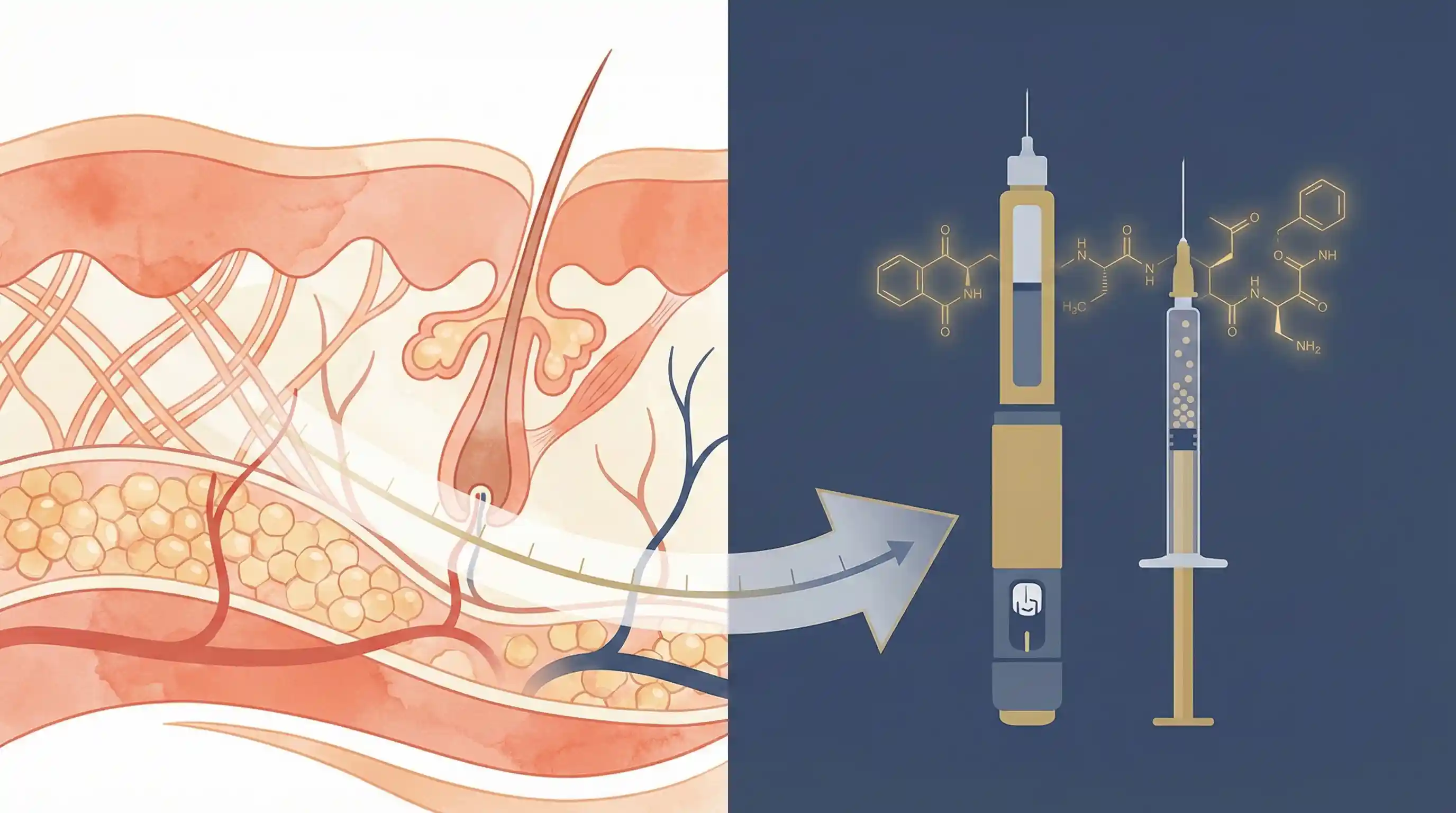
First, it’s a potassium channel opener. Minoxidil opens ATP-sensitive potassium channels in the smooth muscle cells of blood vessels around hair follicles. This causes vasodilation — increased blood flow to the follicle — which means more oxygen, more nutrients, and more growth factors reaching the hair root. Think of it as upgrading the supply chain to a factory that was running on limited resources.
Second, Minoxidil prolongs the anagen (growth) phase of the hair cycle. Every hair on your head goes through a cycle — anagen (active growth, lasting 2–7 years), catagen (transition, 2–3 weeks), and telogen (resting/shedding, 2–4 months). In androgenetic alopecia, the anagen phase gets progressively shorter with each cycle. Hairs that once grew thick and long for years now grow thin and short before falling out. Minoxidil pushes follicles back into a longer anagen phase, giving hair more time to grow thicker and longer.
Third, it stimulates follicular cell proliferation. Minoxidil upregulates the production of vascular endothelial growth factor (VEGF) and prostaglandin E2 in dermal papilla cells — the command center of the hair follicle. This promotes new cell growth within the follicle itself, essentially reviving miniaturized follicles that were on their way to becoming permanently dormant.
The net result? Thinning, miniaturized hairs gradually become thicker. Dormant follicles that had stopped producing visible hair can be coaxed back into action. And the overall density of hair in treated areas improves measurably over 3–6 months of consistent use.
Who Should Use Minoxidil?
Minoxidil works best for specific types of hair loss. Understanding whether you’re the right candidate is the first step toward getting real results.
Ideal candidates include men with early-to-moderate male pattern baldness (Norwood stages 2–5), particularly those with thinning at the crown or vertex area. Women with female pattern hair loss (Ludwig classification I–II), which typically presents as diffuse thinning along the part line and crown rather than a receding hairline. Individuals with telogen effluvium — temporary excessive shedding triggered by stress, illness, surgery, or nutritional deficiencies — where Minoxidil can accelerate the recovery of normal hair density. And patients who have undergone a hair transplant, where Minoxidil is often prescribed to strengthen native (non-transplanted) hair and optimize overall density.
Minoxidil is less effective for completely bald areas where follicles have been dormant for many years. Traction alopecia caused by tight hairstyles, where the follicle damage is mechanical. Alopecia areata, which is an autoimmune condition requiring different treatment approaches. And frontal hairline recession in men, where Minoxidil shows modest results compared to its effectiveness at the crown.
If you’re unsure about your type of hair loss, consulting a dermatologist near me is essential before starting treatment. A trichoscopy evaluation can reveal whether your follicles are miniaturized (likely to respond to Minoxidil) or scarred and permanently destroyed (unlikely to respond).
The 10 Minoxidil Hacks That Will Transform Your Results
Hack #1: Apply on a Completely Dry Scalp
This is the single most common mistake Minoxidil users make. Applying Minoxidil on a damp or wet scalp after a shower dramatically reduces its effectiveness. Water on the scalp dilutes the concentration of the solution and causes it to run off instead of being absorbed into the follicle.
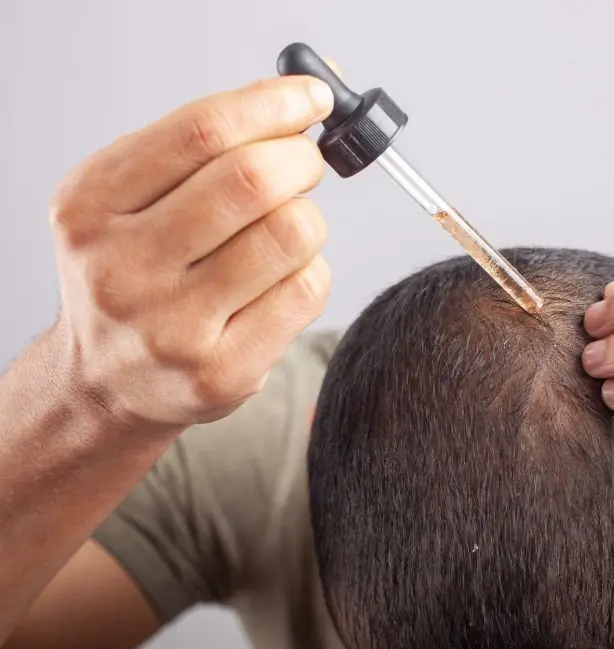
After washing your hair, wait at least 20–30 minutes before applying Minoxidil. Your scalp needs to be fully dry — not towel-dry, not mostly dry, but completely dry. This ensures that the full concentration of Minoxidil (whether 2% or 5%) is delivered directly to the follicle without dilution.
Some dermatologists even recommend using a blow dryer on a cool setting to ensure the scalp is thoroughly dry before application. It’s a small step that makes a measurable difference in absorption and, ultimately, in your results.
Hack #2: Microneedling Is the Ultimate Minoxidil Amplifier
If there’s one hack on this list that separates average results from exceptional results, this is it. Microneedling — using a dermaroller or dermapen at 0.5 mm to 1.5 mm depth on the scalp — creates thousands of controlled micro-injuries that trigger the body’s wound healing response. This releases growth factors (PDGF, EGF, FGF) and stimulates stem cells in the hair follicle bulge area.
But the real magic happens when you combine microneedling with Minoxidil. The micro-channels created by the needles dramatically increase the transdermal absorption of Minoxidil — some studies suggest by up to 4 times. More absorption means more of the active ingredient reaching the dermal papilla where it actually works.
The protocol: Microneedle your scalp once a week (not more — the scalp needs time to heal). Use a 0.5 mm to 1.0 mm needle depth for home use, or 1.0 mm to 1.5 mm if performed by a dermatologist. Wait 24 hours after microneedling before applying Minoxidil to avoid excessive irritation or systemic absorption. On all other days, apply Minoxidil as normal.
A landmark 2013 study published in the International Journal of Trichology compared Minoxidil alone versus Minoxidil plus weekly microneedling. The combination group showed significantly superior hair count and patient satisfaction at 12 weeks compared to Minoxidil alone. This is no longer an experimental hack — it’s evidence-based dermatology.
Hack #3: Nighttime Application Beats Morning
Your body’s repair and regeneration cycle peaks during sleep. Growth hormone secretion, cellular turnover, and scalp blood flow all increase during the night hours. Applying Minoxidil at bedtime allows the drug to work in sync with your body’s natural repair mechanisms.
Apply Minoxidil to your scalp at least 30 minutes to 1 hour before lying down. This gives the solution time to absorb and dry so it doesn’t transfer to your pillow. Leave it on for a minimum of 4 hours undisturbed. Many dermatologists recommend using a silk or satin pillowcase to minimize product transfer and reduce friction on hair.
If you’re using Minoxidil twice daily (the recommended regimen for 5% solution), the morning application is still valuable. But if you can only apply once a day due to lifestyle constraints, make it the nighttime application — you’ll get more bang for your drop.
Hack #4: Don’t Panic During the Shedding Phase
This is where most people quit. And it’s the worst possible time to quit.
Somewhere between weeks 2 and 8 of starting Minoxidil, many users experience a noticeable increase in hair shedding. Hair falls out in the shower, on the pillow, in the comb — seemingly more than before you started treatment. It’s alarming. It feels like the treatment is making things worse.
It’s not. This shedding phase — called “dread shed” in online hair loss communities — is actually one of the strongest signs that Minoxidil is working. What’s happening is this: Minoxidil is pushing dormant telogen (resting) hairs out of the follicle to make room for new, thicker anagen (growing) hairs. The old, weak hairs were going to fall out anyway within the next few weeks. Minoxidil simply accelerates that process.
Think of it like a renovation. You have to tear down the old walls before you can build new ones. The shedding phase typically lasts 2–4 weeks, after which new growth begins to emerge. Patients who push through this phase consistently report the best long-term results. Patients who panic and stop? They lose the weak hairs AND miss out on the new growth that was about to come.
If the shedding is severe or lasts beyond 8 weeks, consult your dermatologist near me to rule out other contributing factors. But in the vast majority of cases, shedding is a positive prognostic sign.
Hack #5: Use the 5% Concentration — Not 2%
Minoxidil is available in two standard concentrations — 2% and 5%. The 2% solution was the original formulation, and for years it was the only option recommended for women. But recent research and clinical practice have shifted significantly.
The 5% concentration has been shown in multiple studies to produce approximately 45% more hair regrowth than the 2% concentration. It works faster, produces denser growth, and has a higher overall response rate. For men, 5% has been the standard recommendation for years. For women, dermatologists increasingly prescribe 5% Minoxidil (typically the foam formulation to minimize the risk of facial hair growth from dripping).
If you’ve been using 2% Minoxidil and seeing limited results, switching to 5% — under dermatologist guidance — could be the upgrade that changes everything.
Foam vs. liquid: The 5% foam tends to cause less scalp irritation than the liquid because it doesn’t contain propylene glycol (a common irritant found in the liquid formulation). Foam also dries faster, is easier to apply, and is less likely to drip onto the forehead or face. For most patients, 5% foam is the preferred choice.
Hack #6: Pair Minoxidil with a DHT Blocker
Minoxidil stimulates hair growth. But it doesn’t address the root cause of androgenetic alopecia — dihydrotestosterone (DHT). DHT is the hormone that binds to androgen receptors in genetically susceptible hair follicles, triggering the miniaturization process that leads to progressive thinning and eventual baldness.
For maximum effectiveness, dermatologists frequently recommend combining Minoxidil with a DHT blocker. For men, this typically means finasteride (oral, 1 mg daily) or dutasteride (oral, 0.5 mg daily), both of which inhibit the 5-alpha-reductase enzyme that converts testosterone to DHT. Topical finasteride is also gaining popularity as it delivers the drug directly to the scalp with significantly lower systemic absorption.
For women, anti-androgen options include spironolactone (oral) or topical formulations containing ingredients like saw palmetto, caffeine, or ketoconazole shampoo — which has mild anti-androgenic properties.
The logic is simple: Minoxidil grows new hair, and DHT blockers protect the hair you still have. Using one without the other is like filling a bathtub with the drain open. Together, they address both sides of the equation.
Important: DHT blockers — especially oral finasteride and dutasteride — are prescription medications with potential side effects. They must be prescribed and monitored by a qualified dermatologist near me or physician. Never self-medicate.
Hack #7: Consistency Is More Important Than Perfection
Minoxidil is not a treatment you use for a few months and stop. It’s a long-term commitment — realistically, an indefinite one if you want to maintain results. Hair regrown with Minoxidil is dependent on continued use. If you stop, the newly grown hair will gradually thin and fall out over 3–6 months, returning you to your pre-treatment baseline.
The biggest predictor of Minoxidil success isn’t the concentration, the brand, or even the combination therapy. It’s consistency. Applying Minoxidil every single day, ideally twice daily, without skipping days. Most treatment failures are actually adherence failures — patients who use Minoxidil sporadically, skip weekends, or stop during travel.
Set a daily alarm. Keep the bottle next to your toothbrush. Build it into your morning and bedtime routine so it becomes as automatic as brushing your teeth. Missing one day occasionally won’t derail your progress. But chronic inconsistency will.
Hack #8: Optimize Your Scalp Environment
Minoxidil needs a healthy scalp to work optimally. If your scalp is inflamed, flaky, clogged with product buildup, or suffering from seborrheic dermatitis, Minoxidil absorption and follicular health are both compromised.
Before or alongside starting Minoxidil, establish a scalp health routine. Use a gentle, sulfate-free shampoo to cleanse without stripping. If you have dandruff or seborrheic dermatitis, use a ketoconazole 2% shampoo 2–3 times per week — it doubles as a mild anti-androgen and anti-inflammatory. Avoid heavy hair oils, serums, or styling products that can clog follicles and create a barrier to Minoxidil absorption. Exfoliate your scalp once a week with a salicylic acid-based scalp scrub to remove dead skin cell buildup.
Think of your scalp as the soil in a garden. You can plant the best seeds (Minoxidil), but if the soil is dry, compacted, and nutrient-poor, nothing will grow properly.
Hack #9: Stack Minoxidil with PRP Therapy
If Minoxidil is the daily medicine, PRP (Platelet-Rich Plasma) therapy is the quarterly booster. PRP uses concentrated growth factors from your own blood — injected directly into the scalp — to stimulate dormant follicles, enhance blood supply, and create an optimal environment for hair regrowth.
The synergy between Minoxidil and PRP is powerful because they work through completely different biological mechanisms. Minoxidil opens potassium channels, increases blood flow, and prolongs the anagen phase. PRP delivers a concentrated dose of PDGF, TGF-β, VEGF, and EGF directly to the follicular microenvironment — growth factors that promote stem cell activation, collagen synthesis, and angiogenesis.
Multiple clinical studies have shown that patients using Minoxidil plus PRP achieve significantly better hair density, thickness, and patient satisfaction scores compared to either treatment alone. At DermaVue, our dermatologists often recommend a protocol of 3–4 PRP sessions (spaced 4 weeks apart) as an initial course alongside daily Minoxidil, followed by maintenance PRP sessions every 3–6 months.
If you’ve been searching for PRP treatment near me or hair fall treatment near me, combining it with your existing Minoxidil regimen could be the breakthrough you’ve been waiting for.
Hack #10: Track Your Progress — Scientifically
This hack sounds simple, but it’s transformative for motivation and adherence. Hair regrowth is slow. You see your hair in the mirror every day, so gradual improvements are almost impossible to notice in real time. This leads to a dangerous perception that “nothing is working” — which leads to quitting.
Fight this with objective documentation. Take standardized scalp photos every 4 weeks — same lighting, same angle, same distance, same time of day. Use your phone’s front camera with a timer, or have someone take the photos for you. Photograph the crown (top-down), the hairline (front), both temples, and the part line.
Compare month 1 to month 3, month 3 to month 6. You’ll be surprised how much has changed when you put the photos side by side. Some patients also track daily hair fall counts (counting hairs in the shower drain or on the comb) to get a quantitative sense of whether shedding is decreasing over time.
At DermaVue, we perform trichoscopy evaluations — a magnified digital analysis of your scalp — at baseline and during follow-ups to objectively measure hair density, follicle count, and hair shaft thickness. This removes all guesswork and gives you hard data on your progress.
Minoxidil — What Most People Get Wrong
Expecting overnight results. Minoxidil takes a minimum of 3–4 months to show visible improvement. Peak results typically appear at 6–12 months. If you’re evaluating effectiveness at 6 weeks, you’re measuring too early.
Using it only on bald spots. Minoxidil works best on thinning areas where follicles are miniaturized but still alive. Completely bald, shiny scalp areas where follicles have been dormant for 5+ years are unlikely to respond. Apply Minoxidil to thinning zones and the areas surrounding bald patches — not just the bald patch itself.
Thinking more is better. Using more Minoxidil than the recommended dose (1 mL of solution or half a cap of foam, twice daily) doesn’t produce faster or better results. It does increase the risk of scalp irritation and systemic side effects like dizziness, heart palpitations, and unwanted facial hair growth. Stick to the recommended dose.
Ignoring underlying causes. Minoxidil treats the symptom (hair thinning) but doesn’t address underlying contributors like thyroid dysfunction, iron deficiency, vitamin D deficiency, hormonal imbalances, or chronic stress. If you’re losing hair, get a comprehensive blood work panel done through your dermatologist near me before assuming Minoxidil alone will solve the problem.
Minoxidil Side Effects — What to Watch For
Minoxidil is generally well-tolerated, but like any medication, it has potential side effects that you should be aware of.
Common side effects include scalp irritation (itching, dryness, flaking) — most often caused by propylene glycol in the liquid formulation, which can be avoided by switching to foam. Initial shedding (the “dread shed” discussed above) lasting 2–6 weeks. And unwanted facial hair growth, particularly in women, caused by accidental transfer of the solution from the scalp to the face via pillow contact or touching.
Uncommon side effects include dizziness or lightheadedness (from the vasodilatory effect if excess product is absorbed systemically), rapid heartbeat or palpitations, and swelling of the hands or feet (fluid retention).
When to stop and consult a doctor: Chest pain, rapid or irregular heartbeat, sudden unexplained weight gain, severe scalp irritation or allergic reaction, and any side effect that feels concerning.
If you experience side effects, don’t just stop and give up on hair growth. Consult a skin specialist near me — they may adjust your concentration, switch you from liquid to foam, reduce frequency to once daily, or explore alternative treatments.
The DermaVue Approach to Hair Restoration
At DermaVue, we don’t just hand you a bottle of Minoxidil and send you home. Our approach to hair fall treatment is comprehensive, personalized, and evidence-based.
It starts with a thorough consultation — detailed history, family hair loss patterns, lifestyle assessment, medication review, and relevant blood work. Next comes a digital trichoscopy evaluation to map your current hair density, miniaturization ratio, and follicle health objectively. Based on this data, your dermatologist designs a customized protocol that may include Minoxidil (topical or oral, at the right concentration for your profile), DHT blockers (topical or systemic, where appropriate), PRP therapy, low-level laser therapy (LLLT), nutritional optimization, scalp health management, and — when indicated — hair transplant surgery as a definitive solution.
This multi-modal, dermatologist-supervised approach consistently delivers results that Minoxidil alone cannot match. Because hair loss is rarely caused by a single factor, and the best treatment plans address every contributing element simultaneously.
Start Your Hair Regrowth Journey Today
Minoxidil works. The science is clear. But getting the best results requires the right technique, the right combinations, and the right guidance. Every hack in this blog is designed to maximize the potential of your Minoxidil regimen — but the single most impactful step you can take is getting a professional evaluation from a qualified dermatologist.
If you’ve been searching for a dermatologist near me, a hair fall treatment near me, or the best hair loss clinic near me, DermaVue is South India’s trusted dermatology chain with expert trichologists and advanced hair restoration programs across Kerala and Tamil Nadu.
Written and Reviewed by Dr. Sarath Chandran SR, MD DVL