Quick answer: Eczema (atopic dermatitis) and psoriasis both cause itchy, scaly skin but have different causes and require different treatments. Eczema is caused by a defective skin barrier and environmental triggers - it typically appears on skin folds (inner elbows, behind knees). Psoriasis is autoimmune - it typically appears on the outer surfaces of elbows, knees, and the scalp. The correct diagnosis requires a dermatologist assessment. Using the wrong treatment for the wrong condition can make things worse.
In dermatology consultations across Kerala and Tamil Nadu, the question of eczema versus psoriasis comes up regularly. Patients bring in photographs, descriptions from family members, or diagnoses from non-specialist practitioners. Some have been treating psoriasis with the moisturisers prescribed for eczema. Others have been using topical steroids at doses appropriate only for psoriasis, triggering rebound flares when they stop.
Getting the diagnosis right matters clinically. This post explains the key differences between the two conditions - what causes them, where they appear, how they look on Indian skin, and what the different treatment approaches involve.
Written by Dr. Sarath Chandran, MD DVL, IADVL-registered dermatologist and Managing Director, DermaVue Clinics. Peer reviewed by Dr. Minu Liz Mathew, MD DVL, Clinical Director, Kochi.
Table of Contents
- What Eczema Is and What Causes It
- What Psoriasis Is and What Causes It
- Side-by-Side Comparison: Eczema vs Psoriasis
- How Eczema and Psoriasis Look on Indian Skin
- How Each Condition Is Diagnosed
- Treatment for Eczema vs Treatment for Psoriasis
- Common Mistakes Patients Make with Both Conditions
- When to See a Dermatologist
- Skin Condition Consultations at DermaVue
- Frequently Asked Questions
What Eczema Is and What Causes It
Eczema (the clinical term is atopic dermatitis) is a chronic inflammatory skin condition driven by two interconnected problems: a defective skin barrier and an overactive immune response.
The skin barrier in patients with eczema does not retain moisture effectively and allows environmental allergens and irritants to penetrate more easily than in unaffected skin. This triggers an immune response - particularly a Th2-type response - that causes inflammation, itch, and the characteristic rash.
It is not contagious. Eczema cannot be passed from one person to another.
It is not caused by poor hygiene. In fact, excessive washing - particularly with harsh soaps - worsens the barrier defect and triggers flares.
It has a strong genetic component. Mutations in the filaggrin gene, which is critical for skin barrier function, are found in a significant proportion of patients with atopic dermatitis. Family history of eczema, asthma, or allergic rhinitis (the atopic triad) is a useful diagnostic indicator.
Common triggers that worsen eczema include soaps, detergents, and fragrances; dust mites and pet dander; heat and sweating; stress; certain foods in young children; and synthetic fabrics.
What Psoriasis Is and What Causes It
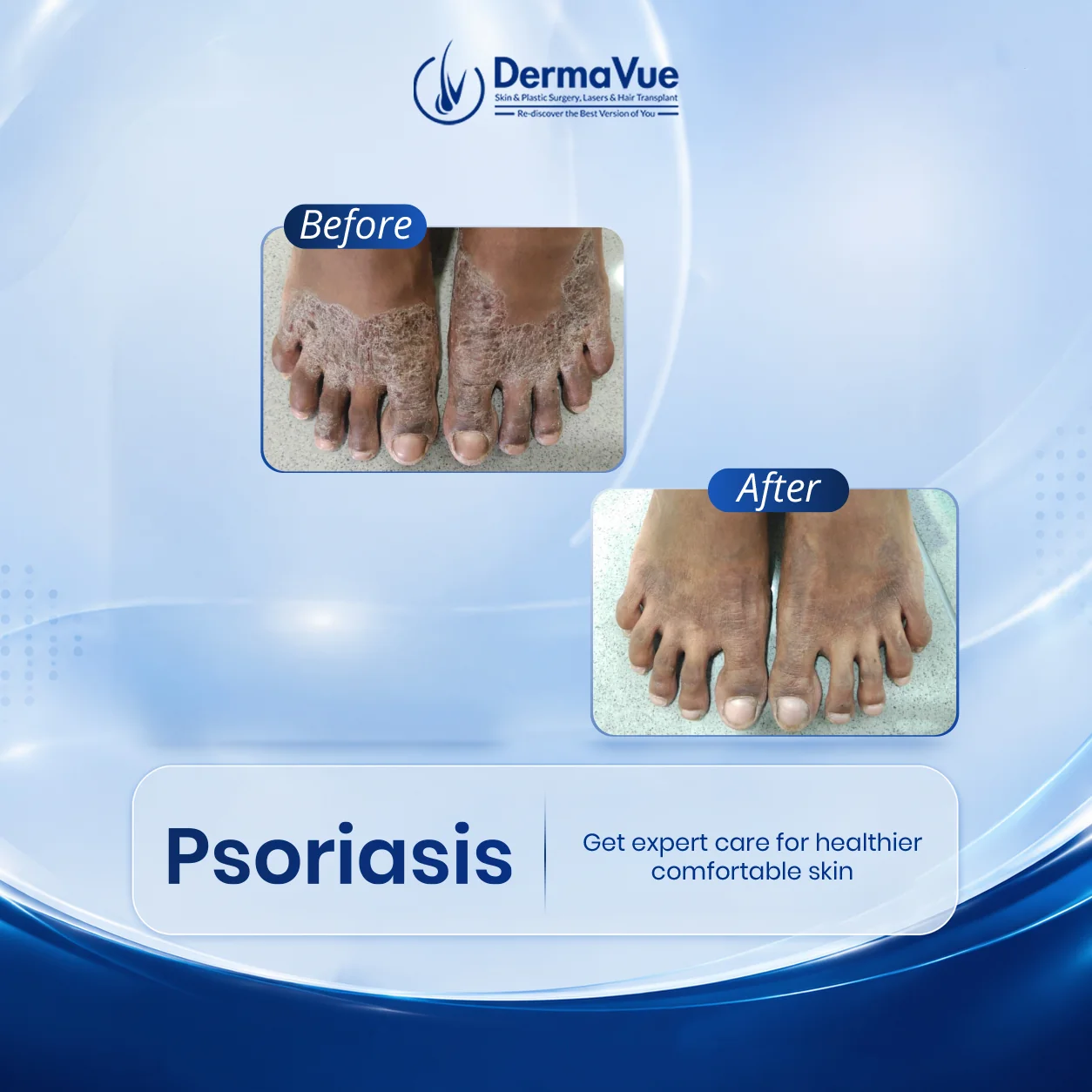
Psoriasis is a chronic autoimmune condition in which T-lymphocytes attack healthy skin cells, causing them to multiply at an accelerated rate and accumulate as thick, scaly plaques. The root cause is immune dysregulation - not a barrier defect or an allergic response.
For a full explanation of psoriasis causes, types, and treatment, see our post on psoriasis treatment in Kerala.
Key differences in causation from eczema: eczema is driven primarily by barrier defect and Th2-type immune response. Psoriasis is driven by Th1 and Th17 immune pathways - a different arm of the immune system. Eczema is triggered by environmental allergens and irritants. Psoriasis is triggered by stress, infections, medications, and skin trauma - not allergens. Eczema typically begins in childhood and often improves with age. Psoriasis can begin at any age and tends to be lifelong.
Side-by-Side Comparison: Eczema vs Psoriasis
| Feature | Eczema (Atopic Dermatitis) | Psoriasis |
|---|---|---|
| Root cause | Defective skin barrier + Th2 immune response | Autoimmune - Th1/Th17 attack on skin cells |
| Is it contagious? | No | No |
| Age of onset | Usually childhood; can persist into adulthood | Any age; peaks in 15 to 35 and 50 to 60 |
| Family history | Atopic triad: eczema, asthma, allergic rhinitis | Psoriasis family history in up to 30 percent |
| Typical locations | Inner elbows, behind knees, wrists, neck, face | Outer elbows, knees, scalp, lower back, nails |
| Appearance | Dry, weeping, or crusted patches. Often poorly defined edges. | Well-defined raised plaques with thick scale |
| Scale | Fine, dry scale or wet crusting in acute phase | Thick, adherent silvery scale (less visible on Indian skin) |
| Itch | Very intense - often the dominant symptom | Moderate; less intense than eczema in most cases |
| Common triggers | Allergens, soap, heat, stress, synthetic fabric | Stress, strep infection, medications, skin trauma, alcohol |
| Association with allergy | Yes - often co-occurs with asthma and allergic rhinitis | No - not an allergic condition |
| Joint involvement | No | Yes - psoriatic arthritis in up to 30 percent |
| Nail involvement | Occasional | Common - pitting, onycholysis, oil-drop sign |
How Eczema and Psoriasis Look on Indian Skin
Both conditions present differently on Indian skin (Fitzpatrick IV to VI) compared to the textbook images derived from lighter skin populations. This is one of the most common reasons for misdiagnosis in Indian patients.
Eczema on Indian skin: the characteristic redness may appear as dark brown, greyish, or violaceous discolouration rather than the classic pink-red. In chronic eczema, lichenification (skin thickening) is often the dominant feature, and the skin may appear hyperpigmented in the affected areas. Post-inflammatory hyperpigmentation after eczema flares resolve is common and distressing.
Psoriasis on Indian skin: the silver-white scale is often less visible or appears as greyish-white rather than the classic silver-white. The underlying plaque may appear dark brown or violaceous rather than pink-red. Post-inflammatory hyperpigmentation after plaques resolve is more pronounced and persistent on Indian skin.
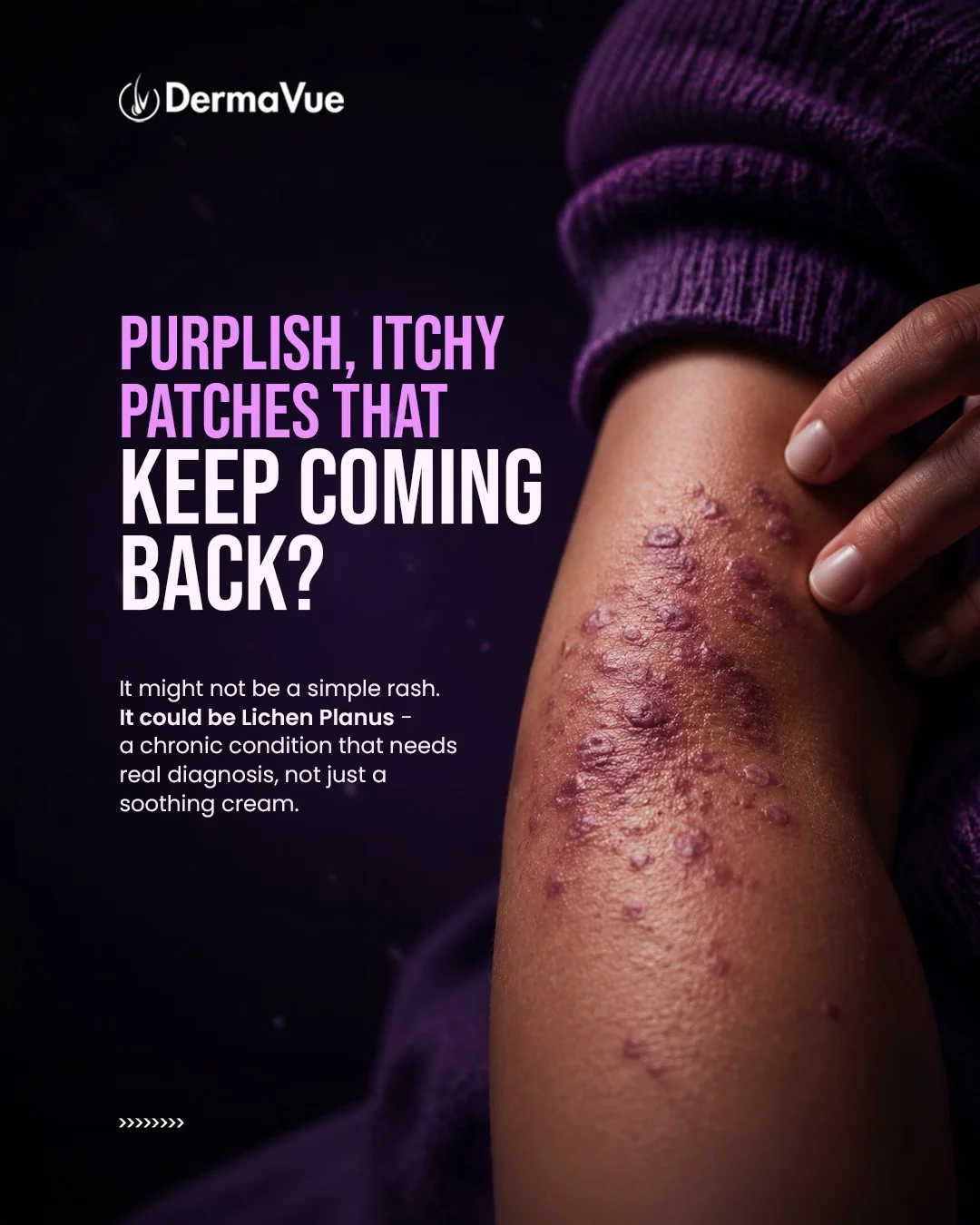
This overlap in atypical appearance makes dermoscopy and, where necessary, skin biopsy essential for accurate diagnosis in Indian patients. See also our post on lichen planus in India - another condition that can mimic both eczema and psoriasis on Indian skin.
How Each Condition Is Diagnosed
Eczema diagnosis: Primarily clinical. The Hanifin and Rajka criteria are used - a combination of major criteria (intense itch, typical distribution, chronic relapsing course, atopic personal or family history) and minor criteria (dry skin, early age of onset, elevated IgE, food allergy). Patch testing may be used to identify specific contact allergens in patients with suspected contact dermatitis overlap.
Psoriasis diagnosis: Primarily clinical - the characteristic appearance of well-defined plaques with scale at typical sites is usually sufficient for an experienced dermatologist. Dermoscopy shows the regularly distributed dotted vessels characteristic of psoriasis. Skin biopsy is used when the diagnosis is uncertain or the presentation is atypical.
When biopsy is needed: When the clinical picture does not clearly distinguish between eczema, psoriasis, lichen planus, or fungal infection, a biopsy produces the definitive diagnosis. This is particularly important in Indian patients where atypical presentations are more common.
Treatment for Eczema vs Treatment for Psoriasis
| Treatment | Eczema | Psoriasis |
|---|---|---|
| First-line topical | Emollients (moisturisers) as the foundation. Topical corticosteroids for flares. Topical calcineurin inhibitors (tacrolimus, pimecrolimus) for maintenance and sensitive areas. | Topical corticosteroids. Vitamin D analogues (calcipotriol). Coal tar preparations for scalp. |
| Why emollients matter | Central to eczema management - repair the defective barrier. Must be applied daily regardless of whether the skin looks inflamed. | Supportive only in psoriasis - not the primary treatment approach. |
| Phototherapy | NB-UVB for moderate widespread eczema | NB-UVB is highly effective for moderate psoriasis |
| Systemic treatment | Cyclosporine, methotrexate, dupilumab (biologic) for severe eczema | Methotrexate, cyclosporine, acitretin, biologics (TNF-alpha, IL-17, IL-23 inhibitors) for moderate-severe psoriasis |
| Trigger management | Essential - identifying and avoiding specific triggers reduces flare frequency | Identify and manage known triggers (stress, infections, medications) |
| Long-term approach | Barrier maintenance daily + treatment of flares. No cure. | Long-term remission with maintenance treatment. No cure. |
The critical point: treatments are not interchangeable. High-potency topical steroids used for psoriasis plaques can cause significant skin thinning and rebound if applied to eczema-prone thin skin areas over time. Emollient-heavy eczema management does not adequately address the immune dysregulation driving psoriasis.
Common Mistakes Patients Make with Both Conditions
Using OTC steroid creams without diagnosis: Very common in India where potent topical steroids are available over the counter. Long-term unsupervised steroid use on eczema leads to skin atrophy and steroid-dependent skin. Abrupt steroid withdrawal in psoriasis can trigger a severe pustular flare.
Treating psoriasis like dry skin: Some patients use only moisturisers for psoriasis, which provides temporary comfort but does not address the immune-driven plaque formation.
Assuming the conditions are the same: Patients sometimes switch between eczema and psoriasis treatments based on what worked for a family member. Since the conditions have different causes, the treatments are not interchangeable.
Stopping treatment when skin clears: Both conditions are chronic. Stopping treatment when the skin looks clear often leads to rapid relapse. A maintenance plan is part of proper management.
When to See a Dermatologist
- Any itchy, scaly, or red rash that has not responded to basic moisturisers and over-the-counter remedies within 2 to 3 weeks
- Any rash that keeps returning to the same areas
- Rash associated with joint pain or stiffness - this needs urgent assessment to rule out psoriatic arthritis
- Skin that is weeping, crusting, or showing signs of secondary infection
- Any rash that has been treated with over-the-counter steroids for more than 2 weeks
- Nail changes (pitting, discolouration, separation from the nail bed) alongside a skin rash
A clinical diagnosis before starting treatment avoids the cycle of mismatched treatment and worsening skin that many patients experience before they reach a dermatologist.
Skin Condition Consultations at DermaVue
DermaVue offers dermatologist assessment for eczema, psoriasis, and other inflammatory skin conditions across all seven clinics in Kerala and Tamil Nadu. All consultations are conducted by IADVL-registered MD DVL dermatologists. Dermoscopy is available at all branches for accurate differential diagnosis. Where biopsy is indicated, it is performed at the clinic. Treatment plans are individualised based on the confirmed diagnosis, severity, and patient history.
| Branch | Address | Phone / WhatsApp |
|---|---|---|
| Thiruvananthapuram | TC 42, 3003-2, Poojappura Main Rd, Kesari Nagar, Chengalloor, TVM 695012 | +91 83308 60007 |
| Kollam | UMK Arcade, Vellayittambalam, Kavanad PO, Kollam 691003 | +91 80868 60465 |
| Thiruvalla | Iykara Peniel Tower, Opp. Indian Overseas Bank, Thukalassery, Thiruvalla 689101 | +91 80860 00608 |
| Kottayam | Zion Towers, Second Floor 101, SH 1, Thellakom, Kottayam 686631 | +91 81298 83331 |
| Kochi (Aluva) | Metro Pillar No. 57, Tamarind Rajadhani Building, Near Pulinchodu, NH-47, Aluva 683101 | +91 90720 07733 |
| Thrissur | Ardra Arcade, Opp. Akshaya Hotel, Punkunnam, Thrissur 680002 | +91 73567 42225 |
| Coimbatore | 460, Ponnaiyan St, Cross Cut Rd, Ram Nagar, Gandhipuram, Coimbatore 641009 | +91 80868 60018 |
Book a skin condition consultation at your nearest branch. Visit dermavue.com/locations, call the branch directly, or WhatsApp our Kochi team for the clinic nearest to you.
Related Reading
- Psoriasis Treatment in Kerala: Causes, Types, and What Works
- Lichen Planus: What Causes It and What Treatment Works in India
- Acne in Adults Over 30: Why It Is Different
- Skin Conditions at DermaVue
Frequently Asked Questions
What is the difference between eczema and psoriasis? Eczema (atopic dermatitis) is caused by a defective skin barrier and an overactive allergic immune response. It typically appears on skin folds and causes intensely itchy, dry, or weeping patches. Psoriasis is autoimmune - it typically appears on the outer surfaces of elbows, knees, and the scalp, with well-defined raised plaques and thick scale. Both are chronic conditions that require different treatment approaches.
How do I know if I have eczema or psoriasis? The location and appearance of the rash are the most useful initial clues. Eczema typically appears on the inside of elbows and behind the knees, tends to be very itchy, and often has a history of childhood onset. Psoriasis typically appears on the outside of elbows, knees, and the scalp, has well-defined edges and thick scale, and may be associated with joint pain. A clinical diagnosis by a dermatologist is needed before starting treatment.
Can eczema turn into psoriasis? No. Eczema and psoriasis are separate conditions with different underlying causes. One does not transform into the other. However, a patient can have both conditions simultaneously, which is one reason why clinical assessment is important.
Is eczema or psoriasis more common in India? Both conditions are common in India. Atopic dermatitis (eczema) affects approximately 2 to 5 percent of the Indian population. Psoriasis affects approximately 0.5 to 1 percent of the Indian population. Both are more common in cities.
Is eczema contagious? No. Eczema is not contagious. It cannot be passed from one person to another through skin contact, shared items, or any other means. It is an inflammatory condition driven by genetics and immune response, not an infection.
Is psoriasis contagious? No. Psoriasis is not contagious. It is an autoimmune condition and cannot be transmitted to another person in any way.
What triggers eczema in Kerala? Common eczema triggers in Kerala include humidity and sweating, dust mites, synthetic fabrics, harsh soaps and detergents, fragrances, and stress. The monsoon season with high humidity and increased dust mite activity is a common period for eczema flares in Kerala.
What triggers psoriasis in Kerala? Common psoriasis triggers in Kerala include stress, streptococcal throat infections, the monsoon season (reduced sun exposure, increased infections), certain medications (beta-blockers, lithium, antimalarials), alcohol, and skin trauma. Abrupt withdrawal of topical steroids is a significant trigger for severe psoriasis flares.
Authored by Dr. Sarath Chandran, MD DVL, IADVL-registered dermatologist and Managing Director, DermaVue Clinics. Peer reviewed by Dr. Minu Liz Mathew, MD DVL, Clinical Director, Kochi. Published September 2026. This article is for general information and does not substitute a clinical consultation. Individual treatment plans vary based on diagnosis, severity, and patient history.