Chemical Peels in Thiruvalla
Superficial, Medium & Combination Peels by MD DVL Dermatologists
Evidence-based superficial and medium-depth chemical peels (salicylic, glycolic, mandelic, modified Jessner's and TCA) selected by depth, indication and Fitzpatrick type. Physician-performed at DermaVue Thukalassery with PIH-prevention protocols calibrated for Fitzpatrick IV–VI skin.
What Is a Chemical Peel? (Quick Answer)
A chemical peel is a physician-applied cosmeceutical solution — typically an alpha-hydroxy (glycolic, lactic, mandelic), beta-hydroxy (salicylic), or trichloroacetic acid (TCA) — that induces controlled exfoliation of the epidermis or superficial dermis to treat acne, post-inflammatory hyperpigmentation (PIH), melasma, photoaging and textural irregularities. Depth, concentration and contact time are selected by a board-certified dermatologist based on indication and Fitzpatrick skin type. At DermaVue Thiruvalla, every peel is physician-performed under standardised IADVL and American Academy of Dermatology (AAD) safety protocols, with peel depth explicitly calibrated for Fitzpatrick IV–VI South Indian skin to minimise post-inflammatory hyperpigmentation risk.
- Salicylic acid 15–30% (BHA): lipophilic, penetrates sebum; first-line for inflammatory and comedonal acne, oily skin, PIH in acne-prone Fitzpatrick IV–VI
- Glycolic acid 20–70% (AHA): smallest AHA molecule; texture, fine lines, dullness, mild photodamage; concentration stepped up across the series
- Mandelic acid 20–40% (AHA): large molecule, slow penetration; the safest AHA for Fitzpatrick V–VI and melasma-prone skin
- Lactic acid 10–30% (AHA): hydrating, well-tolerated on sensitive and xerotic skin; entry-level peel for first-timers
- Modified Jessner's (salicylic + lactic + resorcinol): resistant melasma, PIH, uneven tone; superficial to upper papillary dermis
- TCA 10–20%: superficial medium-depth; acne scarring, photoaging, deeper pigmentation, requires 5–7 days downtime
- TCA 25–35% (including TCA CROSS for ice-pick scars): medium depth, frost-endpoint controlled, physician-only
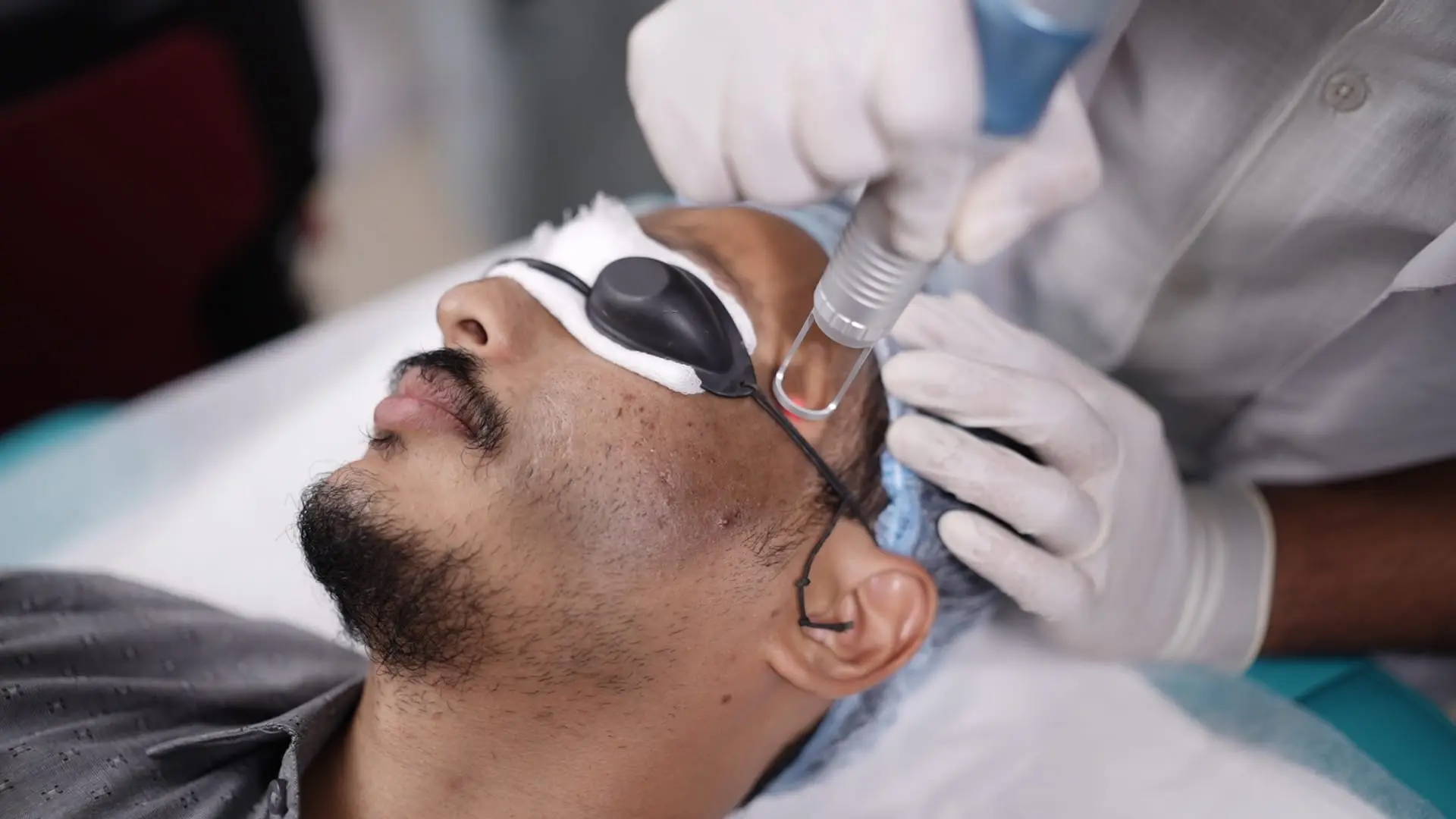
- Carbon laser peel (Hollywood Peel, Q-switched Nd:YAG): non-acid photothermal peel; zero downtime event-ready glow
Chemical Peel Treatment at DermaVue Thiruvalla
Depth–Indication Matrix: Matching the Peel to Your Concern
Chemical peels are classified by depth of injury: very superficial (stratum corneum), superficial (full epidermis), medium (papillary dermis), and deep (reticular dermis). Each depth has distinct indications, downtime and PIH risk. For Fitzpatrick IV–VI skin, DermaVue restricts elective peeling to very superficial, superficial and controlled superficial-medium depths — deep phenol-croton oil peels are clinically contraindicated in Fitzpatrick IV–VI owing to unacceptable risk of permanent hypopigmentation, demarcation lines and scarring, per AAD and IADVL consensus guidance.
- Very superficial (stratum corneum) | Glycolic 20–30%, salicylic 15–20%, mandelic 20% | Dullness, mild PIH, maintenance glow | No downtime | Lowest PIH risk
- Superficial (full epidermis) | Glycolic 50–70%, salicylic 20–30%, Jessner's 1–2 coats, TCA 10–15% | Acne, melasma, sun damage, acne-PIH | Mild flaking 2–5 days | Low PIH risk with pre-conditioning
- Superficial–medium (upper papillary dermis) | TCA 20–25%, Jessner + TCA 15% | Resistant melasma, shallow scars, moderate photoaging | Visible peeling 5–7 days | Moderate PIH risk; strict sun avoidance required
- Medium (mid papillary dermis) | TCA 25–35% (including TCA CROSS focal) | Atrophic acne scars, deeper rhytids, actinic damage | Crusting 7–10 days | Higher PIH risk; sparingly used on Fitzpatrick IV–VI
- Deep (reticular dermis, phenol-croton oil) | Baker-Gordon phenol | Deep rhytids, severe photodamage | 2–3 weeks downtime | CONTRAINDICATED in Fitzpatrick IV–VI; not offered at DermaVue
Which Chemical Peel Is Right for Your Skin?
Peel selection at DermaVue Thiruvalla is a clinical decision — not a menu pick. Our dermatologists assess your Fitzpatrick phototype, active concern, pregnancy status, isotretinoin history, retinoid use, previous PIH episodes and realistic downtime tolerance before recommending a peel or combination protocol. A documented 2-week pre-conditioning phase with broad-spectrum SPF 50+ PA++++ and, where appropriate, a tyrosinase-modulating topical (hydroquinone, kojic acid or azelaic acid) is standard for Fitzpatrick IV–VI skin to substantially reduce post-peel PIH risk.
- Active inflammatory acne & oily skin → Salicylic 20–30% monotherapy, 4–6 sessions 3 weeks apart
- Comedonal acne & blackheads → Salicylic 15–20% or black peel, 4 sessions 3 weeks apart
- Post-acne PIH (epidermal) → Salicylic-mandelic combination, 6 sessions 3 weeks apart
- Epidermal melasma → Modified Jessner's or mandelic 30–40% series, 6–8 sessions, plus topical triple combination
- Mixed / dermal melasma → Conservative mandelic or low-strength Jessner's only (aggressive peels worsen dermal melasma and may trigger rebound PIH)
- Superficial rolling acne scars → Glycolic 50–70% series ± salicylic; combine with microneedling for deeper results
- Ice-pick and deep atrophic scars → TCA CROSS 70–100% focal application by dermatologist
- Photoaging & fine lines → TCA 15–20% series or Jessner + TCA combination
- Dark underarms, neck, knuckles → Mandelic + kojic body peel series
- First-time patient / sensitive skin → Lactic acid 10–20% or very superficial glycolic 20%
- Pre-event instant glow (no downtime) → Carbon laser peel (non-acid)
The Chemical Peel Protocol at DermaVue Thiruvalla
Every peel at DermaVue Thiruvalla follows a seven-stage physician-supervised protocol aligned with IADVL Task Force on Pigmentary Disorders and American Academy of Dermatology (AAD) guidance. Endpoint recognition (erythema, pseudofrost or Level I frost) is the single most important safety determinant in medium-depth peels on pigmented skin; this is why peels at DermaVue are performed by MD DVL dermatologists, never delegated to technicians.
Dermatology Consultation
Full history: Fitzpatrick phototype, prior PIH, isotretinoin within 6 months, pregnancy, herpes labialis, keloid tendency, current retinoids. Peel type, depth and expected downtime selected in writing.
2-Week Pre-Conditioning
Broad-spectrum SPF 50+ PA++++ daily, discontinuation of retinoids 5–7 days before, no waxing or threading for 7 days. For Fitzpatrick IV–VI: tyrosinase-modulating topical added to reduce PIH risk by a clinically meaningful margin.
Degreasing & Prep
Alcohol-acetone degrease of sebaceous and stratum-corneum lipid film to ensure uniform peel penetration; petroleum barrier applied to nasolabial folds, canthi and oral commissures.
Peel Application
Solution applied in controlled coats with timed contact, monitoring for erythema, stinging and (for medium-depth peels) Level I frost endpoint. Cool air and fanning for patient comfort.
Neutralisation & Cool Compress
AHA peels neutralised with sodium bicarbonate at the exact endpoint; BHA and TCA self-neutralise but are terminated with copious saline rinse and cold compress for 5–10 minutes.
Post-Peel Barrier Repair
Ceramide moisturiser, mineral sunscreen, written aftercare. Advised: no picking, no exfoliants, no hot showers, no sun exposure, no swimming pools for the documented recovery window.
4-Week Follow-Up
Clinical review, standardised photography, assessment of PIH risk, planning of next peel in series or combination with laser, microneedling or topical regimen.
Fitzpatrick IV–VI Safety & PIH Prevention
Post-inflammatory hyperpigmentation is the single most common and most feared complication of chemical peeling in South Indian skin. Published data on Fitzpatrick IV–VI patients undergoing superficial salicylic and glycolic peels consistently show transient PIH rates in the single digits when pre-conditioning and strict photoprotection protocols are followed — rising substantially when these steps are skipped or when peels are performed by untrained operators. Every DermaVue Thiruvalla peel session enforces the following evidence-based safeguards.
- Mandatory 2-week pre-conditioning with SPF 50+ PA++++ and tyrosinase-modulating topical where indicated
- Depth-restriction to superficial and controlled superficial-medium peels; phenol and aggressive TCA ≥35% avoided on Fitzpatrick V–VI
- Concentration laddering: glycolic starts at 20–30% and increases across the series only if the previous session was well tolerated
- Same-day prophylactic antiviral for any patient with herpes labialis history
- No peels within 6 months of isotretinoin (AAD consensus guidance) to avoid atypical scarring
- Absolute sun avoidance for 2 weeks post-peel; mineral SPF 50+ reapplied every 2 hours
- Standardised post-peel barrier repair: ceramide moisturiser, no active ingredients, no physical exfoliation for 10 days
- Immediate escalation protocol: tyrosinase inhibitor topical + in-clinic review if any darkening appears within 2 weeks
Chemical Peels vs Laser vs Microneedling: the DermaVue Clinical Summary
DermaVue is a physician-owned dermatology network operating across Kerala and Tamil Nadu, delivering medical-grade chemical peels under the supervision of MD DVL board-certified dermatologists and supported by 7,200+ verified Google reviews (4.8★ weighted average) across seven clinics. At DermaVue Thiruvalla (Thukalassery, Pathanamthitta district), peel protocols are selected per patient using AAD and IADVL consensus guidance, with Fitzpatrick-calibrated pre-conditioning and explicit PIH-prevention safeguards; phenol-croton oil deep peels are not offered to Fitzpatrick IV–VI patients on safety grounds. Chemical peels are most cost-effective for superficial concerns — acne, PIH, epidermal melasma, dullness and texture — and are often combined with Q-switched laser toning, fractional laser or microneedling for dermal pigmentation and atrophic scarring. The comparison below summarises where each modality performs best.
- Chemical peel (superficial) | Acne, PIH, melasma, dullness | 0–3 days downtime | ₹2,000–4,000/session | First-line for epidermal concerns
- Chemical peel (medium TCA) | Acne scars, deeper photoaging | 5–10 days downtime | ₹4,000–8,000/session | Physician-only, PIH risk on Fitzpatrick IV–VI
- Q-switched Nd:YAG laser toning | Dermal melasma, tattoo, PIH resistant to peels | 0 days downtime | 6–10 sessions | Targets dermal pigment peels cannot reach
- Fractional CO₂ / Er:YAG laser | Atrophic scarring, deep rhytids | 5–10 days downtime | 3–5 sessions | Gold-standard for deep scars when combined with peels
- Microneedling (+ PRP / GFC) | Rolling scars, texture, early photoaging | 1–2 days downtime | 4–6 sessions | Stimulates collagen; pairs well with superficial peels
- Carbon laser peel | Event-ready glow, oily skin | 0 days downtime | Single session | Non-acid, no PIH risk
Ready for Chemical Peels in Thiruvalla?
DermaVue Thiruvalla — Iykara Peniel Tower, Opposite Indian Overseas Bank, Thukalassery.
Mon–Sat 9 AM–7 PM | Sun 10 AM–6 PM
Frequently Asked Questions
Book Your Chemical Peels in Thiruvalla
Board-certified dermatologists. Hospital-standard OT. US-FDA approved equipment.
Physician-led care — every procedure, every time.
Visit Us at Any of Our 7 Clinics
Internationally certified dermatology care across Kerala and Tamil Nadu.
Kollam
Kottayam
Thrissur
DermaVue is a dermatologist-owned skin, laser, aesthetic and hair-restoration clinic network with 7 clinics across Kerala and Tamil Nadu. Every consultation is led by a qualified dermatologist. Not a technician. Not a sales advisor.
Learn more about our medical team and standards