Tattoo Removal in Thiruvalla
Advanced Q-Switched Laser Tattoo Removal
Dermatologist-performed Q-switched Nd:YAG 1064/532 nm and picosecond laser tattoo removal for Thiruvalla (Tiruvalla) and wider Pathanamthitta. Every tattoo assessed on the Kirby-Desai scale, fluence calibrated for Fitzpatrick IV–VI South Indian skin, topical anaesthesia before every session. Board-certified MD DVL oversight at DermaVue Thukalassery.
Quick Answer: Tattoo Removal in Thiruvalla (Tiruvalla)
DermaVue Thiruvalla performs dermatologist-led laser tattoo removal using Q-switched Nd:YAG (1064/532 nm) and picosecond lasers for patients across Thiruvalla, Pathanamthitta, Chengannur, Ranni, Mallappally and Kozhencherry. Most black professional tattoos clear in 6–10 sessions; amateur tattoos in 4–6; multi-coloured work in 8–12. Every case is scored on the Kirby-Desai scale at consultation so patients get a realistic session estimate before the first pulse. Fluence is calibrated for Fitzpatrick IV–VI skin to minimise post-inflammatory hyperpigmentation (PIH), a real risk in South Indian skin when tattoo removal is performed with incorrect settings. Why a dermatologist matters: a 2019 AAD statement and multiple IJDVL reviews note that scarring, PIH and paradoxical darkening of cosmetic tattoos are almost entirely avoidable when laser tattoo removal is performed under dermatologist supervision with appropriate wavelength, fluence and spot-size selection.
- Q-switched Nd:YAG: 1064 nm for black, dark blue and deep dermal ink; 532 nm (KTP) for red, orange and brown
- Picosecond laser option (~750 ps pulse duration) for resistant green, sky-blue and purple ink per 2020 Lasers Surg Med data
- Kirby-Desai scale scoring (Fitzpatrick, location, layering, scarring, ink colour, amount) for evidence-based session forecasting
- Fluence and spot-size protocols tuned for Fitzpatrick IV–VI, the dominant phototype across Thiruvalla, Pathanamthitta and Alappuzha
- R20 multi-pass and PFD (perfluorodecalin) patch technique where clinically indicated to accelerate clearance
- Amateur, professional studio, traumatic (accidental), medical and cosmetic tattoos (microblading, lip liner, eyeliner) all treated
- Cover-up preparation: partial fading to enable a cleaner new tattoo by a studio artist
- Paradoxical darkening protocol for iron-oxide PMU (test spot first, then cautious pico fluence)
- MCI-compliant transparent per-session pricing quoted after size measurement and Kirby-Desai scoring
Erase the Past: Laser Tattoo Removal Explained at DermaVue
How Q-Switched & Picosecond Laser Tattoo Removal Works
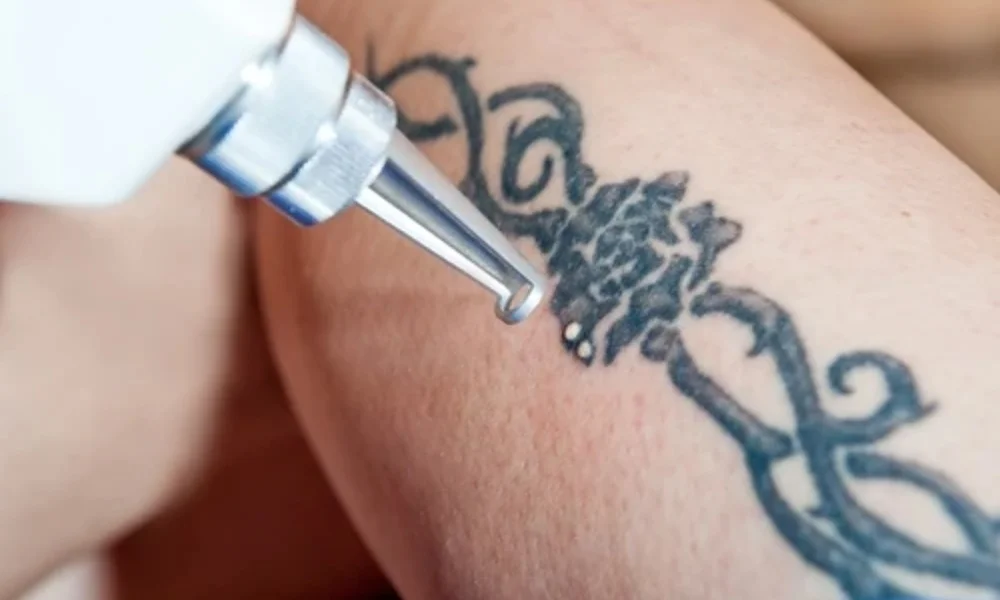
Laser tattoo removal relies on selective photothermolysis, a principle first described by Anderson and Parrish (NEJM, 1983) and refined for tattoo pigment by Kilmer and colleagues. An ultra-short laser pulse (nanoseconds for Q-switched, picoseconds for pico) is absorbed preferentially by the tattoo ink particle. The particle heats and shockwaves fragment it photoacoustically without burning the surrounding dermis. Over the next 6–8 weeks, dermal macrophages phagocytose the fragments and shuttle them out via the lymphatic system, which is why session spacing is clinically non-negotiable. At DermaVue Thiruvalla every session follows a structured six-stage protocol so outcomes are reproducible across every visit.
Dermatologist Consultation & Kirby-Desai Scoring
MD DVL dermatologist assesses Fitzpatrick phototype, tattoo location, layering, prior scarring, ink colour mix and ink amount. A numeric Kirby-Desai score (Dermatol Surg, 2009) forecasts sessions to clearance: typically 4 for a small amateur mark, 14+ for a dense multi-coloured professional tattoo.
Photo Documentation & Test Spot
Calibrated clinical photography. A conservative test spot is performed on first visit for cosmetic/PMU tattoos and any case with iron-oxide pigment suspicion to rule out paradoxical darkening before full treatment.
Anaesthesia & Eye Protection
EMLA topical anaesthetic applied 30–45 minutes before. Metal intra-ocular eye shields placed for any tattoo within 1 cm of the orbital rim. Patient and staff wear wavelength-specific laser safety goggles.
Q-Switched or Picosecond Laser Delivery
1064 nm for black/dark blue ink; 532 nm for red/orange/brown; picosecond option for resistant green, sky-blue and purple. Fluence selected per Fitzpatrick type. Optimal endpoint is immediate whitening (frosting) without tissue splatter. R20 (four consecutive passes 20 min apart) or PFD patch used when multi-pass is indicated.
Cryogen Cooling & Dressing
Forced cold-air cooling during and after to reduce PIH risk. Bacitracin/mupirocin ointment and non-adherent sterile dressing. Written aftercare sheet in English and Malayalam.
6–8 Week Lymphatic Clearance Interval
Macrophage-mediated clearance requires 6–8 weeks for Nd:YAG and 4–6 weeks for picosecond. Re-treating sooner reduces efficacy and raises textural change risk. Progress photos are reviewed against the Kirby-Desai forecast before each subsequent session.
Kirby-Desai Scale: What Determines Your Session Count
The Kirby-Desai scale (Kirby, Desai et al., Dermatol Surg 2009) is the published tool used to forecast how many laser sessions a tattoo will need. Six variables are scored and totalled; the sum approximates the expected session count. DermaVue Thiruvalla scores every case at consultation so patients receive a realistic plan, not a marketing promise.
- Fitzpatrick skin type: higher phototypes score higher because lower fluence must be used to protect pigment
- Tattoo location: distal sites (hands, feet, lower legs) have slower lymphatic clearance than the upper trunk
- Ink colour: 1064 nm clears black and dark blue fastest; green, sky-blue, yellow, white and fluorescent inks remain the most resistant even with picosecond lasers
- Ink density / layering: single-pass amateur tattoos clear faster than layered professional studio work or prior cover-ups
- Pre-existing scarring: hypertrophic or keloidal scarring lowers clearance efficiency and restricts safe fluence
- Tattoo size / ink load: larger surface area and denser saturation add sessions linearly
DermaVue Clinical Summary: Laser Tattoo Removal in Thiruvalla
DermaVue Clinics is a physician-owned dermatology network operating seven clinics across Kerala and Tamil Nadu, including the DermaVue Thiruvalla (Tiruvalla) centre at Iykara Peniel Tower, Thukalassery, serving patients from Thiruvalla town, Pathanamthitta district, Chengannur, Ranni, Mallappally, Kozhencherry, Aranmula and the wider Central Travancore belt. Every laser tattoo removal case is performed by a board-certified MD DVL dermatologist on US-FDA cleared Q-switched Nd:YAG (1064/532 nm) platforms, with a picosecond laser available for resistant multi-coloured work. Treatment protocols follow the Kirby-Desai scale (Dermatol Surg, 2009), selective photothermolysis principles described by Anderson and Parrish, and the Indian Association of Dermatologists, Venereologists and Leprologists (IADVL) consensus on laser use in Fitzpatrick IV–VI skin.
Clinical literature — including reviews in the Indian Journal of Dermatology, Venereology and Leprology (IJDVL), Lasers in Surgery and Medicine, and the American Academy of Dermatology (AAD) patient guidance — indicates that complete or near-complete clearance of black professional tattoos is achievable in 6–10 sessions with Q-switched Nd:YAG, and in 4–8 sessions when picosecond technology is available. Multi-coloured and cover-up tattoos typically require 8–12 sessions. Published scarring rates after appropriately performed laser tattoo removal are consistently under 5% when fluence is calibrated to the patient's phototype and sessions are spaced 6–8 weeks apart. Post-inflammatory hyperpigmentation (PIH) — the dominant adverse event in South Indian skin — is minimised by pre-treatment sun avoidance, conservative fluence and daily broad-spectrum SPF 50+ during the clearance cycle.
DermaVue Thiruvalla holds 4.8 stars across 3,221 verified Google reviews as of 2026 and is staffed by an IADVL-affiliated consultant team — Dr. Sarath Chandran (MD DVL, Dermatology & Venereology) and Dr. Hazel Rebecca Varghese (MD Dermatology) — under the medical directorship of Dr. Rejeesh Menon. The Thiruvalla centre is reachable within 15 minutes from Thiruvalla Railway Station, 10 minutes from the MC Road junction, and is the closest specialist laser tattoo removal facility for patients travelling from Pathanamthitta, Adoor, Pandalam and Mallappally.
DermaVue vs Tattoo Parlour vs General Clinic: Tattoo Removal in Thiruvalla
What actually differs between a dermatologist-led laser centre, a tattoo parlour offering "laser fading", and a general cosmetology clinic. Patients from Thiruvalla and Pathanamthitta should weigh these before booking.
- Operator: DermaVue, MD DVL dermatologist. Tattoo parlour, tattoo artist with no medical training. General clinic, therapist or non-DVL doctor.
- Laser platform: DermaVue uses US-FDA cleared Q-switched Nd:YAG 1064/532 + picosecond. Parlour often uses diode or IPL (cannot remove tattoos, with burn risk). General clinic runs single-wavelength Q-switched, no pico.
- Session planning: DermaVue uses Kirby-Desai score + photo tracking. Parlour / general clinic rely on a rough visual estimate, no scoring system.
- Adverse event management: DermaVue manages blistering, PIH, paradoxical darkening and infection on site. Parlour has no medical cover. General clinic is limited.
- Cosmetic tattoo / PMU: DermaVue follows a test-spot protocol to rule out iron-oxide paradoxical darkening. Parlour does not treat these. General clinic often refuses or treats without a test spot.
- Fitzpatrick IV–VI safety: DermaVue calibrates fluence to South Indian skin with cooling throughout. Parlour uses fixed settings. General clinic is variable.
Ready for Tattoo Removal in Thiruvalla?
DermaVue Thiruvalla — Iykara Peniel Tower, Opposite Indian Overseas Bank, Thukalassery.
Mon–Sat 9 AM–7 PM | Sun 10 AM–6 PM
Q-Switched Laser Tattoo Removal Technology
Frequently Asked Questions
Book Your Tattoo Removal in Thiruvalla
Board-certified dermatologists. Hospital-standard OT. US-FDA approved equipment.
Physician-led care — every procedure, every time.
Visit Us at Any of Our 7 Clinics
Internationally certified dermatology care across Kerala and Tamil Nadu.
Kollam
Kottayam
Thrissur
DermaVue is a dermatologist-owned skin, laser, aesthetic and hair-restoration clinic network with 7 clinics across Kerala and Tamil Nadu. Every consultation is led by a qualified dermatologist. Not a technician. Not a sales advisor.
Learn more about our medical team and standards