Beard Transplant & Facial Hair Restoration in Kottayam
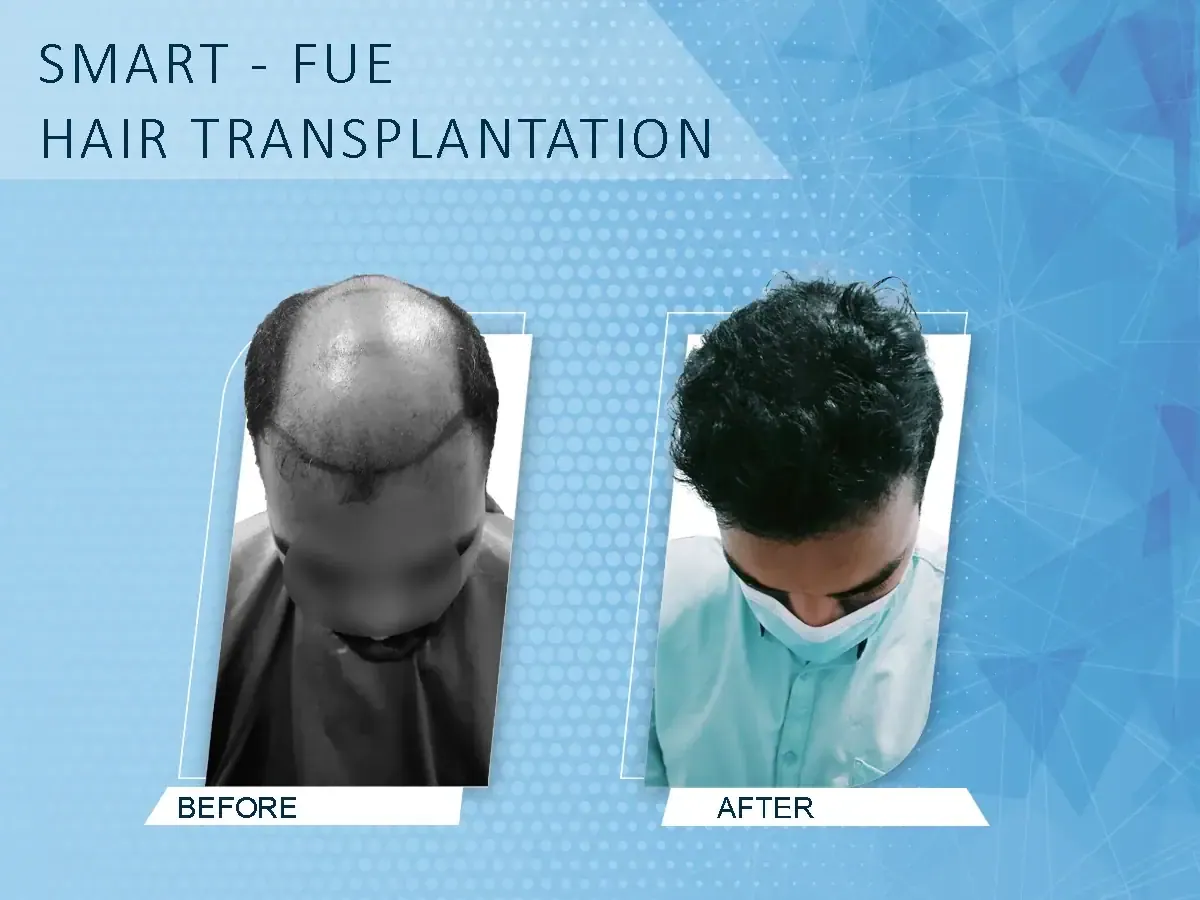
Patchy beard growth is a follicular density deficit — genetically determined, hormonally modulated, and untreatable by any topical serum, minoxidil, or biotin supplement. Beard transplant at DermaVue Kottayam performs scalp-to-beard follicle transposition using FUE extraction and Korean Choi Implanter technology, achieving over 90% graft survival rates documented in published case series (Bater et al., Dermatol Surg 2021). Each single-hair graft is implanted at the precise angle (10-20 degrees), depth, and directional orientation matching natural facial hair growth patterns — producing permanent beard hair that grows, can be shaved, trimmed, and styled for life. The procedure is surgeon-performed, not technician-delegated.
Facial Hair Restoration at DermaVue Kottayam
Facial hair grows differently from scalp hair — each zone of the face has a distinct growth angle, direction, and density pattern. The cheek requires flat-lying grafts at 10-15 degrees, the chin at 15-20 degrees with anterior projection, the mustache at 30-45 degrees for downward growth. DermaVue Kottayam's surgeon maps these patterns before designing each implantation plan, selecting single-hair grafts from the occipital donor zone that match the calibre of natural facial hair.
No Beard Growth? Here's Why — and How Beard Transplant Works
No Beard Growth? Here's Why and How to Fix It — DermaVue
The Technical Difference at DermaVue Kottayam
Beard transplant demands higher technical precision than scalp hair transplant because facial hair growth patterns are more complex and more visible. Scalp hair exits at 30-45 degrees; beard hair exits at 10-20 degrees and lies nearly flat against the skin. Each facial zone — cheek, chin, jawline, mustache, sideburn — has a different growth direction and swirl pattern. A 5-degree error in implantation angle produces a "planted garden" appearance that is visually obvious at conversational distance. DermaVue Kottayam's surgeon photographs and maps each patient's existing facial hair pattern (or desired pattern for patients with absent beard growth) before designing the implantation blueprint — every graft position, angle, and direction is planned before the first extraction begins.
Beard & Mustache Transplant Technique — DermaVue
Beard and Mustache Transplant — DermaVue Surgical Technique
About Beard Transplant at DermaVue Kottayam
DermaVue Kottayam provides beard transplant and facial hair restoration using FUE (follicular unit extraction) technique with Korean Choi Implanter technology. The procedure harvests individual follicles from the scalp donor area and implants them into beard, moustache, sideburn, or goatee zones for permanent facial hair growth. Published case series report over 90% graft survival in beard transplantation when performed using direct implantation technique.
Beard Transplant Results at DermaVue
Explore More
Beard Transplant Across DermaVue
Beard Transplant at other clinics
Related reading
Serving All of Kottayam District
On MC Road in Thellakom, Beside Caritas Hospital
DermaVue is the only DermaVue clinic in Kottayam district, on MC Road (SH1) in Thellakom, beside the 635-bed Caritas Hospital and about 7 km north of Kottayam town centre (3.3 km from Mahatma Gandhi University, Athirampuzha). Patients across the district travel here for beard transplant, because MC Road buses toward Ettumanoor and Pala stop at the door.
Travel time to the clinic
| From | Distance | Drive | Route |
|---|---|---|---|
| Kottayam town / Thirunakkara | ~7 km | ~18 min | MC Road (SH1) |
| Kottayam Railway Station / KSRTC, Nagampadam | ~8–9 km | ~20 min | MC Road (SH1) |
| MG University, Athirampuzha | 3.3 km | ~8 min | MC Road (SH1) |
| Ettumanoor | ~5 km | ~10 min | MC Road (SH1) |
| Kumarakom | ~16–18 km | ~30–35 min | Kumarakom Road |
| Changanassery | ~24–26 km | ~40 min | MC Road (SH1) |
| Pala | ~22–25 km | ~45 min | Ettumanoor–Pala Road |
How to reach us
From Kottayam town / Thirunakkara: board any Ettumanoor-bound MC Road bus and alight at Caritas Hospital, Thellakom.
From the railway station / KSRTC (Nagampadam): about 8–9 km north on MC Road, ~20 minutes by auto or taxi.
Driving from Pala, Changanassery or Kumarakom: on-site parking at Zion Tower on MC Road.
Areas we serve across Kottayam
Distances are approximate road distances from the Thellakom clinic. See the DermaVue Kottayam clinic page for the full list of treatments and directions.
Frequently Asked — Beard Transplant Kottayam
The primary cause is genetic — your DNA determines follicle density in each facial zone, and some men are simply programmed for sparse beard coverage in specific areas. Secondary causes include beard alopecia areata (autoimmune patchy loss affecting the beard specifically), low testosterone or poor 5-alpha reductase activity in facial follicles, post-trauma or surgical scarring that destroyed follicles, and congenital absence of follicles in specific zones. Beard transplant at DermaVue Kottayam addresses all of these by transplanting genetically resistant occipital scalp follicles to the face.
Yes — this is the fundamental advantage over all non-surgical approaches. FUE beard transplant uses follicles harvested from the occipital (back-of-head) donor zone, which are genetically programmed to resist DHT-driven miniaturisation. These follicles retain their genetic identity after transposition to the face — they grow continuously as permanent beard hair. The transplanted beard can be shaved with razors, trimmed with clippers, and styled exactly like natural facial hair. Published case series report permanent growth from transplanted follicles at 5+ year follow-up.
Graft requirements depend on the desired coverage area and density: full beard (cheeks, jawline, chin, mustache, sideburns) typically requires 2,000-3,500 single-hair grafts. Patchy beard filling for localised sparse areas requires 500-1,500 grafts. Mustache alone: 300-600 grafts. Goatee: 600-1,200 grafts. Eyebrow transplant: 200-400 grafts per brow. DermaVue Kottayam provides a precise graft count estimate at your initial consultation after facial assessment and discussion of your target beard style.
Donor follicles are extracted individually from the occipital scalp zone (the dense area at the back and sides of the head) using 0.8-0.9 mm micro-punches. Each extraction point heals as a sub-millimetre dot scar that is invisible within surrounding hair — even with short haircuts. The occipital zone is chosen because it has the highest follicle density on the body and contains DHT-resistant follicles. Fine single-hair grafts are specifically selected for beard work to match the natural single-strand growth pattern of facial hair.
Day 1-3: mild swelling in the donor and recipient areas; analgesics manage discomfort. Day 5-7: small scabs form over each implanted graft on the face — these are visible at close range but concealable with a mask. Day 7-10: scabs shed naturally; donor scalp fully healed. Day 10-14: presentable for work and social situations. Day 14+: gentle shaving can resume. Weeks 2-4: transplanted hairs undergo "shock loss" — a normal shedding phase. Months 3-4: new permanent growth emerges from transplanted follicles.
The growth timeline follows a predictable biological pattern. Months 1-2: shock loss phase — transplanted hairs shed (this is normal and temporary; the follicle root remains alive beneath the skin). Month 3: first fine new hairs emerge. Months 4-6: progressive thickening and increasing density visible. Months 6-9: substantial coverage; most patients begin regular grooming and styling. Months 12-18: full final result with mature hair calibre and complete density. The 12-month result is permanent and grows for life.
Yes. PRP (platelet-rich plasma) is used at DermaVue Kottayam as part of the post-operative protocol to enhance graft survival and accelerate early growth. The concentrated growth factors (PDGF, VEGF) promote angiogenesis — new blood vessel formation around transplanted follicles — which improves oxygen and nutrient delivery during the critical first weeks. Post-transplant PRP sessions begin at month 2 and are performed monthly for 3-4 sessions. This is particularly valuable for beard transplant because facial skin has less natural blood supply than the scalp.
Four technical factors: (1) Single-hair graft selection — multi-hair grafts produce unnatural tufting on the face. (2) Correct implantation angle — beard hair lies flat at 10-20 degrees against the skin; incorrect angle creates a "porcupine" appearance. (3) Directional accuracy — each facial zone has a specific growth direction that must be replicated. (4) Density calibration — natural beard density varies by zone (chin denser than cheeks), and the surgeon must replicate this gradient. DermaVue Kottayam's Choi Implanter technique controls all four variables simultaneously.
Gentle electric trimmer use can begin at day 14. Standard razor shaving can resume at 3-4 weeks post-procedure, once all graft scabs have shed and skin has fully healed. After the shock loss phase (weeks 2-4), there will be a period of minimal visible hair before new growth emerges at month 3. Once the transplanted beard grows in, there are no restrictions — you can shave daily with any razor, use trimmers at any guard length, and style the beard exactly as you would natural facial hair. The transplanted hair behaves identically to native beard hair.
Natural beard density varies by zone: chin averages 40-50 follicles/cm², cheeks 20-35 follicles/cm², and the jawline 30-40 follicles/cm². Beard transplant typically achieves 25-35 grafts/cm² in a single session — sufficient for a natural, full appearance. If greater density is desired, a second session can be performed 12-18 months after the first, once initial grafts have fully matured. DermaVue Kottayam discusses realistic density expectations at your consultation, based on your donor availability and target beard style.
WhatsApp +91 8129883331 — you can send photos of your current beard for a preliminary assessment and approximate graft count estimate before visiting. In-person consultation (₹300) at Zion Tower, 2nd Floor, Thellakom, near Caritas Matha Hospital on MC Road, Kottayam. The consultation includes facial hair pattern assessment, donor area evaluation, and detailed procedure planning. Patients from Ettumanoor (20 min), Changanassery (35 min), Pala (45 min), and Vaikom (50 min) are seen regularly. Monday-Saturday 9 AM-7 PM; Sunday 10 AM-5 PM.
Related at DermaVue Kottayam
Book Your Beard Transplant Consultation in Kottayam
Send photos via WhatsApp for a free preliminary assessment and graft count estimate. Permanent, natural results at DermaVue Kottayam.