Stop Hair Loss in Kottayam — Expert Alopecia Treatment
Kottayam's hair loss patterns are not the same as the rest of Kerala. Rubber plantation workers face chronic scalp exposure to latex chemicals that most clinics never think to test for. Students at MG University and CMS College deal with exam-stress shedding that appears months after the semester ends. And bore-well households in the Ettumanoor-Panachikkadu belt often wash their hair in iron-rich water that can coat and weaken strands. At DermaVue Kottayam, board-certified dermatologist Dr. Sarath Chandran (MD DVL) diagnoses and treats hair loss at this intersection of occupation, environment, and genetics.
Types of Hair Loss We Treat at DermaVue Kottayam
Most hair loss pages describe the same conditions in the same order. That approach fails Kottayam patients because this district has a hair loss risk profile that is genuinely different — rubber-processing chemical exposure, iron-rich bore-well water in parts of the belt, and seasonal monsoon shedding all compound genetic predisposition. Scalp dermoscopy and targeted blood work at DermaVue Kottayam establish the diagnosis accurately before any treatment begins.
Understanding Hair Loss — Causes & Mechanisms
Why do follicles miniaturise in pattern baldness? What happens in alopecia areata? Understanding the mechanism helps set realistic expectations for treatment timelines.
Hair Loss Causes and Treatment — DermaVue Dermatologist Explains
Hair Loss Treatments at DermaVue Kottayam
DermaVue Kottayam occupies a position that other hair clinics in the district do not replicate. Dr. Sarath Chandran, MD DVL, personally evaluates every hair loss patient and performs advanced procedures. The clinic offers both GFC (Growth Factor Concentrate) and PRP — a 2025 study in Dermatologic Surgery found that GFC demonstrated superior outcomes in total hair count and shaft diameter compared to PRP. At our Kottayam clinic, the dermatologist selects the optimal therapy based on your specific condition.
PRP & GFC Hair Therapy
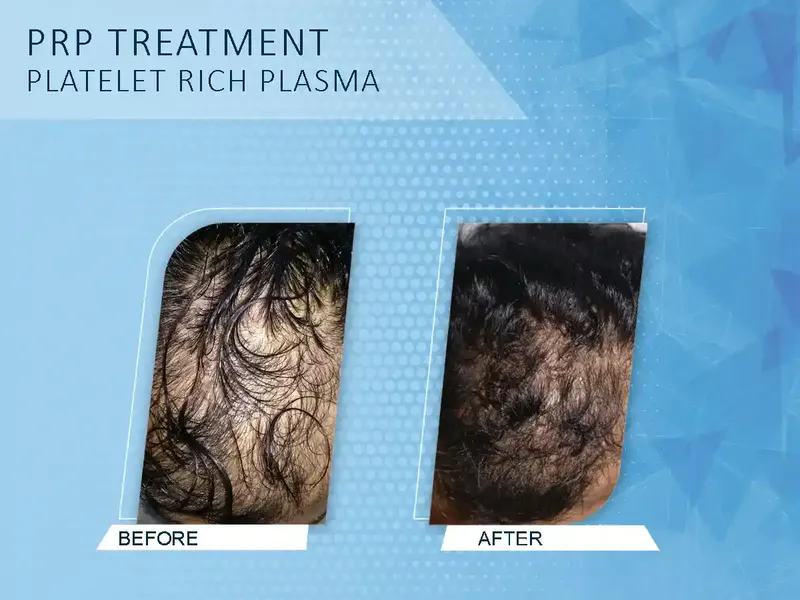
Growth Factor Concentrate (GFC) and Platelet-Rich Plasma (PRP) inject concentrated growth factors directly into the scalp — stimulating dormant follicles, improving scalp vascularity, and slowing DHT-driven miniaturisation. 4–6 sessions at monthly intervals. Results visible at 3–4 months.
Finasteride + Minoxidil Protocol
Gold-standard medical combination for androgenetic alopecia. Finasteride 1mg blocks DHT production. Topical minoxidil prolongs anagen phase and increases follicle size. Prescribed and monitored by a dermatologist — not available as a general pharmacy recommendation.
Scalp Analysis & Dermoscopy
Trichoscopy with digital dermoscopy reveals follicle density, miniaturisation ratio, scalp condition, and sebaceous plugging — enabling precise diagnosis and objective progress monitoring across visits.
Mesotherapy for Scalp
Microinjections of vitamins, minerals, and growth factors directly into the scalp mesoderm. Provides follicle nutrition and stimulation for diffuse thinning and telogen effluvium.
FUE Hair Transplant (Referral & Co-Management)
For stable androgenetic alopecia with adequate donor density. DermaVue Kottayam evaluates transplant candidacy and co-manages medical therapy around transplant procedures for best long-term outcomes.
Blood Work We Recommend for Hair Loss
- Serum ferritin (iron stores — most sensitive iron marker for hair loss)
- Thyroid function tests (TSH, T3, T4)
- Vitamin D3 levels
- Zinc and biotin levels
- Hormonal panel (DHEAS, testosterone, LH/FSH for female pattern loss)
- Blood count for anaemia (complete blood picture)
Each Treatment, Explained Honestly
No single therapy fixes every pattern of hair loss. What follows is how each option works, who it suits, and the timeline you can realistically expect. Dr. Sarath Chandran (MD DVL) selects and combines these after dermoscopy and blood work.
PRP (Platelet-Rich Plasma)
How it works: your own blood is centrifuged to concentrate platelets, which release PDGF, VEGF and IGF-1 into the scalp. These growth factors prolong the anagen growth phase and stimulate the dermal papilla around miniaturising follicles.
Who it suits: early to moderate androgenetic alopecia in men and women, and as an adjunct in telogen effluvium. Not a substitute for DHT suppression in advanced male pattern loss.
What to expect: usually 4 sessions at 4-week intervals, then maintenance every 3 to 6 months. A systematic review of eleven randomised trials found PRP produced statistically significant gains in hair density. Measurable change is typical by months 3 to 6.
GFC (Growth Factor Concentrate)
How it works: GFC purifies growth factors from your blood while excluding red and white cells, giving a more standardised, acellular preparation than conventional PRP.
Who it suits: the same early-to-moderate patterns as PRP, and patients who want a cleaner, more consistent injection with fewer variables.
What to expect: a comparable 3 to 4 session schedule at monthly intervals. A 2025 comparative study in Dermatologic Surgery reported GFC outperforming PRP on total hair count and shaft diameter. Some patients note change after the second session.
Finasteride and Minoxidil (medical management)
How they work: oral finasteride 1 mg inhibits type II 5-alpha-reductase and lowers scalp DHT by roughly 60 to 70 percent, slowing miniaturisation at its cause. Topical minoxidil opens follicular potassium channels, improves perifollicular blood flow, and extends the anagen phase.
Who it suits: finasteride for male androgenetic alopecia, prescribed and monitored, and contraindicated in women of childbearing potential. Minoxidil suits both sexes, including female pattern loss at 2 or 5 percent with monitoring.
What to expect: shedding often stabilises within the first 8 to 16 weeks, with density gains judged at a minimum 12-month review per IADVL practice. Benefit is maintained only while treatment continues.
Scalp Mesotherapy
How it works: microinjections deliver vitamins, trace minerals and growth-factor compounds into the scalp mesoderm, aiming to nourish follicles and improve the local environment.
Who it suits: diffuse thinning and telogen effluvium, generally as an adjunct rather than a stand-alone answer for genetic pattern loss.
What to expect: a short course alongside primary therapy. Evidence is more limited than for PRP or finasteride, so it is offered as support, not as the mainstay.
FUE Hair Transplant
How it works: DHT-resistant follicular units from the occipital donor zone are extracted and implanted into thinned areas, where they keep their donor-dominant, permanent growth.
Who it suits: stable androgenetic alopecia with adequate donor density, after reversible causes are corrected and the pattern has settled, usually from age 25.
What to expect: a one-day procedure, shock loss at weeks 2 to 6, and final density at 10 to 12 months. Medical therapy continues afterward to protect the untransplanted native hair. See our Kottayam hair transplant page for the full protocol.
Home Remedies vs. Medical Treatment for Hair Fall
Most patients try 3–5 home remedies before consulting a dermatologist. Here's why medical treatment produces results that home care cannot.
Hair Fall Treatment — Why Medical Approach Works Better
About Hair Loss Treatment at DermaVue Kottayam
DermaVue Kottayam provides comprehensive hair loss diagnosis and treatment, addressing androgenetic alopecia, telogen effluvium, alopecia areata, and nutritional hair loss under board-certified dermatologists. Treatment modalities include FDA-approved minoxidil and finasteride, platelet-rich plasma (PRP) therapy, growth factor concentrate (GFC), and low-level laser therapy. A systematic review of 11 randomized controlled trials confirms PRP therapy produces statistically significant improvement in hair density and thickness for androgenetic alopecia.
Explore More
Hair Loss Treatment Across DermaVue
Hair Loss Treatment at other clinics
Related reading
Serving All of Kottayam District
On MC Road in Thellakom, Beside Caritas Hospital
DermaVue is the only DermaVue clinic in Kottayam district, on MC Road (SH1) in Thellakom, beside the 635-bed Caritas Hospital and about 7 km north of Kottayam town centre (3.3 km from Mahatma Gandhi University, Athirampuzha). Patients across the district travel here for hair loss treatment, because MC Road buses toward Ettumanoor and Pala stop at the door.
Travel time to the clinic
| From | Distance | Drive | Route |
|---|---|---|---|
| Kottayam town / Thirunakkara | ~7 km | ~18 min | MC Road (SH1) |
| Kottayam Railway Station / KSRTC, Nagampadam | ~8–9 km | ~20 min | MC Road (SH1) |
| MG University, Athirampuzha | 3.3 km | ~8 min | MC Road (SH1) |
| Ettumanoor | ~5 km | ~10 min | MC Road (SH1) |
| Kumarakom | ~16–18 km | ~30–35 min | Kumarakom Road |
| Changanassery | ~24–26 km | ~40 min | MC Road (SH1) |
| Pala | ~22–25 km | ~45 min | Ettumanoor–Pala Road |
How to reach us
From Kottayam town / Thirunakkara: board any Ettumanoor-bound MC Road bus and alight at Caritas Hospital, Thellakom.
From the railway station / KSRTC (Nagampadam): about 8–9 km north on MC Road, ~20 minutes by auto or taxi.
Driving from Pala, Changanassery or Kumarakom: on-site parking at Zion Tower on MC Road.
Areas we serve across Kottayam
Distances are approximate road distances from the Thellakom clinic. See the DermaVue Kottayam clinic page for the full list of treatments and directions.
Frequently Asked — Hair Loss Treatment Kottayam
The most effective approach depends on diagnosis. For androgenetic alopecia, DermaVue Kottayam offers GFC (Growth Factor Concentrate) therapy — clinically shown in 2025 studies to outperform PRP in hair density improvement — alongside medical management with finasteride and minoxidil under Dr. Sarath Chandran, MD DVL. A dermoscopy evaluation determines the right combination for each patient.
PRP sessions at DermaVue Kottayam typically involve 3-4 sessions spaced 4 weeks apart. GFC follows a similar schedule. Exact costs depend on the treatment plan prescribed after dermoscopy evaluation. Initial consultation with our board-certified dermatologist starts at Rs.300. Contact the clinic for current session pricing and package options.
Yes. Rubber accelerator chemicals — thiurams, carbamates, and mercaptobenzothiazole — are documented contact allergens that can cause scalp dermatitis when they reach the scalp through fumes, contaminated hands, or sweat. Chronic scalp inflammation from this contact disrupts the hair cycle and triggers secondary telogen effluvium. Patch testing identifies the specific allergen so targeted avoidance and treatment can begin.
Kerala's monsoon brings sustained humidity above 85%, creating ideal conditions for Malassezia yeast overgrowth on the scalp. This fungal pressure causes seborrhoeic dermatitis — itching, flaking, inflammation — that weakens hair anchoring. Post-monsoon (September-October) is when patients notice the peak shedding, typically 2-3 months after the trigger began.
Exam-stress-related hair loss is telogen effluvium — a temporary condition where cortisol pushes hair follicles into the resting phase prematurely. Shedding appears 2-3 months after the stressful period. In 95% of acute cases, hair regrows naturally within several months once stress resolves. MG University and college students in Kottayam frequently present with this pattern. Professional evaluation rules out underlying conditions and prevents unnecessary treatments.
Kottayam's bore-well water is generally soft to moderately hard, but iron above the drinking-water limit is common in parts of the midland belt (Ettumanoor, Panachikkadu). Iron and residual minerals coat the hair shaft, can irritate the scalp, and reduce how well topicals like minoxidil absorb. Chelating or clarifying shampoos and filtered water for washing are part of the standard advice at DermaVue where bore-well water is iron-rich.
Both use your own blood. PRP (Platelet-Rich Plasma) concentrates platelets but includes other blood components. GFC (Growth Factor Concentrate) extracts only the growth factors, excluding red and white blood cells, resulting in a more targeted preparation. A 2025 study in Dermatologic Surgery found GFC showed superior results in hair count and shaft diameter compared to PRP. DermaVue offers both, with the dermatologist selecting based on your specific condition.
Stabilization typically occurs in weeks 1-4. Fine new growth begins at months 2-3. Visible, satisfying improvement is usually evident by months 4-6. IADVL guidelines recommend a minimum 12-month assessment period for finasteride. GFC patients may see measurable improvement after the second session. Hair growth follows biological timelines — no legitimate treatment produces overnight results.
IADVL (Indian Association of Dermatologists) guidelines confirm finasteride at 1mg daily has proven efficacy and safety for long-term use in male androgenetic alopecia. Side effects occur in a small percentage of patients and are reversible upon discontinuation. The drug is contraindicated in women of childbearing potential due to teratogenicity. At DermaVue, Dr. Sarath Chandran discusses benefits and risks before prescribing, with regular monitoring.
Yes. Female pattern hair loss, post-pregnancy shedding, PCOS-related hair fall, and menopause-associated thinning each require distinct treatment protocols. Dr. Sarath Chandran evaluates hormonal panels, thyroid function, and iron stores before prescribing. Topical minoxidil (2% or 5% with monitoring), anti-androgen therapy, GFC/PRP, and nutritional correction are tailored to each woman's specific cause.
Related Hair & Scalp Services
Stop Hair Fall in Kottayam — Start Today
Expert hair loss treatment at DermaVue Kottayam. Diagnose the cause, build the right plan, see results. 813+ patients trust our physician-led care.